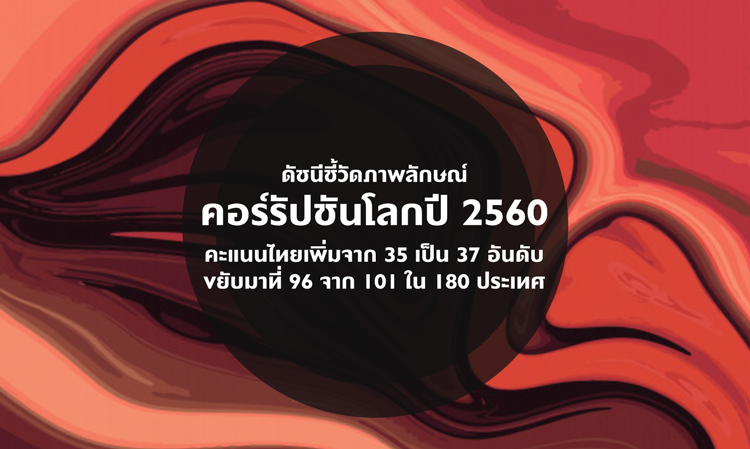
Corruption Perceptions Index 2017: Thailand's Score Rises from 35 to 37, Ranking Moves Up to 96 from 101 Among 180 Countries
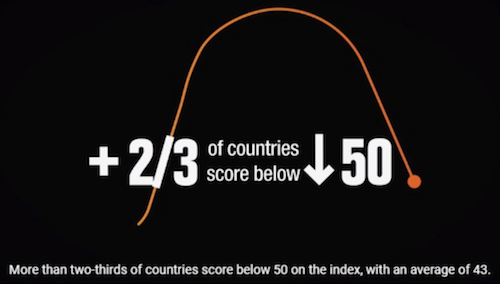
Transparency International has announced the Corruption Perceptions Index (CPI) for 2017, revealing that two-thirds of the 180 countries surveyed scored below 50, similar to the previous year, with an average score of 43.
The top-ranked country is New Zealand with a score of 89, surpassing Denmark, which scored 88 this year after both countries shared the top spot in 2016 with a score of 90. However, both countries saw a decrease in their scores.
This year, Singapore continues to shine as a leader in Asia, maintaining its score of 84 from last year but moving up to 6th place from 7th. Thailand's score increased by 2 points to 37 out of a possible 100, resulting in a ranking improvement to 96 out of 180 countries, up from 101 in 2016 among 176 countries.
In assigning the CPI score for 2017, Transparency International evaluated Thailand based on data from 9 sources, the same as in 2016. However, only 8 sources provided scores this year, with 3 sources giving Thailand a higher score, 3 sources showing a decrease, and 2 sources maintaining the same score. The breakdown of each source is as follows:
1. Sources that increased Thailand's score from last year include:
1.1 World Justice Project (WJP): Rule of Law Index scored 40, up from 37 last year, assessing transparency based on the rule of law.
1.2 Global Insight Country Risk Rating (GI) scored 35, a significant increase from 22 last year, evaluating business-related corruption factors, state interference, bribery, and incentives for contract considerations and licensing.
1.3 World Economic Forum Executive Opinion Survey 2017 increased to 42 from 37, surveying opinions on bribery related to exports, imports, public utilities, taxes, government procurement, and court rulings, as well as the transfer of funds from public to private sectors.
2. Sources that decreased Thailand's score from last year include:
2.1 IMD World Competitiveness Yearbook 2017 measured perceptions of bribery and corruption, with a score drop from 44 to 43.
2.2 Bertelsmann Foundation Transformation Index (BF-BTI) scored 37, down from 40 last year, using expert analysis to assess the transition to democracy and a free-market economy, focusing on political, economic, and governance changes.
2.3 Varieties of Democracy Project, a new source last year, scored Thailand 23, down from 24, measuring democratic diversity, elections, freedoms, and consensus among stakeholders.
3. Sources that maintained Thailand's score from last year include:
3.1 International Country Risk Guide (ICRG): Political Risk services scored 32, the same as last year, providing analysis and rankings of national risk conditions, assessing political, economic, and financial risks.
3.2 Economist Intelligence Unit (EIU): Country Risk Rating scored 37, unchanged from last year, offering in-depth analysis of the economic risks facing the country.
One source that did not report a score is the Political and Economic Risk Consultancy (PERC), which measured perceptions of corruption in the country, scoring 38 last year.
This year's Corruption Perceptions Index by Transparency International marks the 23rd edition since its inception in 1995, coinciding with the 25th anniversary of the organization's founding. The CPI measures the perceived corruption of public sectors worldwide, based on assessments from experts and businesspeople, scoring from 0 (most corrupt) to 100 (least corrupt). A lower CPI score indicates less transparency and higher corruption.
The index was compiled through 13 surveys of businesspeople and expert assessments, linking corruption to media freedom and civil liberties globally.
Transparency International noted in its press release that over the past six years, several countries, including Ivory Coast, Senegal, and the United Kingdom, have seen increases in their CPI scores, while others, such as Syria, Yemen, and Australia, have experienced declines. Syria, Sudan, and Somalia have the lowest scores at 14, 12, and 9, respectively.
The region with the highest score increase is Western Europe, averaging 66, while the region with the lowest is Sub-Saharan Africa, averaging 32, followed by Eastern Europe and Central Asia with an average of 34.
The report indicates that corruption remains a significant issue in over two-thirds of the ranked countries, and this year's results are disappointing. Despite global anti-corruption efforts, most countries are making very slow progress, with little advancement over the past six years. Additionally, countries lacking protections for media freedom and NGOs tend to score very low on the CPI.
Asia-Pacific's Slow Progress on Corruption Issues
The Corruption Perceptions Index report also states that this year, the survey of public sector corruption perceptions shows significant diversity in the Asia-Pacific region, with New Zealand scoring the highest, while Singapore improved its ranking. However, countries like Cambodia and North Korea scored poorly. More than half of the countries in the Asia-Pacific region scored below 50, leading to an average score of 44. When measuring scores from 0 (deeply entrenched corruption) to 100 (least corruption), the Asia-Pacific region fails to pass.
No country in the Asia-Pacific region achieved a perfect score of 100, not even New Zealand or Singapore. Over the past six years, only 2-3 countries have seen slight improvements, signaling better trends. Indonesia, however, continues to struggle with corruption but has improved its score to 37 from 32 due to the efforts of anti-corruption agencies, moving up to 96, the same as Thailand. Meanwhile, South Korea's score has remained stagnant for five years.
This year's index also highlights that corruption remains a major issue in some countries. Despite public outcry, many journalists, activists, opposition leaders, and even agencies working on these issues face threats or, worse, assassination. The Philippines and the Maldives are two countries with deteriorating situations, with 15 journalists investigating corruption murdered over the past six years.
Furthermore, civil liberties are increasingly restricted, with organizations working on civil liberties in Cambodia, Papua New Guinea, and China facing ongoing threats from authorities.
Each country has its own issues to address, but the report suggests that while corruption problems persist, improvements can be made with political will and effective strategies. It is essential not to focus solely on scores, rankings, or methodologies but to identify actionable areas for clear change, leading to genuine transformation. A holistic approach to problem-solving is necessary; otherwise, the next ranking may only show slight improvements or further declines.
Note: Some images in this article are unrelated to the content.
Thanks for the information and images from: www.thaipublica.org on the topic of Corruption Perceptions Index 2017: Thailand's Score Rises from 35 to 37, Ranking Moves Up to 96 from 101 Among 180 Countries