Siam Architects Association Integrates Ideas for 'Home Adjustment, City Improvement' to Revamp Thinking for the New Economic Era
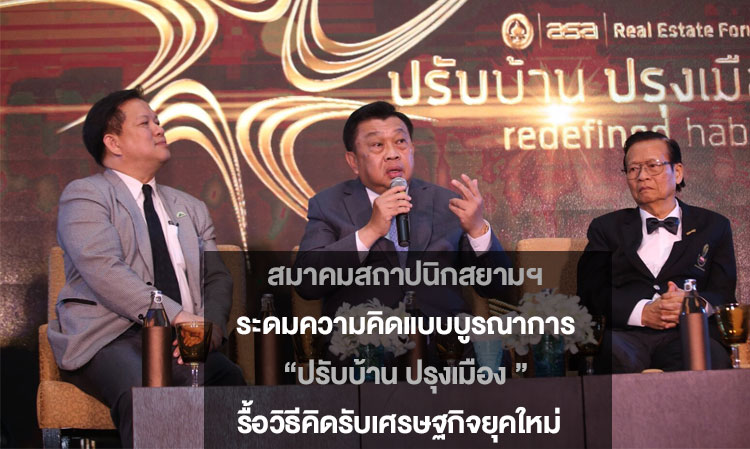
The Siam Architects Association organized a dinner talk titled “Home Adjustment, City Improvement... Redefined Habitat,” gathering thoughts on Thailand's future in the next 20 years in line with national strategies. It emphasized the need for an integrated approach, allowing private sector development alongside public initiatives. The discussion pointed out that outdated city plans need to be revised, advocating for a human-centered design approach that aligns urban planning with the new economic landscape, while also ensuring that low-income individuals have access to urban spaces.

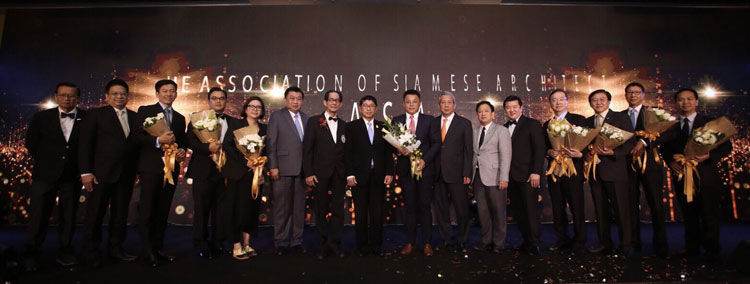
The Siam Architects Association under royal patronage, in collaboration with Ultimate Property Corporation, held a major seminar titled “ASA Real Estate Forum 2018” under the theme “Home Adjustment, City Improvement.” This event aimed to enhance the capabilities of entrepreneurs and elevate Thai architects to an international level, featuring the “ASA Real Estate Forum Dinner Talk Award 2018.” The discussions focused on rethinking urban integration with a human-centered approach.

Professor Manop Pongthatt, head of the real estate development program and a faculty member at Chulalongkorn University's Faculty of Architecture, stated that “Home Adjustment, City Improvement” means rethinking and innovating urban spaces to align with the rapidly changing world. The government cannot achieve this alone; it requires public-private partnerships (PPP) as a puzzle piece for success.
With the new city planning laws and the Eastern Economic Corridor (EEC), it is crucial to address past planning mistakes. The EEC should be seen as an opportunity to create new urban spaces, with the government shifting its role to allow private sector and community-led design rather than doing it themselves.
There should be a collaborative effort among architects, the private sector, and stakeholders to reduce conflicts and gather diverse opinions to develop future cities.
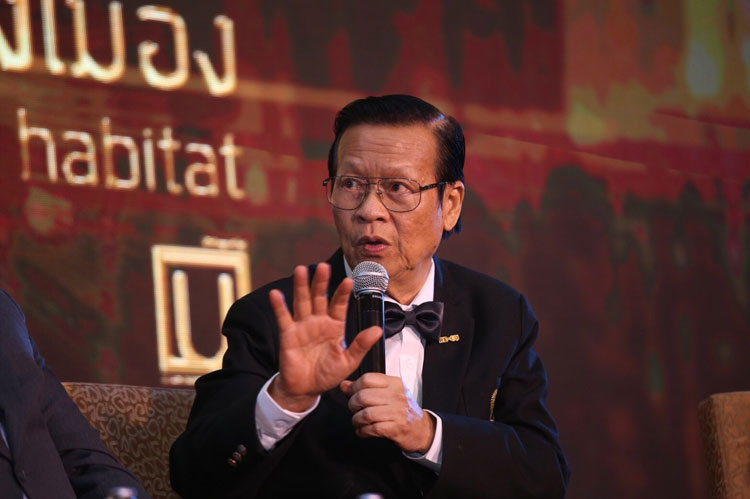
Mr. Athip Pechanchai, president of the Housing Business Association, emphasized that before adjusting homes and cities, we must envision the future of urban areas in alignment with the 20-year national strategy to clarify the direction of urban development and understand Thailand's position compared to neighboring countries. Importantly, it is essential to foster participation, allowing residents to design their own homes and cities, utilizing technology to manage social infrastructure for urban living.

It is time to address outdated laws that do not align with urban development, particularly city planning laws that focus solely on abstract concepts from the past. The direction of urban planning must be updated to reflect reality, considering physical aspects, national development directions, and the involvement of people as central to the process.
“Placing people at the center is crucial for achieving real benefits. Providing knowledge and education about urban development directions enables informed decision-making and collaborative city design. Urban planning must guide the future of the country in line with national development plans,” he added.

Moreover, urban planning must integrate all aspects of development, linking economic drivers and value creation for cities and provinces with infrastructure, transportation systems, industries, raw materials, and logistics to reduce costs. A well-designed urban plan that aligns with city development will help real estate developers see interconnected opportunities across all dimensions.
“Design should meet the needs of residents and identify key development drivers, whether focusing on production, services, or tourism. Clear positioning must be established from the national level down to local communities. In the past, we focused on one level but lacked the necessary connections, emphasizing city planning without actual urban development. By aligning supply and demand, we can see a clear direction for development that is systematic and consistent with urban growth trajectories,” he stated.
He suggested that new urban planning should involve a city development corporation, emphasizing the need to reform the urban planning laws to establish such entities, similar to those in other countries, to manage land development and improve previously utilized urban areas, akin to practices in Singapore and Japan.
The government should shift its role from being a regulator to a supporter and promoter of urban development, allowing the private sector to invest. This approach will reduce government spending on urban development while enabling professional architects to approve and inspect projects, streamlining the process and facilitating rapid urban growth.
The most critical principle of smart cities is systematic management that ensures safety and welfare for all groups, including low-income individuals. Therefore, developing affordable housing for low-income residents in the form of long-term leases (30 years) does not meet the needs of both private investors and buyers who cannot pass on these properties as inheritance. The government should support the private sector in creating housing for low-income individuals in urban areas through various incentives to assist in purchasing high-priced land in city centers, granting ownership rights to low-income homeowners instead of leasing.
Mr. Pornnaris Chuanchaisit, president of the Thai Real Estate Association, noted that Thailand has undergone rapid changes over the past 50 years, with Bangkok's population growing from 1-2 million to 10 million, alongside a significant influx of foreigners and the emergence of high-rise buildings with land prices soaring to 3 million baht per square wah. The urban development of the past resembles a poorly tailored pair of pants, which is no longer applicable under traditional urban planning theories. Therefore, it is essential to gather diverse opinions from various stakeholders to envision a future that accommodates the changing economic landscape, including population growth, increased tourism, and greater national diversity, while addressing the overcrowding and the plight of low-income groups who are pushed further away from urban centers.
“When developing cities, the needs of low-income individuals are often considered last. Urban growth tends to demolish old structures and replace them with new ones, pushing the urban workforce further away. The development of cities often exacerbates the struggles of these individuals, negatively impacting their lives,” he concluded.
Current urban plans in many provinces have been adversely affected by designs that do not align with the needs of the population and the growth trajectory of cities, posing obstacles to future development projects. Although tax laws for land and buildings have been established, there is still a lack of tangible development. A single urban planning framework cannot encompass all cities with varying development needs. Therefore, systematic improvements are necessary, and smart cities must also include smart living opportunities for low-income individuals to reside in urban areas.
Thank you for the information from http://asa.or.th/homepage-th/