
Minimum Wage Increase in 2018 Across All Provinces by 5-22 Baht, Limited Impact on Thai Economy (Kasikorn Research Center)
- The Wage Committee Meeting No. 19 has approved the adjustment of the minimum wage for all provinces for the year 2018 to a range of 308-330 Baht/day (averaging 315.97 Baht/day), effective from April 1, 2018. This adjustment will not be uniform across the country but will vary by region, categorizing provinces into 7 wage levels.
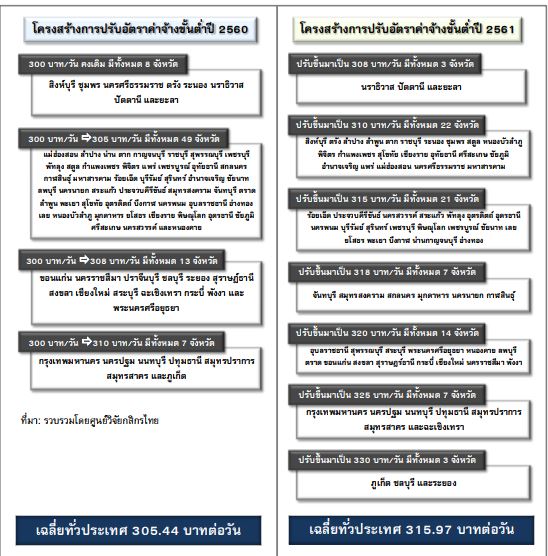
- Notably, the provinces with the highest minimum wage of 330 Baht/day are located in the Eastern Economic Corridor, aligning with government policies aimed at attracting skilled labor to work in this special economic zone. Conversely, provinces with the lowest minimum wage of 308 Baht/day have fewer investments. The modest increase in minimum wage, which aligns with the cost of living for workers, is expected to attract more investors, thereby creating more jobs in these areas.
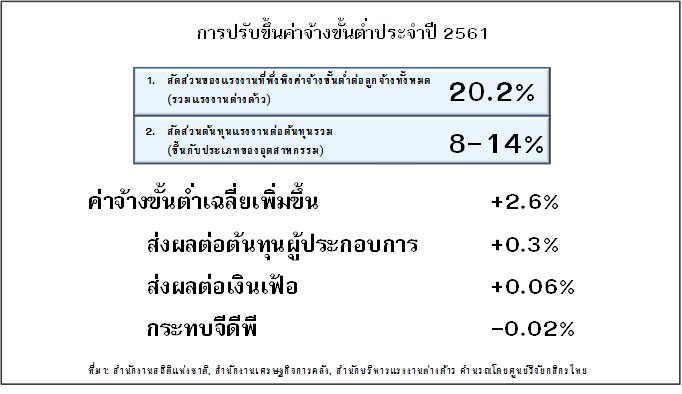
Regarding the impact on businesses and industries, Kasikorn Research Center estimates that the average minimum wage increase of 2.6% in 2018 will directly affect the costs of labor-intensive businesses, increasing them by about 0.5% of total costs. Industries that are labor-intensive primarily include service sectors that rely on unskilled labor and base their wages on minimum wage rates, such as retail, construction, restaurants, accommodation, textiles, clothing, furniture, and agriculture. Meanwhile, other businesses that previously paid slightly above the minimum wage or primarily employed semi-skilled labor may face indirect impacts as they need to raise semi-skilled wages to maintain wage differentials amid a tightening labor market. This will lead to an overall increase in business and industry costs by about 0.4% of total costs. Additionally, businesses with limited options to adopt technology and machinery in place of labor, mostly SMEs, will be more affected compared to other sectors. If the government implements measures to allow businesses to deduct labor costs for tax purposes at a rate of 1.5 times, it could alleviate some of the increased cost burdens from the minimum wage hike.
|
Business Sector |
Employment by SMEs (Million People) |
Proportion of Total Employment (%) |
|
Retail and Wholesale |
3.7 |
92% |
|
Construction |
0.85 |
93% |
|
Restaurants and Accommodation |
1.3 |
85% |
|
Total Across All Sectors |
11.7 |
79% |
Source: OSMEP.
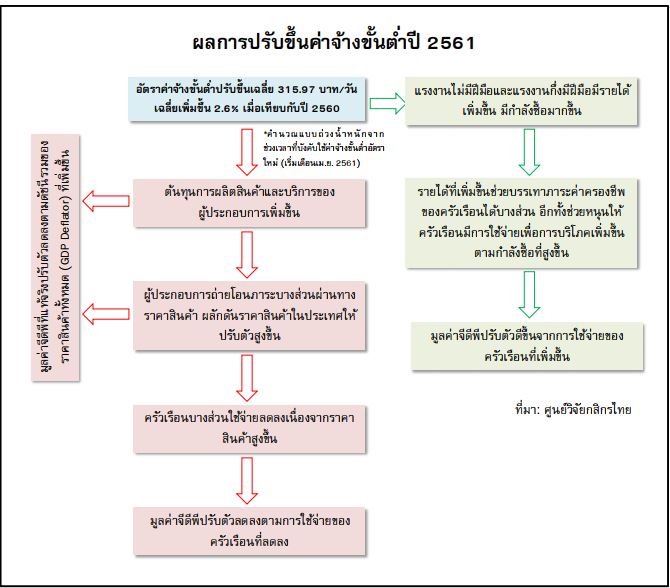
- As for the macroeconomic impact, the increased income for unskilled and semi-skilled workers from the minimum wage hike will help alleviate some of their cost of living burdens and boost household spending in line with higher purchasing power, positively affecting the country's GDP. However, the minimum wage increase will also raise production costs for businesses, which, combined with other rising production costs, may lead some businesses to pass on these increased costs through higher prices for goods and services. Kasikorn Research Center predicts that consumer prices will rise by about 0.06% in 2018 compared to a scenario without the minimum wage increase. (Part of the impact of the minimum wage adjustment has already been included in the general inflation estimate for 2018.) The increase in production costs and consumer prices will exert pressure on GDP value. Nevertheless, the rise in worker income will also support GDP value to some extent. Additionally, the government has measures to control domestic prices for essential goods such as toilet paper, detergent, soap, shampoo, eggs, and ready-to-drink dairy products, which will limit the overall economic impact of the minimum wage increase on Thailand. According to the assessment of the impact on Thailand's GDP in 2018, Kasikorn Research Center expects that the minimum wage increase will have a negligible effect on GDP value, with a net decrease of about 0.02% compared to a scenario without the minimum wage increase. Therefore, Kasikorn Research Center maintains its GDP growth forecast for Thailand in 2018 at 4.0% and the average general inflation rate at 1.1% as previously stated.
Kasikorn Research Center continues to forecast Thailand's economic growth rate and overall inflation rate for 2018 at 4.0% and 1.1%, respectively.
Thank you for the information from www.kasikornresearch.com