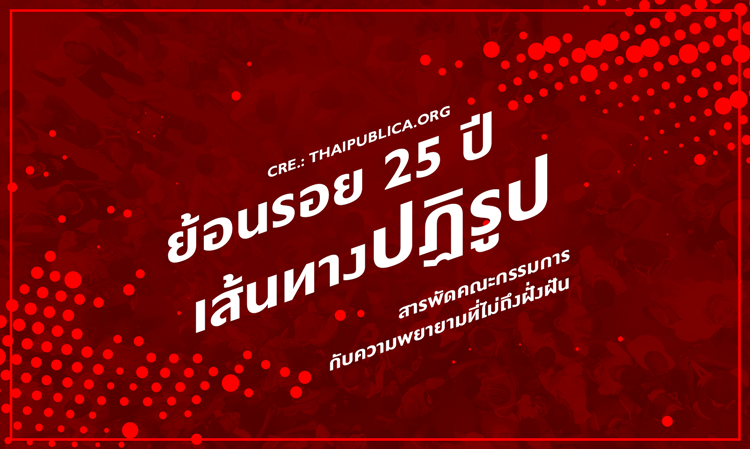
Reflecting on 25 Years of Reform: The Journey of Various Committees and Unfulfilled Aspirations
“Reform” is not a new concept in Thai political history. Since the change of government in 1932, reform has become a rhetoric used by those in power to legitimize their authority and foster national unity to overcome obstacles and address issues that hinder the country's progress.
Moreover, the topic of reform has often been used as a pretext for movements to oust governments or as a justification for past coups.
Looking back over the past two decades, we can see a clear political reform initiative starting from 1992 under the Chuan Leekpai government, with Mr. Marut Bunnaak from the Democrat Party serving as the Speaker of the House. The House of Representatives appointed the Democracy Development Committee (DDC) to draft proposals for political reform, chaired by Professor Dr. Pravesh Wasi.
The reform proposals included four key points:
- 1) Addressing systemic political issues, not just isolated problems.
- 2) Reforming the political system by eliminating all forms of corruption, creating political stability, and enhancing the efficiency of political organizations.
- 3) Drafting the constitution and related laws as part of the political reform, to be completed simultaneously.
- 4) Ensuring that the political reform adheres to a democratic framework with the monarchy as the head of state, aiming to modernize the outdated parliamentary system.
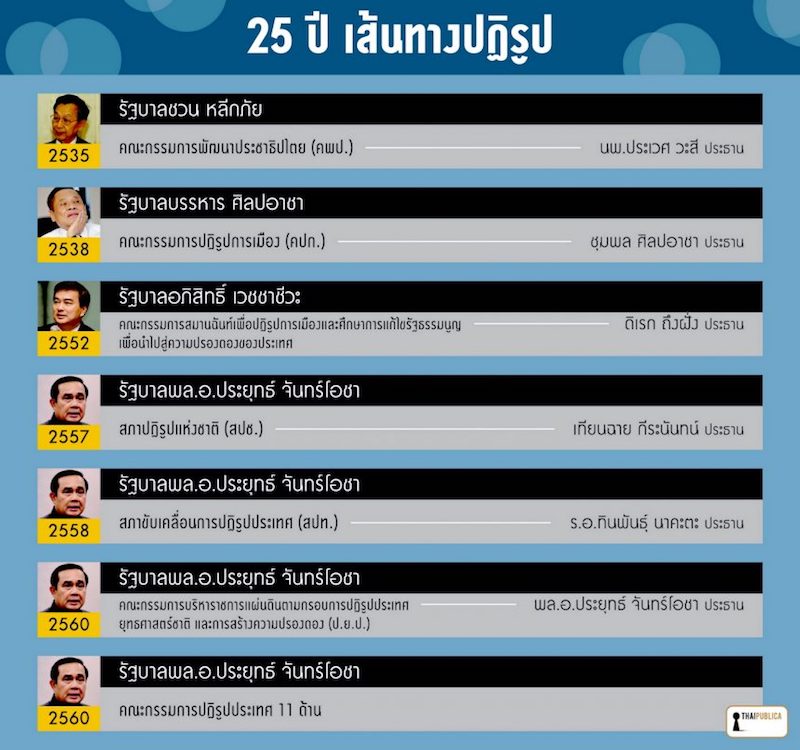
Later, during the Banharn Silpa-archa government, Article 211 of the constitution was amended to reform politics, and on August 8, 1995, the Prime Minister's Office issued Order No. 118/2538 to establish the Political Reform Committee (PRC), chaired by Mr. Chumpol Silpa-archa, to drive key political reform policies, leading to the 1997 People's Constitution.
The political reform considerations outlined six urgent reform guidelines:
- 1) Developing a political development plan and establishing a Political Development Committee to implement the plan.
- 2) Reforming the constitution-making process to ensure public participation.
- 3) Reforming the bureaucracy and the systems for checking corruption and misconduct among politicians, civil servants, and state enterprise employees, including high-level position oversight, administrative courts, constitutional courts, and public auditor systems.
- 4) Reforming political parties to be more democratic and representative of the masses.
- 5) Reforming the electoral system and establishing election oversight bodies at all levels.
- 6) Reforming public political participation, enacting laws for public consultations on significant public policies, and promoting community organization to protect their interests and those of society and the nation, with state agencies considering their opinions.
During the Abhisit Vejjajiva government, with Mr. Chai Chidchob as Speaker of the House, a parliamentary order was signed on May 1, 2009, to establish a reconciliation committee for political reform and constitutional amendment, consisting of 39 members, chaired by Mr. Direk Thangfang. This committee was tasked with studying and amending the constitution to foster national reconciliation, recognizing that some issues stemmed from constitutional provisions and their practical application.
Under Yingluck Shinawatra's government, the first meeting titled “Moving Forward with Thailand’s Reform: Developing Democracy and the Nation Together” was held in August 2013, setting reform goals that included:
- 1) Strengthening the stability of the democratic system with the monarchy as head of state.
- 2) Ensuring equality and reducing disparities.
- 3) Establishing transparent and accountable mechanisms based on good governance.
- 4) Creating processes that ensure justice and equality in fundamental rights according to the rule of law.
- 5) Promoting democracy through participation from all sectors, respecting majority voices while listening to minority opinions.
- 6) Building trust and a positive atmosphere of mutual confidence.
- 7) Prioritizing collective interests based on correctness.
Then came the Prayuth Chan-o-cha government, which received a royal decree on October 2, 2014, appointing 250 members of the National Reform Council, chaired by Mr. Tianchai Kiranant, tasked with studying and proposing recommendations for reforms in various areas, including politics, administration, law and justice, local governance, education, economy, energy, public health, environment, media, society, and more.
The aim was to ensure that the democratic governance with the monarchy as head of state aligns with the Thai social context, establishing a fair and honest electoral system, effective mechanisms to prevent and eliminate corruption and misconduct, reducing disparities, and creating economic and social justice for sustainable development, enabling state mechanisms to serve the public comprehensively, conveniently, and swiftly, with strict and fair law enforcement. From October 6, 2014, to September 6, 2015, the National Reform Council concluded 37 reform agendas and six development agendas.
This was followed by the National Reform Steering Assembly (NRSA), consisting of 200 members, which took over from the National Reform Council. After working from October 13, 2015, to August 3, 2017, the NRSA, chaired by Lt. Gen. Thinpan Nakata, proposed 188 recommendations for various reforms to the Prime Minister, resulting in 27 concrete outcomes, such as the establishment of anti-corruption and misconduct courts and reforms to computer crime regulations.
Subsequently, the National Administration Reform Committee was established under the framework of national reform, national strategy, and reconciliation (P.Y.P.) using powers under Section 44 of the temporary constitution of 2014, set up in January 2017, with the Prime Minister as chair, to systematically review and prioritize proposals from the National Reform Council, NRSA, and various sectors.
Finally, we arrive at the latest reform mechanism, the “National Reform Committee”, which is seen as the last hope for advancing reforms in this round, amidst skepticism that it may be just another “old wine in a new bottle.”
The National Reform Committee: The Last Hope of the NCPO Era
The path of “reform” has reached a significant milestone with the “last hope” placed in the National Reform Committee across 11 areas, amidst criticism that it is merely “old wine in a new bottle.”
Part of the concern arises from the fact that over half of the 120 committee members have previously served as members of the National Reform Council (NRC) and the National Reform Steering Assembly (NRSA), with some also part of the National Administration Reform Committee, which will lead proposals from the NRC, with some being close associates of the National Council for Peace and Order (NCPO) leaders.
Looking back at the “achievements” and “directions” of the NRC and NRSA, many are beginning to doubt whether this committee can push reforms into tangible outcomes as society expects.
Starting with the individuals, it is noted that out of the 120 members, 51 have previously held positions in the NRC and NRSA, raising concerns about whether the reform committee will produce anything significantly different or more concrete than what was achieved during the NRC and NRSA.
Focusing on the crucial committee for political reform, it is found that 7 out of 13 members have previously served in the NRC or NRSA, including the chair, Dr. Anake Laothamatas, a former NRC member and drafting committee member, Mr. Pornchai Trakulvoranont, a former NRSA member, Dr. Wanthanak Kanjanasuwan, a former NRSA member, General Thitiwat Khamlaek, a former NRC and NRSA member, Police Lieutenant General Trithat Ronrithiwichai, a former NRSA member, Ms. Narath Pimsena, a former NRSA member, and Mr. Wanchai Sornsiri, a former NRSA member.
The committee with the highest number of former NRC or NRSA members is the social reform committee, which has 9 out of 13 members, chaired by Mr. Piti Pong Phungboon Na Ayutthaya, a former NRSA member, along with other NRSA members including Dr. Ampon Jinda-watana, M.R. Chakkarat Jitphong, Mr. Torpong Selanont, Mr. Wichian Chonlawit, Mr. Anothai Rithipanyawong, Mr. Somdet Nilpan, and Mr. Surin Jirawisit, along with one former NRC member, Mr. Winai Dahlan.
According to the National Reform Plan and Procedures Act of 2017, the reform targets that need urgent action are:
- 1. Leading the country towards peace, unity, sustainable development based on the sufficiency economy, and balancing material and spiritual development.
- 2. Creating a peaceful, just society with equal opportunities to eliminate disparities.
- 3. Ensuring citizens' happiness, good quality of life, and participation in the development of the country and governance under a democratic system with the monarchy as head of state.
Importantly, the national reform must align with and follow the national strategy.
Given past issues in the NRC and NRSA, which were criticized for merely providing information without the power to push for actual implementation, this time, each reform committee is legally bound to create a “reform plan” that includes plans, procedures, methods of implementation, and expected outcomes, along with timelines for each step and performance indicators for the reform process in each area.
Additionally, they must designate responsible state agencies or individuals for the implementation, estimate the budget for each reform area or issue, and project the expected outcomes of the reforms to be achieved within five years, which will enhance clarity and feasibility for the reforms.
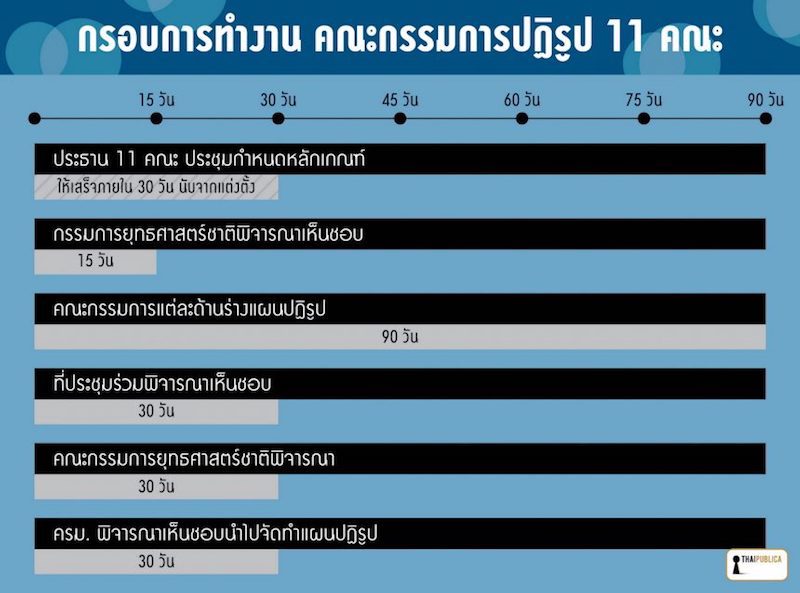
Importantly, to ensure speed, different from the past, this time a clear working framework has been set for about 7 months, starting with a joint meeting of all reform committee chairs to establish criteria, methods, and conditions for drafting the national reform plan to be completed within 30 days from the appointment of the reform committee, then submitted to the National Strategy Committee for approval within 15 days.
Subsequently, the reform committee must complete the draft national reform plan for their respective areas within 90 days, and the joint meeting must approve it within 30 days before submitting it to the National Strategy Committee for alignment with the national strategy and master plan within 30 days, which must then be sent to the Cabinet for approval within 30 days to formulate the national reform plan.
However, ultimately, the powers and duties of the national reform committee, which will have a five-year term, remain limited to defining criteria, methods, and details of the reform, monitoring, and evaluating the implementation, as well as providing recommendations to the National Strategy Committee for submission to the Parliament, Cabinet, or relevant state agencies regarding the implementation of the national reform plan.
In the end, the real decision-making or driving power still lies with the National Strategy Committee and the Cabinet, similar to the NRC and NRSA, which merely studied and summarized the work before submitting it to the Prime Minister. Yet, after three years, there has been little visible progress towards tangible implementation.
With no tangible results, questions are increasingly being raised about how much the NCPO government truly values reform as it has publicly declared, especially in the few months remaining.
All eyes are now on the performance of the reform committee, which is seen as the last hope after the reform mission has been passed down from the NRC and NRSA, to see if it can reach the intended destination, proving whether this coup was truly worthwhile.
Note: Some images accompanying this article are not related to the content.