Summary of 3 Years of the "Prayuth Chan-o-cha Government" with a Mid-Year Budget Increase of 396 Billion Baht
In 3 years and 4 months since General Prayuth Chan-o-cha took office as Prime Minister, the government formed through a coup has demonstrated effective governance similar to that of an elected government. Recently, Mr. Dechaphiwat Na Songkhla, the new Director of the Bureau of Budget, is preparing to propose a draft of the additional budget bill for the fiscal year 2018, or "Mid-Year Budget 61", with a budget framework of 150 billion baht, continuing for the third consecutive year, for approval at the Cabinet meeting on Tuesday, January 16, 2018, alongside the framework for the annual budget for 2019 (regular budget) amounting to 3 trillion baht.
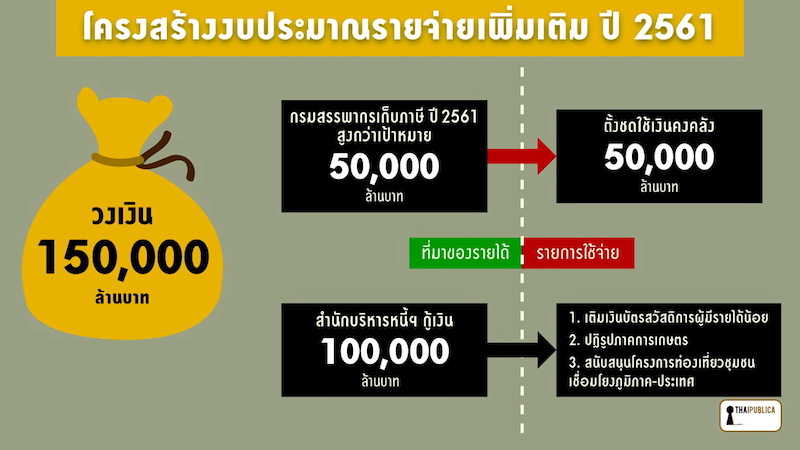
Following a meeting of four agencies, including the Bureau of Budget, the Ministry of Finance, the National Economic and Social Development Board (NESDB), and the Bank of Thailand (BOT), chaired by Dr. Somkid Jatusripitak, Deputy Prime Minister for Economic Affairs, Mr. Dechaphiwat Na Songkhla stated that the Bureau is preparing to submit the draft of the "Mid-Year Budget 61" amounting to 150 billion baht for the Cabinet's consideration on January 16. The sources of funding or revenue for this "Mid-Year Budget 61" consist of two parts:
1. The Ministry of Finance anticipates that the Revenue Department will collect revenue this year exceeding the target by 50 billion baht.
2. The Public Debt Management Office will issue bonds to borrow 100 billion baht, with the government planning to use the excess revenue from the Revenue Department to compensate for the cash flow used to pay pensions, retirement benefits, and medical expenses for civil servants.
The 100 billion baht loan is earmarked for spending on state welfare projects for low-income individuals, agricultural sector reform projects, and community tourism development projects linked to the region and neighboring countries.
Mr. Dechaphiwat stated that the budget framework for the fiscal year 2019 set by the joint meeting of the four agencies is 3 trillion baht. The Ministry of Finance predicts that this year the government will have revenue of 2.55 trillion baht, resulting in a deficit of 450 billion baht, based on the assumption that the economy will grow by 4% per year. The structure of the expenditure budget consists of regular expenditures accounting for 75-76% of the total budget, with an investment budget of approximately 600 billion baht, representing 21% of the total budget. The remaining budget is for debt repayment and interest, approximately 70 billion baht, accounting for 3-4% of the total budget.
"This year's expenditure budget will focus on economic reform, education, public health, social issues, and the environment, reducing inequality, and supporting the grassroots economy by increasing the proportion of subsidies to local administrative organizations to 29.5% of the total budget. It will also enhance the country's competitiveness to support the digital economy, with most of the investment budget supporting large-scale investment projects in the Eastern Economic Corridor. According to the budget calendar, government agencies can submit requests for budget support for various projects by January 25. Currently, government agencies and state enterprises have submitted budget requests totaling over 5 trillion baht," Mr. Dechaphiwat stated.
Meanwhile, Mr. Apisak Tantivorawong, Minister of Finance, revealed that the purpose of this Mid-Year Budget 61 is to allocate funds for the second phase of the state welfare project for low-income individuals, amounting to 35 billion baht, to reform the agricultural sector with a budget of 40 billion baht through a project addressing the low rubber prices, compensating for the reduction of rubber tree planting areas by 10-20%. The remaining funds will be used for grassroots economic development projects, supporting community tourism with 20 billion baht, and allocating 10 billion baht to village funds.
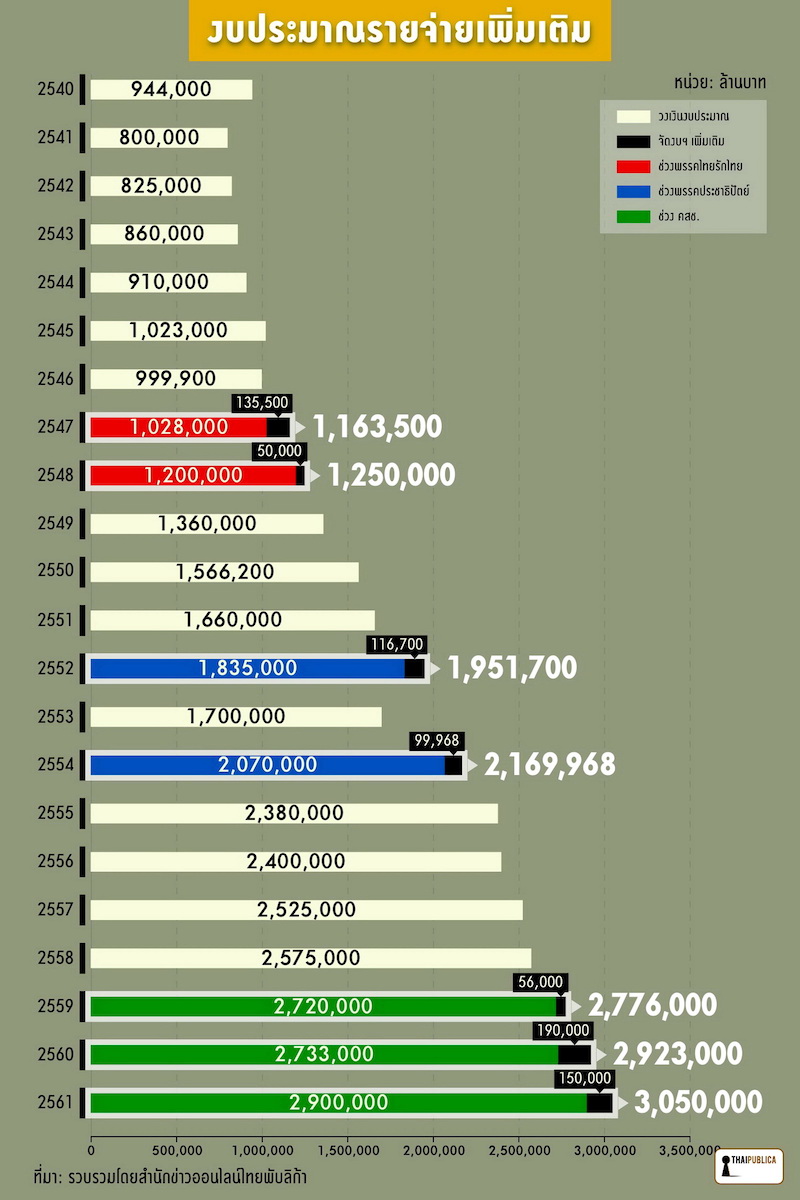
It is noteworthy that during the tenure of General Prayuth Chan-o-cha's government, three additional budgets have been created beyond the regular budget, totaling 396 billion baht. The first occurred in the fiscal year 2016 when the Thai economy was affected by political unrest, prompting the government to create an additional budget to inject funds to stimulate the economy. Coincidentally, that year, the government received 56.29 billion baht from the auction of 1800 MHz and 900 MHz frequency licenses, which was used to create a mid-year budget of 56 billion baht. The increased budget was allocated for telecommunications infrastructure projects to drive the economy, 15 billion baht for strengthening and advancing the country according to reform guidelines, and 8.34 billion baht for cash flow compensation.
As a result of the government's economic stimulus measures through the mid-year budget of 2016, cash was distributed to the poor, budget disbursement was accelerated, and tax deductions for tourism were increased. At that time, the Ministry of Finance predicted that the Revenue Department would collect taxes exceeding the target by no less than 27 billion baht. In the fiscal year 2017, General Prayuth's government decided to continue with a mid-year budget of 190 billion baht, allowing the Ministry of Finance to issue savings bonds to borrow 160 billion baht from the public, with the remainder coming from the Revenue Department exceeding the target.
The third time, before the election roadmap was opened, the Bureau of Budget prepared to propose a mid-year budget of 150 billion baht to inject funds into the system once again.
Note: The images accompanying the article may not be related to the content.
Thank you for the information and images from: www.thaipublica.org