
Overcoming 6 Traps Towards Digital Economy to Solve the Issues of "Aging, Illness, Poverty, Declining Population, Low Education, and High Inequality"
The wave of technology is a massive force rapidly transforming the world, yet Thailand still faces structural problems such as poverty, inequality, and an aging society. Therefore, it is essential for Thailand to undergo a "major transition." The government of General Prayuth Chan-o-cha has been attempting to address these issues by establishing a national reform committee and planning a 20-year national strategy across ten committees to restructure and prepare Thailand to cope with rapid changes and technological advancements. However, it remains unclear what the committee's goals and directions are.
Similarly, the Thailand 4.0 policy, aimed at propelling Thailand into a digital economy on par with the world, lacks clarity on its true meaning and the practical steps needed to implement it. Thai Publica sought answers from Dr. Anuchit Anuchitanukul, Chairman of the Development System for Sales Channels and Products at Kiatnakin Bank Public Company Limited, who serves as an advisor to the National e-Payment working group, responsible for redesigning Thailand's payment system infrastructure, including the "PromptPay" system launched last year.
"A true digital economy requires a solid infrastructure across six areas, which serve as building blocks," Dr. Anuchit stated, illustrating the infrastructure of the digital economy and discussing the technological planning that Thailand should prioritize. He emphasized that beyond payment systems, there are many other "infrastructures" that Thailand must urgently advance to keep pace with the impending changes.
"I see six main issues that Thailand will face, which require careful planning. Technological planning must align with these issues, which we need to understand: our country is facing aging, illness, poverty, a declining population, low education, and high inequality. These are the challenges, and we must find solutions. Why is healthcare important? Why is education important? We don't need to research other issues because we lack data on poverty, employment, and livelihoods. In over ten years, these six problems will hit Thailand simultaneously, and if we don't act now, we may not be able to catch up. We cannot escape these issues in the next decade: aging, illness, poverty, a declining population, low education, and inequality will all come together. The workforce is shrinking due to an aging population, productivity is declining, the tax base is shrinking, welfare costs are rising, and businesses are fleeing the country. Everything will collide," he warned.
Dr. Anuchit clarified that what he is discussing today is not about existing solutions but rather about what Thailand still lacks, which is crucial and necessary. These tasks cannot be accomplished by any single individual; they require collective effort. Unlike simply investing money to create something, this is a collaborative endeavor that is inherently challenging.
He emphasized, "Success cannot occur without cooperation, including effective communication to ensure everyone understands the necessity and importance of these efforts. We must work together to achieve this."
6 Infrastructures Needed for Transitioning to a Digital Economy
Dr. Anuchit continued, stating that a true digital economy must have foundational elements supporting everything. There are seven areas of infrastructure, of which one has already been developed: 1. Payment systems, because without digital payment, the digital economy cannot progress. 2. Without a digital identity system, we cannot verify who is doing what or who is who, making collaboration impossible. 3. Logistics and location. 4. Data; without data, nothing can be accomplished. 5. Network security. 6. Human resources. All of these must be actively developed because they are the foundation or building blocks of the digital economy. It is not about organizing exhibitions or studying elsewhere; it is about reallocating budgets and resources to create these infrastructures.
"For example, in the manufacturing era, discussions revolved around whether there was electricity, roads, water, and industrial estates. However, in the digital economy, we rarely discuss digital infrastructure. Instead, we talk about multi-billion projects for road construction and village internet, which are merely conduits, without addressing the need to connect every village," he pointed out.
Identity Verification – Digital ID
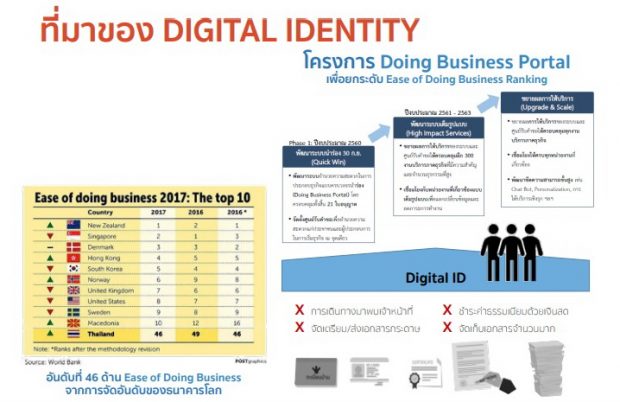
Dr. Anuchit further explained that the current work involves the identity verification system, which is crucial in the digital world. The challenge is operating in a realm where identities are invisible, making it difficult to know who we are interacting with. He provided an example: the government aims to promote ease of doing business, meaning that when citizens or private entities seek permits or contact government agencies, it should all be done electronically. The government has set up websites to facilitate this, but when it comes to actual data usage, the problem arises: who is requesting the permit or contacting the government?
"Thus, the critical issue in electronic transactions is how to verify that a person is indeed who they claim to be. This is the core challenge," he stated.
The absence of such infrastructure makes it impossible to initiate any actions. The only method is for individuals to present themselves in person every time, even if they have filled out information online. They still need to show up to confirm their identity. When developing a digital economy, this is a significant problem.
Each government service requires users to create their own username and password, and they must present themselves at least once to establish their identity. If they use multiple services, they end up with numerous usernames and passwords, leading to complications. Therefore, pushing for ease of doing business through a government business portal will face obstacles. We must address the identity verification challenge.In addition to identity verification, there are issues related to consent and data sharing between agencies. For instance, when applying for online loans, credit information must be requested from credit bureaus, but how can we know that the requester is indeed the individual? Without proper verification, obtaining accurate data from credit bureaus becomes impossible, which relates to e-consent.
In summary, there are two main issues: the first concerns verifying that a person is genuinely conducting a transaction without needing to see their face, and the second relates to ensuring that once identity is verified, the individual consents to share their data from trusted sources with those who need it. For example, in the case of credit bureaus, if identity is verified as genuine, the individual can authorize the credit bureau to share their information with the bank for electronic loan applications.
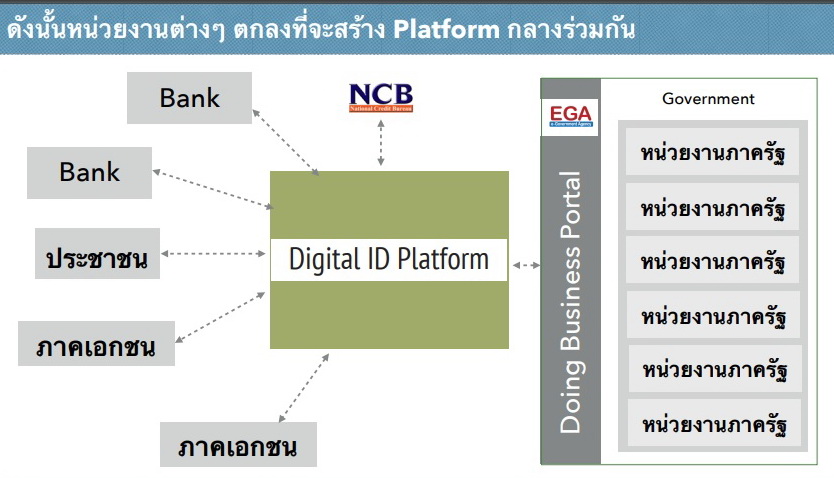
Dr. Anuchit continued, stating that in the past two years, there has been a significant demand for customer identity verification through e-channels, resulting in numerous projects. If nothing is done, there will be ten different projects, all addressing the same issue. When citizens attempt to use these services, they will find it exhausting. If they need to contact one agency, they must use one method, and if they need to contact another, they must use a different method. If there are 1,000 service providers in the system, and each must communicate with every other, it would require 1,000 x 1,000 projects, totaling 1,000,000 projects for 1,000 service providers to collaborate. How is that feasible? Therefore, a central infrastructure is necessary, leading to the agreement that each agency should only focus on its own tasks while connecting to a central platform known as the digital ID platform, allowing everyone to communicate effectively. This is the concept.
"Currently, there is no central infrastructure; signatures are still required. Thus, any request for cross-agency data must involve identity verification. Anything that still requires photocopies and certified copies indicates that digital identity is not yet in use. The need for certified copies implies that I must contact you and provide certain information, such as marriage certificates. If I do not send it, does that mean I am not married? Or if I send documents, how can we verify their authenticity? We cannot know because I certify it myself, but the real data resides with the civil registry. Without a system to extract that data, the only method is to send information directly, forcing the recipient to find ways to verify it themselves, leading to a high incidence of fraud in Thailand," he explained.
"To advance towards a digital economy, relying on random data provided by individuals is not feasible. However, if we have a digital ID that can verify authenticity, the data shared will be genuine, not fabricated. Can a digital economy thrive on fraudulent data? This is why I emphasize that these infrastructures must be developed to utilize real data effectively, enabling everyone to communicate, share information, verify identities, and securely transfer data to others," he asserted.
Dr. Anuchit discussed the suggestion to use the 13-digit national ID number as a digital ID, stating that the ID number is merely a number and does not address the verification of identity. For example, using the 13-digit number to access government services does not guarantee that the person entering the number is indeed that individual. Anyone can input that number; it does not verify identity but merely indicates that the data belongs to that person. While it is true that they have an ID card and fingerprints, it still requires physical presence for verification. One cannot use the ID card universally; it must be presented at the district office with a reader. If the intention is to develop a system that allows remote verification from home, it would require distributing readers to every household in Thailand. In addition to having an ID card, one would also need to carry a reader, which is not a comprehensive identity verification method.
In other countries, when contacting government agencies or private entities, individuals often verify their identities using commonly used methods, such as mobile banking, which already has established verification processes. When using services, individuals can confirm their identities seamlessly. Many European countries have advanced in this direction, and in a few years, the world will likely adopt similar practices.
"For instance, Singapore was very excited about our National e-Payment initiative. We led the way, and they followed, even extending to national ID because they recognized its necessity. Initially, when the Ministry of Finance began developing e-payment two years ago, we emphasized the need for a digital ID, but it was outside the ministry's scope. Thus, we could only push for payment systems, hoping someone would address the ID issue. Nonetheless, we are now working on it," Dr. Anuchit noted.
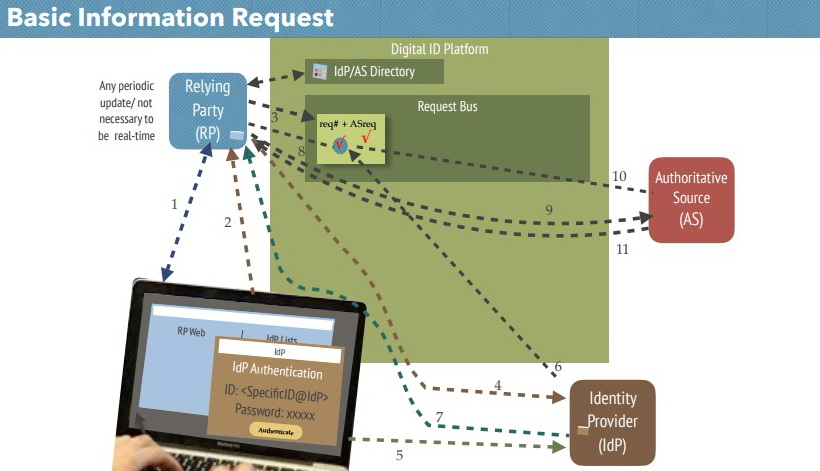
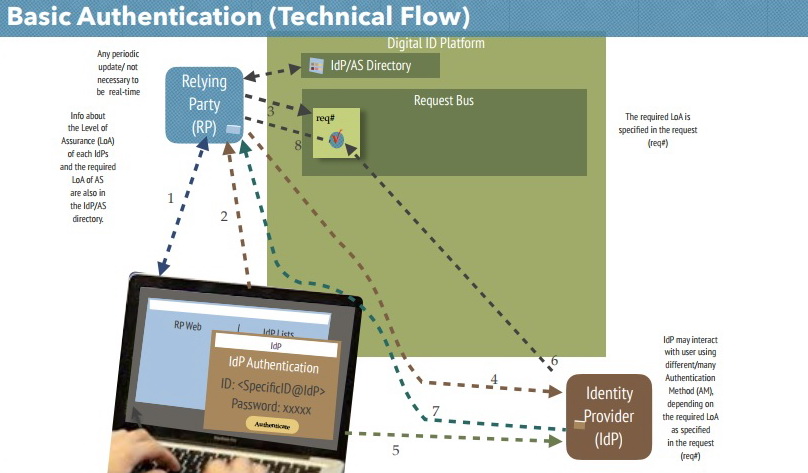
Dr. Anuchit continued, explaining that the current system under development will involve mutual identity verification among various parties. To illustrate, suppose a user wants to access a service from a website, whether public or private, to apply for a service or submit a request. However, neither the service provider nor the requester knows each other and lacks a username and password. The service provider instructs the requester to find someone else to verify their identity. The requester, who regularly uses a banking service, can log in to their bank, which verifies their identity and sends that confirmation to the service provider, stating, "Yes, this is the person." This is the fundamental principle, but the challenge lies in how to implement it effectively. If this can be achieved, the bank already knows the customer and can assist in verification, allowing the new service provider to recognize the requester. This is a common practice in other countries, but the question remains: how can we design it effectively?
The digital ID platform will serve as a central connection point between the public and private sectors, with private entities investing to create the digital ID platform under the oversight of the digital ID foundation working group. The technical framework indicates that the development of the digital ID platform will begin in June 2018, with partial identity verification for financial and certain government sectors (IdP) starting in December 2018, linking at least ten data-providing agencies. By December 2019, full identity verification will be implemented, with comprehensive database connections under the supervision of the digital identity verification development committee.
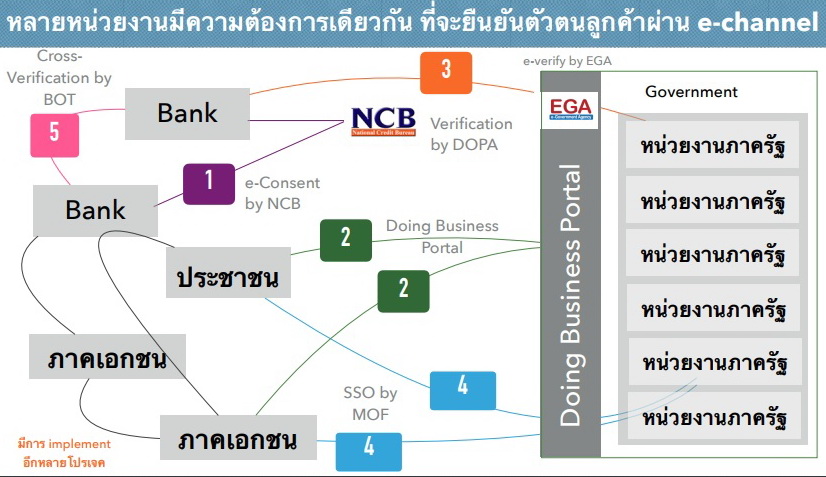
Furthermore, obtaining consent to share data from one person to another is similar. For instance, when a service requester applies for a loan from a provider that requires information from a credit bureau, neither party knows each other. However, a bank that already knows the requester can assist in verifying their identity. The requester applies for the loan, and the provider requests the bank to verify their identity, using a username and password, while also requesting that the bank share the data. Once verification is complete, the bank confirms that the requester has consented to share their information with the credit bureau, which then provides the data to the provider.
Moreover, identity verification methods will continue to evolve beyond just usernames and passwords. There will be fingerprint scanning, facial recognition, and various technologies. In the future, mobile phones may even be able to scan DNA. Therefore, the approach is to use the examples above, verifying identity with usernames and passwords. If not through a website, then through applications like mobile banking, which can confirm identity directly on the device. There are many methods, and various individuals can assist in verification. Thus, if we design the infrastructure well, identity verification can be diverse, and as technology advances, it will remain compatible. One day, we may simply use our phones for facial recognition, and that will work with the existing infrastructure, allowing others to verify as demonstrated.
The government must establish standards, such as determining the minimum length for usernames and passwords or specifying how facial recognition should be conducted. These standards can be implemented by anyone. Additionally, the design must accommodate both digital and non-digital systems, as many Thais have yet to start using digital services. The readiness of individuals varies, so the system must integrate both digital and non-digital methods. For example, if someone needs to access a service but lacks a verification method, they should be able to find the nearest location to verify their identity.
"If we had this infrastructure (digital ID) established years ago, when we registered low-income individuals, there would be no need to visit a bank. Currently, individuals must go to show their identity, but with a digital ID infrastructure, low-income individuals could register anywhere and verify their identity. Those with bank accounts could use their banks, while those without could go to the nearest available point. Even new fintech companies could emerge, allowing individuals to verify their identities at the closest location equipped with ID card readers, enabling service providers to operate without branches nationwide. This would significantly facilitate development. Initially, we planned to distribute card readers and EDC machines across the country to support digital ID initiatives," he concluded.
Security of Identity Verification
Dr. Anuchit discussed the security of identity verification, stating that a robust system can be confirmed through multiple sources. Relying on a single verification source poses risks; if that system fails, no transactions can occur. However, if the system has multiple confirming sources, such as three different entities, it is more likely to represent a genuine identity. For instance, if Mr. A applies for a government service and logs in from two different banks, and both banks confirm his identity, it is more reliable than just one bank's confirmation. Additionally, there is potential to develop a universal ID system, requiring confirmation from both Bank A and Bank B. If verification comes from other sources, it would not be considered Mr. A. This adds another layer of security, ensuring that not just anyone can verify their identity. If someone attempts to impersonate Mr. A from different sources, both banks would alert that someone is trying to impersonate him.
Thus, it is not about having a single ID; rather, it is about having a platform that allows for multiple types of IDs. Just as in payment systems, we refer to it as any ID, paired with infrastructure that can utilize various IDs for identity verification. This is similar to how banking services can be accessed through multiple banks, regardless of whether one logs in using a username and password or other methods, as long as it confirms that the individual is indeed who they claim to be from various sources.

"We do not need a single system for everyone. It is not necessary for everyone to use the same method. Individuals can choose what works best for them, but this system accommodates various methods. When designing, we emphasize that it is an infrastructure that does not rely on any single entity. People will choose the best service available. Technology evolves, and we design it to be adaptable, fostering free competition in an open market. Anyone can provide services without monopolizing the system. Importantly, no single entity will hold all data about individuals. The infrastructure will not store any data; it will merely process requests and verify them. Real data will remain with the respective agencies, and once authorized, it can be retrieved from those agencies. There will not be a large repository of everyone's data, which is not different from the current situation," he explained.
Location & Logistics
Dr. Anuchit continued, stating that there is still much work to be done regarding other infrastructures, such as logistics. He provided a real example: the postal code does not match the administrative code, and no one is aware of this. Traditionally, the postal code has been used, which is illegal because the law mandates using the administrative code as the correct legal address. If a package is sent using the administrative code, it may not reach the recipient. Therefore, if e-commerce is not developed, logistics will lag.
"This is a simple example, not to mention other issues. Singapore claims that in a few years, they will have driverless taxis, while Thailand still relies on human drivers using GPS maps, which sometimes lead to wrong turns. How can robots drive in such conditions? This illustrates Thailand's unpreparedness. We have not laid the groundwork for these technologies. When autonomous vehicles are introduced, they will struggle with the current mapping system. We have not planned urban designs to accommodate robots, which is why these are fundamental issues," he noted.
Logistics must also consider how to ensure that all goods can be delivered. For instance, road construction projects are often completed without considering how goods will be transported. There are projects to build roads, but the focus is solely on road construction without integrating logistics into the planning process.

Data Systems Must Be Ready
Dr. Anuchit stated that the fifth infrastructure is data, and Thailand still lacks a comprehensive data bureau. Currently, we only have credit data from credit bureaus, while Singapore has complete data systems. For example, they can pull up a student's educational history, including grades and behavioral traits, allowing them to plan education and workforce needs effectively. In contrast, Thailand lacks such data; educational records are not digitized, and there are still instances of physical grade copies that can be altered.
Moreover, there is no medical data available. Regardless of the sector, there is a lack of usable data, and it is not organized for effective policy-making.
It is evident that when the government formulates policies, they often lack data. For instance, in agricultural policy aimed at implementing Agriculture 4.0, there is no data on the number of farmers or the size of farmland in each province or district. Consequently, meaningful actions cannot be taken. At most, they can automate water management systems, which Israel has been doing for 30 years. In Japan, agricultural plots are geometrically shaped, allowing for automation, while Thai fields are irregularly shaped, making automation impossible. We must recognize these foundational issues before attempting to implement advanced technologies.
The most data we currently have pertains to low-income individuals, which is a result of the National e-Payment development. Previously, the government sought to address poverty but lacked data on who was poor, how poor they were, and where they lived. Although the data collected on low-income individuals is not 100% accurate, it is better than having no data at all, especially compared to the previous chaotic data situation. We now have some information on spending patterns, demographics, and debts, which is an improvement.
"National strategies must address these issues, but I have not seen any committee tackle these matters. Years ago, the Ministry of ICT invited us to review the national ICT plan, and I noticed that the oldest person in the room was 78, while I was the youngest. I wondered how they could plan for a future they would not be around to see. I feel old myself, and some of them do not even use email, yet they are invited to strategize the national ICT plan. This results in abstract plans that lack efficiency and security. They stopped inviting me after that, as my ideas did not resonate with them, but they seemed content discussing among themselves. Who is planning for the future?"
Thailand Has Long Lost Cyber Sovereignty
Dr. Anuchit stated, "The final issue is network security, which can be divided into network and security. The first aspect is still expanding networks without proper management. When problems arise, we cannot protect the country or take action. We have long lost our sovereignty in cyberspace. For example, during the Pokémon Go incident at Government House, the Prime Minister requested that it not be released, but we have already lost our sovereignty. This means we have no control over cyberspace. However, if we had a well-structured system, we could block threats effectively. If designed correctly, we could prevent issues entirely. Currently, when banks face phishing emails, they must seek help from foreign entities to shut down threats because we cannot control our own systems. However, with a solid infrastructure and ID systems, we would know who is using what from where, allowing us to manage security effectively. We need to be concerned about terrorism and national security, as we still have land borders and fences, but cyberspace lacks such boundaries, making it impossible to manage effectively.
What I have shared highlights the multitude of issues we need to address. Thailand's digital economy can be summarized in two ways: one is a trivial digital existence, where Thais excel in platforms like Instagram and Facebook, yet this does not translate into improved living conditions. The other scenario is that we wait for foreign entities, like China, to take over everything, and we become mere laborers. We are ready to serve foreign interests, whether they are Western, Japanese, or Chinese. This has been our historical pattern, working for foreigners. It is challenging to progress beyond this point, but we are not failing either.
"Thailand 4.0 has yet to produce tangible results. Have you seen anything concrete aside from seminars and product showcases? There is a lack of action. If we truly define it, we need to build the infrastructures I have mentioned, which actually number six: human resources. The quality of Thai children is still insufficient, and we have yet to see any significant developments in programming or other skills. With this level of quality, the country cannot progress," he concluded.
Thank you for the information from thaipublica.org