
The New Consumer and Middle-Class Lifestyle
Key Points
- Staying updated with news and events remains a priority for most people. Many follow news that combines informative and entertaining content, but information relevant to daily life and beneficial for business is the most sought after by consumers. This is a positive sign for the direction of producing and developing news content that can be applied for the benefit of individuals, organizations, and businesses.
- KASIKORN Research Center believes that the increasing number of middle-class individuals in society, along with income levels, education, and job characteristics, may influence consumers' news consumption patterns to shift towards more practical and beneficial information for daily life and careers.
- Poll results indicate that the preferred format for content presentation under the criteria of "quick, easy to understand, and informative" will be the most followed. The ideal length for text is 5-10 lines, video clips should be around 1 minute, and infographics/images with captions should consist of about 2-4 images.
KASIKORN Research Center anticipates that in the future, content will continue to be a significant draw in the age of discerning consumers. Producing content that communicates effectively at the right time will not only attract followers but also lead to widespread sharing, ultimately benefiting content producers in terms of value (revenue) and reputation (credibility).
Every day, there is an overwhelming amount of information available for people to follow. Initially, this came from traditional media such as television, radio, and print media, but we are now in the golden age of new media, including online and social media (internet, various websites, applications like Facebook, Line, Instagram, Twitter, YouTube, etc.), which capture consumer attention more effectively. From the consumer's perspective, having diverse options is likely to have a positive impact on their choice of what to follow. However, for businesses involved in producing news content, this may present more challenges in terms of market competition. The key issue is not just competition but also the survival of businesses in the news production sector, which will depend on content that communicates effectively at the right time. KASIKORN Research Center's survey revealed interesting points:
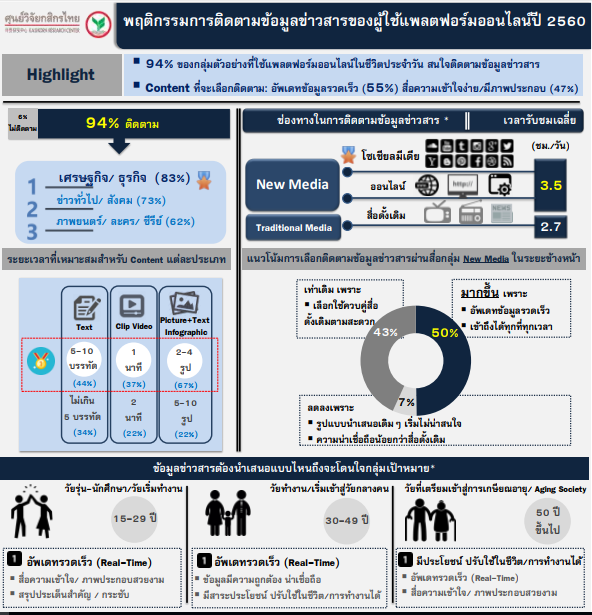
- 94% of respondents who use online platforms daily are interested in following news, with a primary focus on economic/business developments (83%), followed by general news and entertainment (73% and 62%, respectively). Notably, information related to daily life and business benefits is increasingly followed, especially by middle-aged consumers (35 years and older) and those with higher incomes (over 30,000 THB/month), representing 52% of the sample.
In contrast, those earning less than 30,000 THB/month, accounting for 48% of the sample, along with teenagers and seniors, tend to focus more on general news and entertainment, likely because such content is lighter and more stress-relieving compared to information that requires deeper consideration. Thus, age and social status significantly influence the type of news consumers choose to follow.
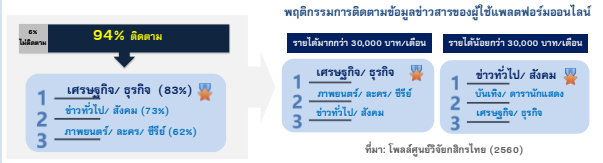
- It is noteworthy that the survey results may reflect the characteristics of the sample group, which is familiar with online living, leading to a higher proportion of respondents with incomes over 30,000 THB/month. Therefore, it is not surprising that economic/business developments are among the most popular topics.
Looking ahead, KASIKORN Research Center believes that the increasing number of middle-class individuals, along with income levels, education, and job characteristics, will influence the way society consumes news and the type of content presented, likely shifting towards more practical and beneficial information for daily life and careers. This is a positive sign for the direction of producing and developing news content that can be applied for the benefit of individuals, organizations, and businesses.
- The influence of new media indicates that people are spending more time following information through these channels, with survey results showing an average of 3.5 hours spent on new media daily, compared to 2.7 hours on traditional media like television, radio, and newspapers. This is nearly three times the time spent reading books by Thais.
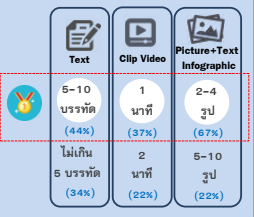
Current survey results show that the ideal length for presenting content that does not bore followers or lead them to switch channels is 5-10 lines for text (44% of respondents), approximately 1 minute for video clips (37%), and about 2-4 images for infographics and captions (67%). In the future, KASIKORN Research Center anticipates that consumer behavior will change rapidly, influenced by various factors such as lifestyle, content format, and platform strategies for presenting news.
Currently, content that meets the criteria of "quick, easy to understand, and informative" is the most followed among discerning consumers. Survey results indicate that content presented quickly (real-time) is what consumers are most interested in following (55%), followed by infographics/images with short descriptions (47%) and content that is practically applicable to daily life (45%).
- Content is a crucial draw in the age of discerning consumers, as information producers today are not limited to traditional media but can be anyone who can convey and present news, leading to an increase in new media producers, both organizationally and individually. Especially among new consumers, who are not just passive recipients of information but also active producers of content. (Although producing text-based information may require visibility of the producer, in social media presentations, the communicator's social status and personality significantly influence consumer trust.) This intensifies competition in the news production business, as existing players must compete not only among themselves but also with new entrants.
KASIKORN Research Center observes that we are currently in a phase of adaptation for businesses involved in news production to keep pace with changing consumer behaviors. Regardless of the direction of these changes, content remains one of the most critical draws that will determine the survival of information producers. If successful, it will not only attract followers but also lead to widespread sharing, ultimately benefiting producers in terms of value (revenue) and reputation (credibility).
Moreover, in the future, the increase in the middle class, population income, education levels, and job characteristics may influence changes in how consumers follow news, likely shifting towards more practical and beneficial information for daily life and careers. Therefore, related businesses must remain alert and continuously develop, as consumers will always seek new experiences and innovations.
Thank you for the information from www.kasikornresearch.com