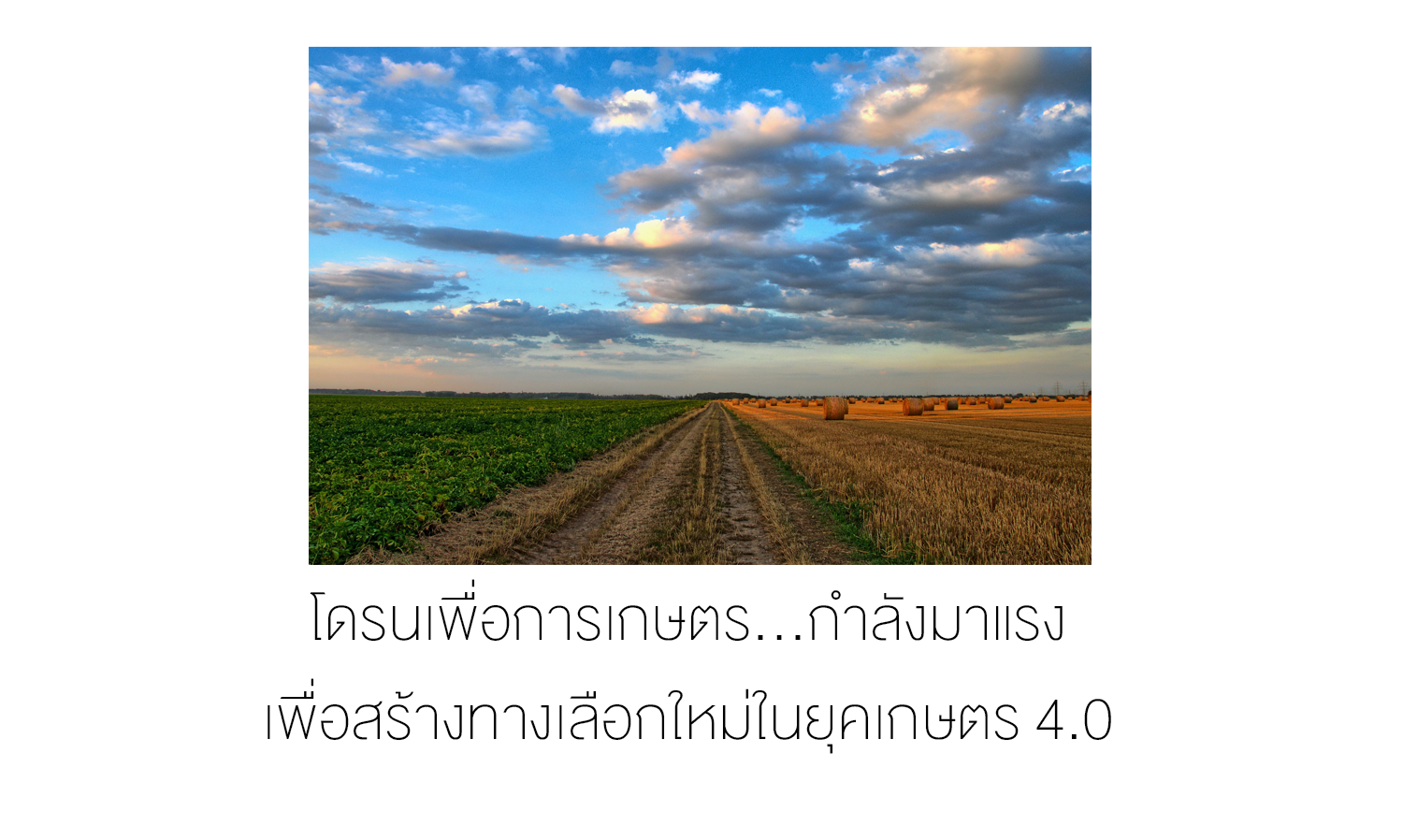
Drones for Agriculture... Gaining Momentum as a New Alternative in the Era of Agriculture 4.0
Key Points
- The Kasikorn Research Center views agricultural drones as an interesting option as a highly precise agricultural tool that is gaining traction in the era of Agriculture 4.0, which emphasizes technology and innovation to enhance the efficiency of agricultural production, reduce production costs, save time, and minimize labor usage amidst a trend of decreasing agricultural labor. Additionally, agricultural drones can accurately control the quality of agricultural products.
- The Kasikorn Research Center estimates that if Thailand adopts agricultural technologies such as drones in accordance with the government's large-scale farming policy initiated in 2017, farmers could reduce production costs by approximately 1.1 billion baht, with expectations to lower costs by around 6 billion baht in the next four years, assuming the large-scale farming areas meet government targets.
- Furthermore, if the government increases support for the use of technologies like agricultural drones, and if investment groups continuously share technological knowledge, along with the trend of technology products becoming more widespread and affordable, it will help elevate the development of the Thai agricultural sector to the next level.
Currently, as the world shifts into a new era characterized by Knowledge-Based and Digital Economy, where innovation and development are driven by technology across various business sectors, unmanned aerial vehicles (UAVs), or drones, are becoming increasingly significant in business operations. Many stakeholders are closely monitoring this trend, as drones can operate aircraft autonomously, leading to their growing use in various fields beyond military applications, as seen in the past (20th century). Recently, drones have been employed in agriculture to enhance production efficiency, reduce costs, save time, and labor, by performing tasks such as spraying pesticides and fertilizers. Moreover, they can accurately control production quality, making agricultural drones an appealing option for modern farming that farmers and entrepreneurs should adopt to evolve into professional farmers (Smart Farmers).
|
Agricultural Drones... A Trending Tool in the Era of Agriculture 4.0 |
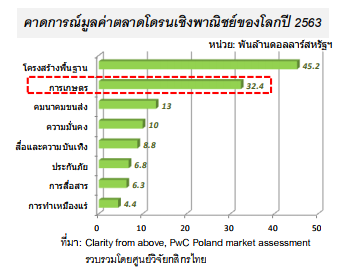 Drones are automated aircraft that can currently be seen in the skies. They can be utilized for various purposes, such as surveying gas pipelines, collecting weather data, monitoring traffic, transporting goods, capturing aerial images or events, and exploring agricultural and irrigation areas. It is estimated that by 2020, the global commercial drone market could be valued at around $127 billion or 4.4 trillion baht, with agricultural drones expected to hold the second-highest market value at approximately $32.4 billion. In countries with advanced agriculture, drones are expected to be more affordable.
The operation of drones can be categorized into three types:
1. Multirotor UAVs are the most commonly seen type, known for their quick and agile movement, available in 4, 6, and 8 propeller configurations. They do not require a runway for takeoff but have the drawback of lower flight speed compared to other types, capturing a market share of up to 77%.
2. Fixed-wing drones operate similarly to airplanes and require a runway. These drones can fly longer and faster, making them suitable for surveying large areas, capable of carrying heavier loads over long distances while using less energy.
3. Hybrid models (tilt-wing) can fly faster, farther, and more efficiently than fixed-wing drones without needing a runway, but they are less common in the global market.
(Data from PwC)
They can be used to survey large agricultural areas, analyze soil, plant seeds, and accurately predict harvest times. With the ability to create three-dimensional (3D) maps, operators can analyze and plan their cultivation more easily, indicating a positive trend in the future demand for agricultural drones.
In Thailand today, agricultural drones are increasingly playing a role in precision farming, such as:
- Watering, hormone application, and foliar fertilization to overcome the limitations of tall plants that make it difficult for farmers to irrigate thoroughly. Foliar fertilizers should ideally be applied between 6:00-7:00 AM, a time when plants are opening their stomata, allowing them to absorb nutrients directly through the leaves without going through the roots. This process needs to be done quickly, making drones more time-efficient than manual labor. Additionally, for shorter plants like rice, it prevents farmers from trampling the crops and causing damage.
- Image analysis and disease detection, allowing farmers to treat plant diseases more precisely by using drones to spray solutions directly onto affected areas. One drone can cover 100-200 rai of crops such as rice, cassava, and sugarcane in a day, requiring only 1-2 operators, whereas manual labor would need 10-20 workers. Moreover, using drones reduces the dispersion of chemicals that farmers might otherwise inhale or come into contact with while spraying.
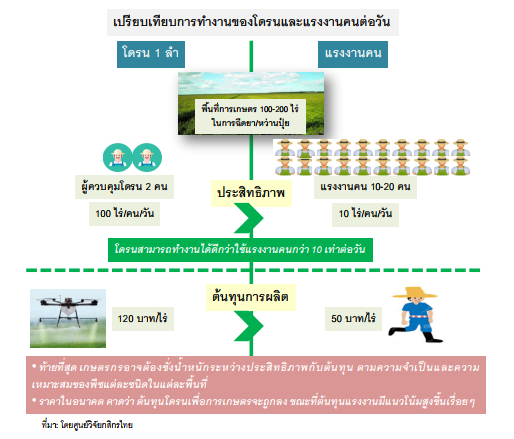
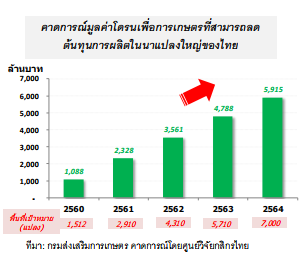
The Kasikorn Research Center estimates that if Thailand adopts agricultural technologies like drones in accordance with the government's large-scale farming policy initiated in 2017, farmers could reduce production costs by approximately 1.1 billion baht, with expectations to lower costs by over 6 billion baht in the next four years.
The results of the large-scale farming promotion project as of April 2017 included 1,175 plots, accounting for 77.7% of the total target area for 2017 (Source: Department of Rice).
In the next four years, the estimated reduction in production costs is based on the assumption of targeting 1,512 plots in 2017 and 7,000 plots by 2021, including the depreciation costs of the drones. It is also anticipated that in the future, drones will increasingly be used as part of agricultural tools, with the aforementioned cost reductions based on the assumption that farmers can participate in the large-scale farming project and that the areas using drones are adequately prepared. However, there may be practical limitations regarding the large-scale farming areas, as they must be of suitable size, owned or leased with proper documentation, or authorized for use by relevant agencies. Most farmers are smallholders renting land, which may lack proper documentation, posing a significant barrier to full participation in the large-scale farming project.
Although the use of agricultural drones in Thailand is not yet widespread, it is expected that in the future, the prices of agricultural drones will decrease due to competition among various manufacturers. Coupled with the increasing popularity of drones among farmers and entrepreneurs as labor-saving tools, along with the trend of technology products generally decreasing in price as technology advances, the Kasikorn Research Center estimates that in the next five years (by 2022), the prices of agricultural drones may drop by about 20-25% per year, ranging from 67,000 to 106,000 baht, down from the launch prices of 300,000-500,000 baht in 2015.
The government supports agricultural technologies like drones for participants in the large-scale farming project. However, most farmers still engage in small-scale farming, making them ineligible for support. Additionally, investing in such technology for small-scale farms may not be cost-effective. Therefore, if farmers' land is suitable and meets the characteristics of the government's large-scale farming project, they may consider forming groups.
Currently, Thailand can produce agricultural drones for its own use, developed by private companies and educational institutions in collaboration with private firms for tasks such as fertilizing, seeding, and spraying pesticides in five main economic crops: rice, cassava, corn, sugarcane, and pineapple.
These drones can seed, fertilize, and spray pesticides, serving as representatives for analysis. Agricultural drones come in various price ranges depending on their operational efficiency and functionalities.
To align with the government's large-scale farming strategy, the government should also enhance understanding of technology and farmer participation to facilitate acceptance of technological changes. Furthermore, the government should consider the cost-effectiveness of investing in technology adoption.
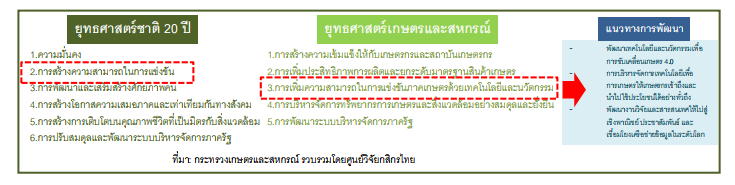
The Ministry of Agriculture and Cooperatives recognizes the challenges farmers face in accessing technology and has set goals for agricultural technology access in its 20-year agricultural and cooperative strategy (2017-2036) to enhance the competitiveness of the agricultural sector.
The implementation of large-scale farming from 2017 to 2021 aims for targets of 1,512, 2,910, 4,310, 5,710, and 7,000 plots, respectively (Source: Agricultural Promotion Department).
Technology and innovation, including operational guidelines and various indicators, align with the 20-year national strategy (2017-2036) to build competitiveness. However, in the initial phase of technology adoption, farmers may need to prepare and invest upfront, such as assessing soil/water conditions and adjusting plot areas. They will also require expert guidance, which may involve collaboration between the government and private sectors to facilitate farmers' access to government-supported technology.
Thank you for the information from www.kasikornresearch.com