The Next Step Towards Urban Reform: The Role of UrbanTech in ASEAN and Developing Countries
Urbanization, or the expansion of urban society, is one of the world's significant "megatrends" resulting from the gathering of large populations into major urban communities or the spread of urban prosperity from central cities to other areas. This phenomenon has fundamentally changed the lifestyles of people, as well as the patterns and development of economic and social structures.
According to data from the United Nations, the world is rapidly transitioning to an urban society, partly due to the increasing global population. It is projected that in the next 30 years, there will be approximately 3 billion more residents in urban communities, a change that previously took 10,000 years to occur.
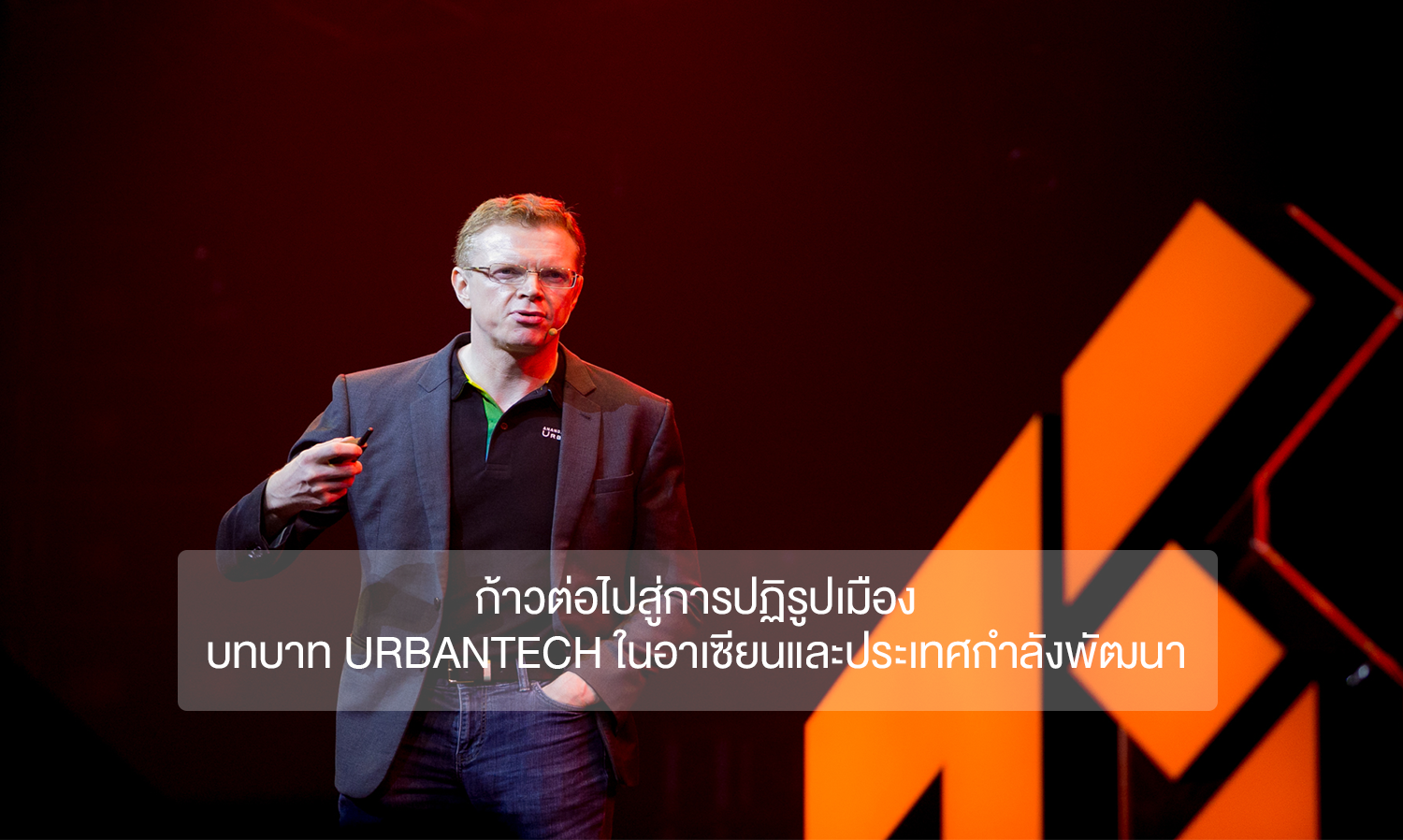
“The ongoing transition to urban society worldwide is one of the major challenges in the history of humanity,” said Mr. John Millar, Chief Strategy Officer of Ananda Development Public Company Limited, at the Techsauce Global Summit 2017.
In the 2015 ranking of urban societies by the CIA World Factbook, ASEAN countries were still at a low level of urbanization, ranking between 114 and 183 out of 199 countries worldwide. Indonesia has an urban population of 53.7%, followed by Thailand at 50.4%, the Philippines at 44.4%, Laos at 38.6%, Vietnam at 33.6%, and Cambodia at 20.7%. However, urban development in these countries is now progressing rapidly, especially in Thailand's neighboring countries such as Laos, Cambodia, and Myanmar.
Urban Expansion + Technology = Opportunity
The emergence of Urbanization coinciding with unprecedented technological changes presents Ananda with an “opportunity” to equip ourselves with tools to tackle various challenges. Similarly, in the real estate industry, Ananda has redefined itself as an UrbanTech Solutions Company, moving away from traditional real estate models.
UrbanTech refers to solving urban problems through new innovations and technologies. These innovations are not limited to construction, finance, or marketing but also cater to the lifestyle needs of urban residents.
Interpreting innovation through outdated perspectives may lead to being unprepared for the world of “disruption.” Companies that fail to keep pace with these changes will inevitably fade away over time. Data from Stanford Business School indicates that the lifespan of leading U.S. companies is decreasing from a previously predicted 90 years to just 15 years, aligning with the survival rate of the Fortune 500 companies, where only 37% survived from 1957 to 1997.
Furthermore, new economic concepts such as the “Sharing Economy,” which arises from shared resource utilization, have led to new business models that cater to the daily lives of people. This concept has been adapted to create UrbanTech, which is central to Ananda's business transformation.
UrbanTech Transforms Business Models
Just as business models must evolve, consumers no longer need to pay higher prices for convenience. They do not have to buy condos near the subway to avoid traffic; instead, they can purchase homes in suburban areas and call for a self-driving car to pick them up when they reach the ground floor. This concept of disruption has reduced living costs. In the U.S., the cost of travel per mile has been calculated, revealing that taxis are the most expensive at $2.5 per mile, followed by Uber at $1.8, and self-driving cars at $0.3. This means that instead of buying an expensive condo in the city, urban residents can opt for larger suburban homes and use self-driving services, which are significantly cheaper. This has prompted Ananda to shift its perspective on real estate development to meet the future lifestyle of consumers.
“UrbanTech is the greatest opportunity in history to benefit the greatest number of human beings”, Mr. Millar stated.
Ananda aims for technology company-like growth, targeting a tenfold increase in the next two years since its initial public offering in 2012, from approximately 5,000 units to 58,000 units. It is projected that 2017 will be a pivotal year for Ananda, aiming for a 69% growth compared to the previous year, with innovation and technology being key to achieving this goal.
Emphasizing the “Startup” Model as Today’s Era Requires “Speed”
The idea of doing everything in-house is now considered outdated. The pharmaceutical industry was the first to adopt the outsourcing model to “lean organizations” for operational agility and enhance the capabilities of experts with funding. Companies now serve merely as a “Platform” to support marketing, funding, and sales. Similarly, Ananda has shifted its business management approach from “development” to “innovation discovery,” from “asset management” to “access management” to find the best solutions to meet customer needs ahead of competitors.
“In the modern business world, we believe that what matters is not ownership but how fast we can move”, Mr. Millar concluded.
Thank you for the information from techsauce