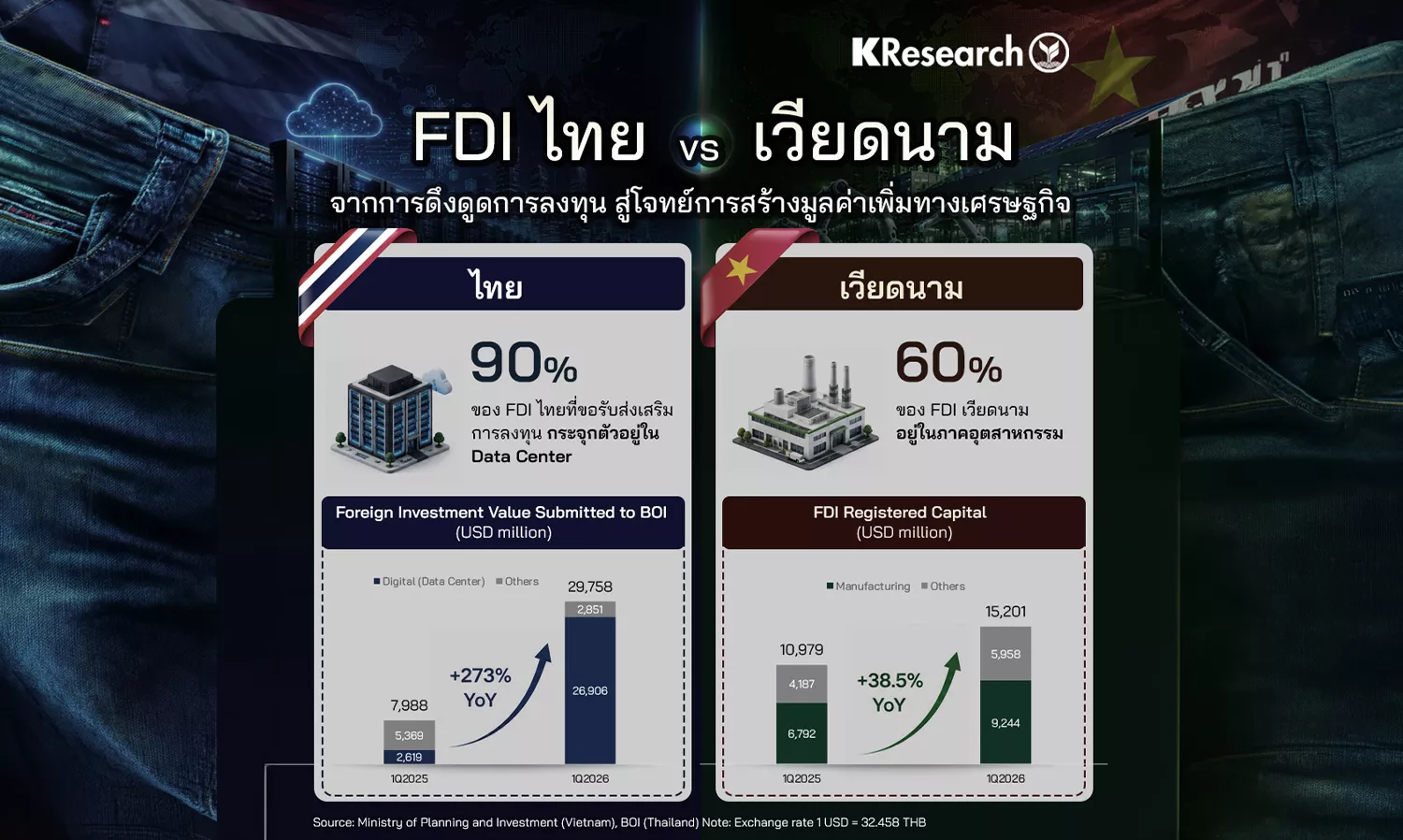
Thailand vs Vietnam in FDI: From Attracting Investment to the Challenge of Creating Economic Value (Kasikorn Research Center Infographic)
• Vietnam is one of the most successful countries in attracting FDI in the ASEAN region, as evidenced by the continuous increase in FDI value from approximately $8 billion in 2010 to nearly $22 billion in 2025. In contrast, Thailand, despite having an FDI of nearly $19 billion in 2025, has experienced more volatile growth, particularly during the COVID-19 crisis in 2020 when Thailand faced capital outflows due to the sale of retail businesses.
• The structure of FDI has played a significant role in promoting Vietnam as a global manufacturing hub and has helped develop the Vietnamese economy in the long term. In the first quarter of 2026, Vietnam's registered capital FDI reached $15 billion, a 38.5% year-on-year increase, with over 60% of this value concentrated in the manufacturing sector, particularly in electronics, electrical appliances, and technology products. This sector creates a large number of jobs, facilitates technology transfer, and supports the development of domestic supply chains.
• Thailand's FDI is increasingly concentrated in the digital business sector. Although Thailand had a high value of foreign investment promotion applications amounting to 970 billion baht ($29.8 billion) in the first quarter of 2026, a 273% year-on-year increase, over 90% of this value is concentrated in Data Centers and digital infrastructure. This reflects Thailand's new potential to become a digital economic hub in the region amid the growing global demand for investment in AI, Cloud Computing, and digital services.

• However, while Data Centers generate significant investment, their direct impact on economic growth may be more limited compared to the manufacturing sector, as they rely heavily on imported machinery and equipment, have relatively limited direct employment, and are less connected to domestic operators than the manufacturing sector.
• Therefore, a key challenge for Thailand moving forward is to leverage investments in Data Centers to enhance the country's digital infrastructure and connect it to attracting investments in other economic sectors, particularly through the application of digital technology in manufacturing, such as Smart Factories, automation, and AI in industry. This will help increase productivity, create high-skilled jobs, and enhance the country's long-term competitiveness. Additionally, it will serve as a crucial foundation for developing a Digital Transformation Ecosystem and supporting investments in high-value-added technology and electronics industries in the future.