
Global Urea Fertilizer Prices Surge Due to Iran War, Pressuring Rice Cultivation, Expected to Reduce Production by Over 21% (Kasikorn Research Center Infographic)
- Global urea fertilizer prices have surged to a 43-month high of $750 per ton in March 2026 due to the closure of the Strait of Hormuz, increasing the risk of fertilizer shortages and rising prices worldwide. The Strait of Hormuz, a key global shipping route, has been disrupted, with over one-third of urea produced in the Middle East, which is also the world's largest exporter, accounting for over 26% of global supply.
- Thailand must import expensive urea fertilizer in line with global market prices and faces the risk of shortages, as the country relies entirely on imports. Urea fertilizer is a key input for Thai agriculture to boost crop yields, with over 50% of all chemical fertilizers imported, primarily from the Middle East, making up over 55% of imports.
- It is expected to impact the rice planting season from May to July 2026, coinciding with the critical period for planting rice, which requires a large amount of fertilizer. Coupled with rising production costs due to high fertilizer prices, this could lead to a 21% decrease in production, while rice prices are expected to rise by 2%, resulting in an overall 19% decrease in farmers' income.
The global urea fertilizer prices are once again becoming a significant pressure on the agricultural sector, as the tension from the Iran war affects major global shipping routes, particularly the Strait of Hormuz, a crucial strategic point for energy and commodity transportation. As shipping begins to face uncertainties, global urea fertilizer prices have surged to $750 per ton in March 2026, the highest level in 43 months, reflecting a 55% increase since before the war.
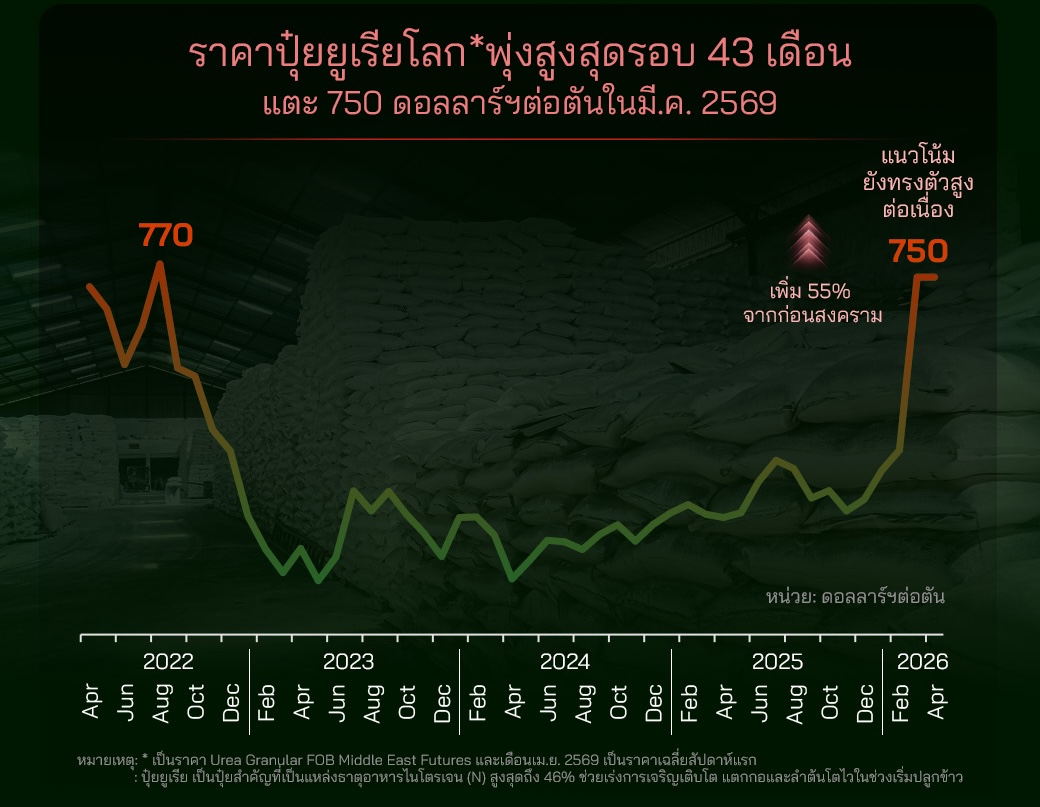
This issue does not only affect the global market but also sends shockwaves directly to the Thai agricultural sector, as Thailand still relies entirely on imported urea fertilizer at global market prices. Urea fertilizer is a crucial production factor in agriculture, especially for planting crops and rice, which require a significant amount of fertilizer during the initial planting phase. In Thailand's chemical fertilizer usage structure, urea accounts for over 50% of imports, with more than 55% coming from the Middle East.
The vulnerability lies not only in the "rising prices" but also in the "risk of shortages." The Middle East is a major global urea fertilizer production source, accounting for more than one-third of total production and being the world's top exporter with over 26% of the market share. When uncertainties arise in the source regions, the impacts inevitably ripple through to countries like Thailand that rely heavily on imports.
What is concerning is that this surge in fertilizer prices coincides with the start of the rice planting season from May to July 2026, a period when farmers need to use fertilizer at a rate of about 82% during the tillering and flowering stages. This means that production costs will immediately increase at a critical juncture in the planting season, and since fertilizer constitutes about 13% of total costs, the rising fertilizer prices are not a minor burden but a significant pressure affecting both production and farmers' income.
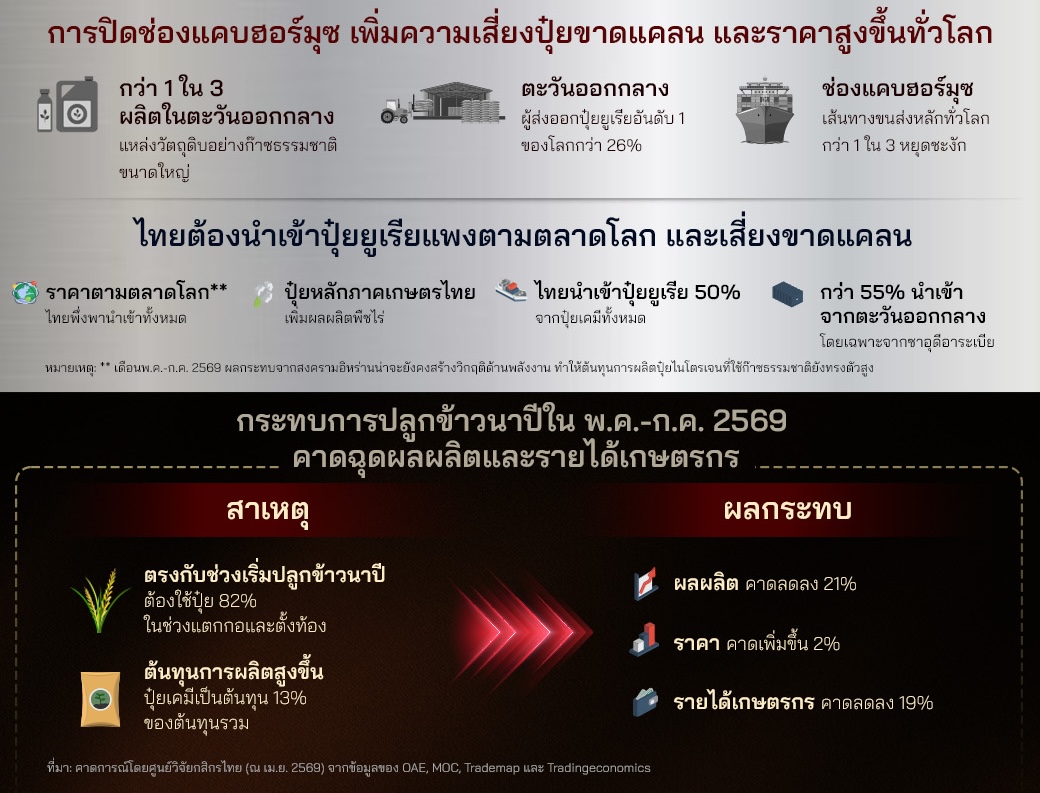
The Kasikorn Research Center estimates that this situation could lead to a 21% reduction in rice production. Although rice prices are expected to rise by 2%, this increase is still insufficient to fully offset the higher costs, resulting in an overall potential 19% decrease in farmers' income. This scenario clearly illustrates that in agriculture, a "slight increase in selling prices" does not necessarily mean "improved income" if production costs rise significantly.
On a deeper level, this event underscores the structural issues within the Thai agricultural sector, namely the high dependence on imported production factors. When geopolitical crises or transportation issues arise, Thailand has little bargaining power and must absorb the full impact of global market fluctuations in terms of both prices and supply continuity.
This urea fertilizer crisis is not merely news of rising agricultural product prices but a warning signal about the fragility of Thailand's food production system in an increasingly interconnected world. Every conflict occurring far away can quickly and severely impact costs on Thai farmland, often more than many anticipate.