Real Estate Battle of 2025 Heats Up! Sansiri Overcomes Adverse Factors to Achieve Record Profit of Over 4.5 Billion Baht, Eyes New Projects Worth Over 100 Billion Baht in 2026
The year 2025 has been another challenging year for the real estate market, particularly due to the potential decline in purchasing power among Thai consumers. While there are still some individuals looking to buy homes or condominiums, difficulties in securing housing loans have created significant obstacles in the transfer of ownership. Nevertheless, many developers have reported high revenues and profits, not differing much from the previous year.
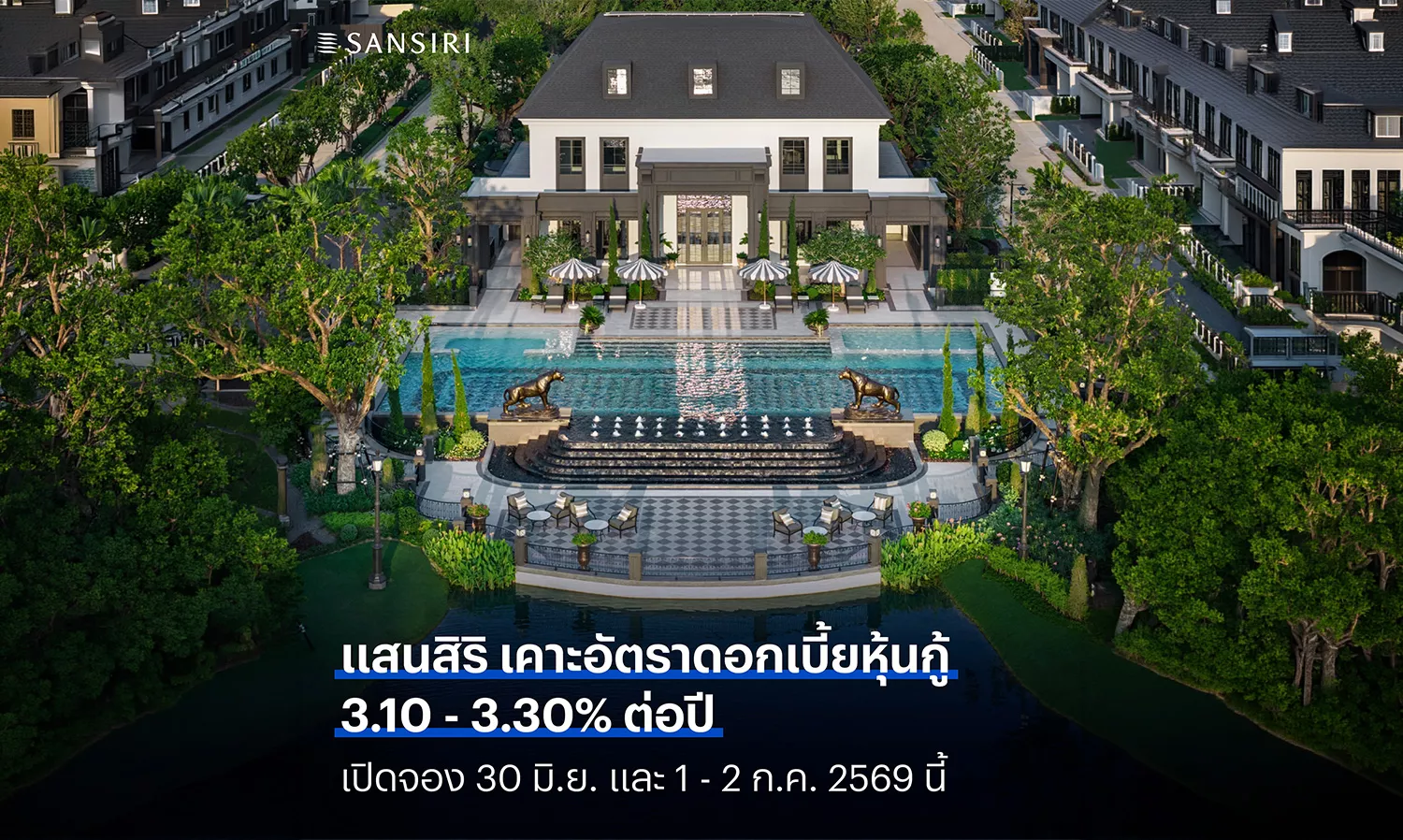
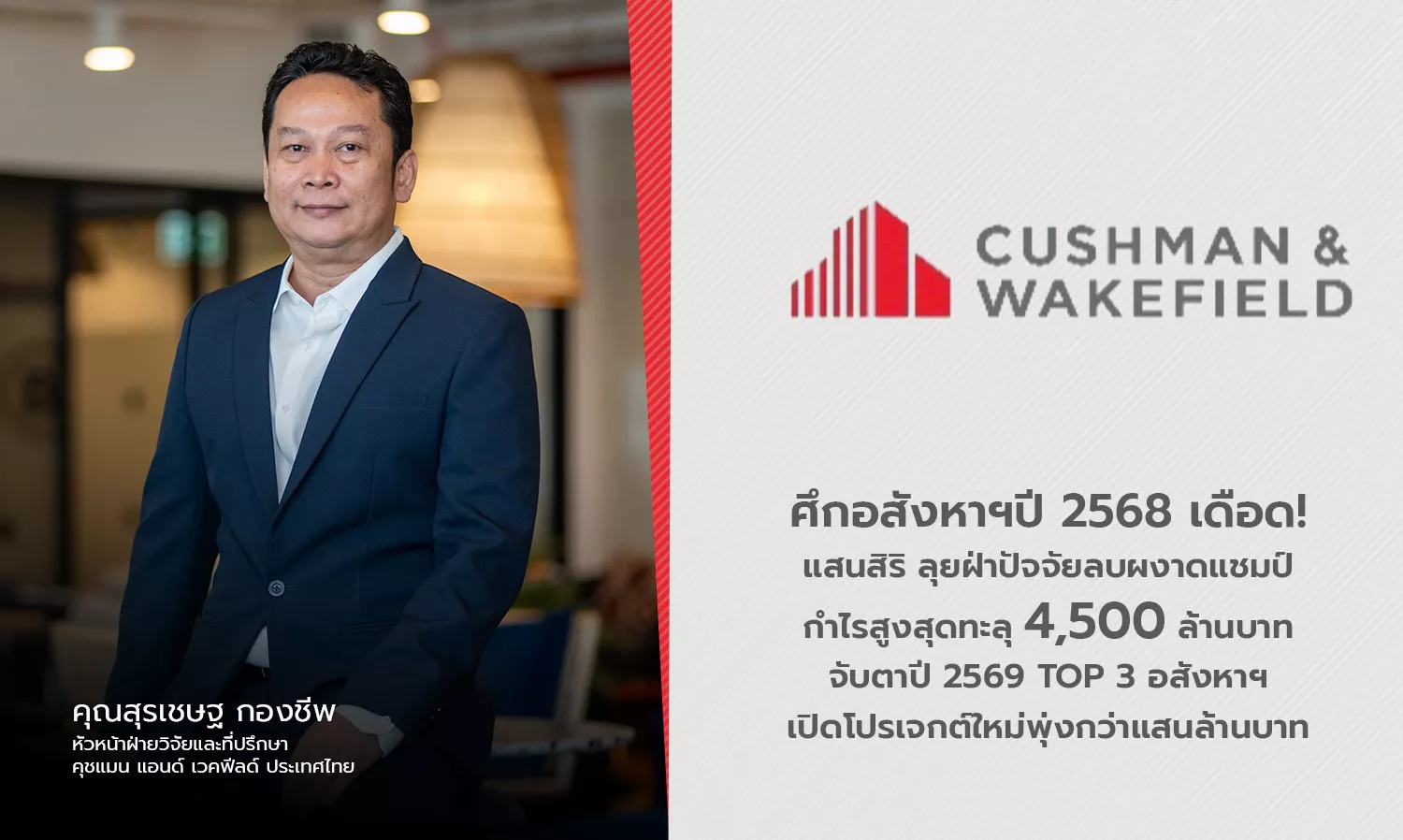
Surachet Kongcheep, Head of Research and Consulting at Cushman & Wakefield Thailand, assessed the real estate market in 2025 as facing numerous challenges. Almost all developers experienced a decrease in net profit margins from sales. Sansiri claimed the top spot with a profit of 4.513 billion baht, the highest among property development companies, with total revenue of 34.395 billion baht and total sales for the year reaching 51 billion baht. Approximately 51% of sales came from housing projects, while 49% came from condominium projects, with ownership transfers amounting to around 36.7 billion baht. Despite the highly competitive housing market last year, Sansiri's brand confidence allowed it to achieve the highest profits and declare additional dividends, totaling 0.13 baht per share for 2025, including the interim payment made earlier in the year.
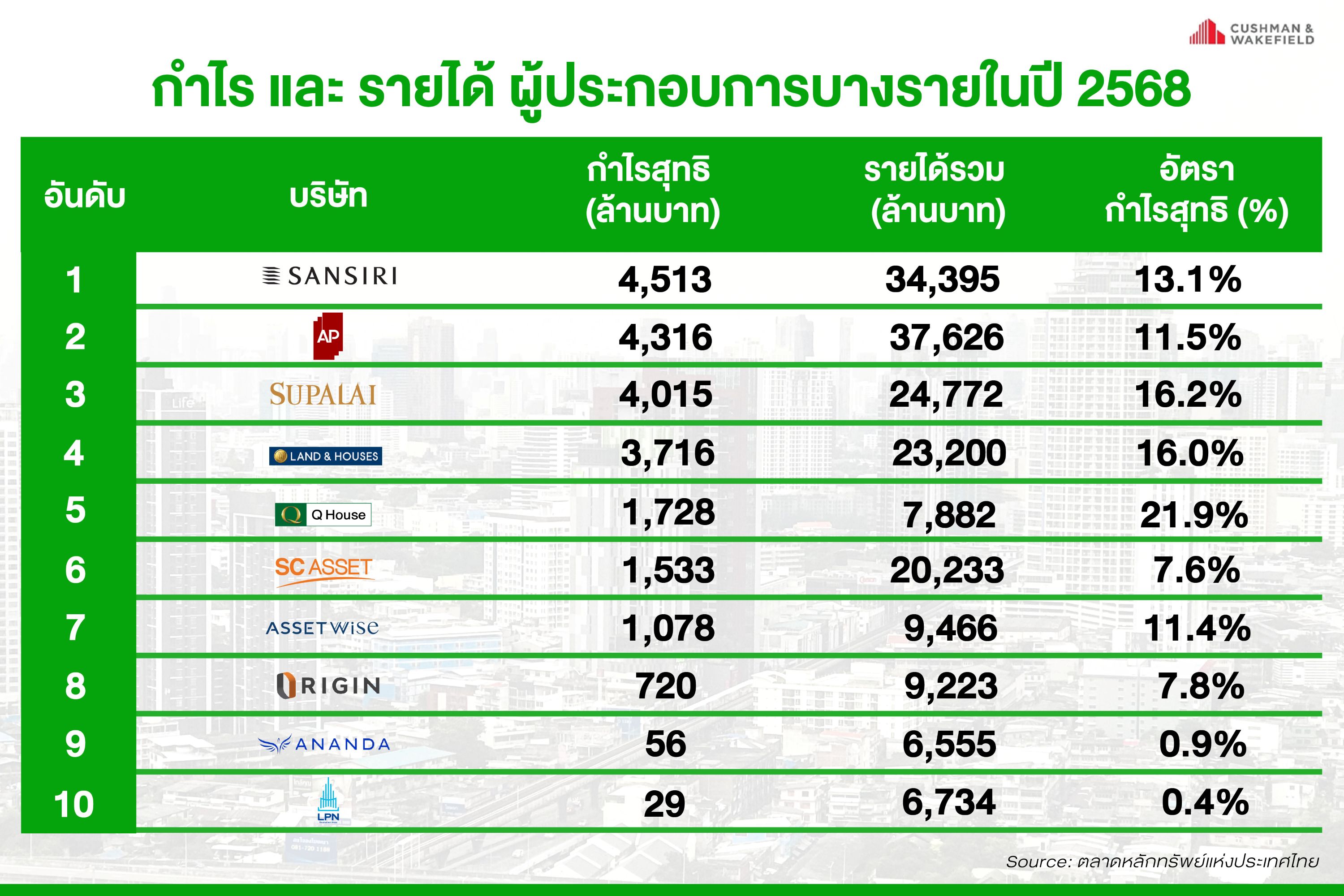
Meanwhile, AP (Thailand) ranked second with a profit of approximately 4.316 billion baht, a significant decrease from the previous year, followed by Supalai in third place with a profit of around 4.015 billion baht. All three companies primarily derive over 80% to 90% of their income from home and condominium sales, although they may have some revenue from other sources.
Additionally, it is noteworthy that the net profit after tax for most developers decreased by over 20% compared to the previous year (YoY). Only three companies saw a decline of less than 20%: SC Asset Corporation with a decrease of about 10%, Sansiri down 14%, and AP (Thailand) also down 14%. This indicates a highly competitive environment in the real estate sector throughout 2025.
Major developers like Sansiri, AP (Thailand), and Supalai continue to launch new projects in 2026. AP (Thailand) leads with the most new projects, totaling 42 with a combined value of 55 billion baht, while Sansiri has 33 new projects worth 51 billion baht, and Supalai has 28 new projects valued at 35 billion baht. These three major real estate companies alone account for over 100 billion baht in new investments for 2026. If we consider all companies in the industry, new project developments in 2026 could reach approximately 200 to 300 billion baht.
“The year 2026 may not be as challenging, and the competition in the real estate market may not be as intense as in 2025, as many developers are choosing to adapt their investment strategies to align with current economic conditions and the housing market. Most developers continue to launch new projects, although the number may not match the periods of strong economic expansion. However, this does not mean that developers will stop launching new projects altogether. Furthermore, most developers remain focused on transferring ownership and expediting sales of completed projects, similar to trends observed in the past 2-3 years. Although the housing market still lacks clear signs of expansion, there are better prospects than last year due to an improving economic outlook, declining interest rates, and an increase in foreign purchasing power, particularly among Chinese buyers. However, we may need to wait for a new government for clearer economic stimulus measures, including initiatives to boost purchasing power in the real estate market,” Surachet concluded.