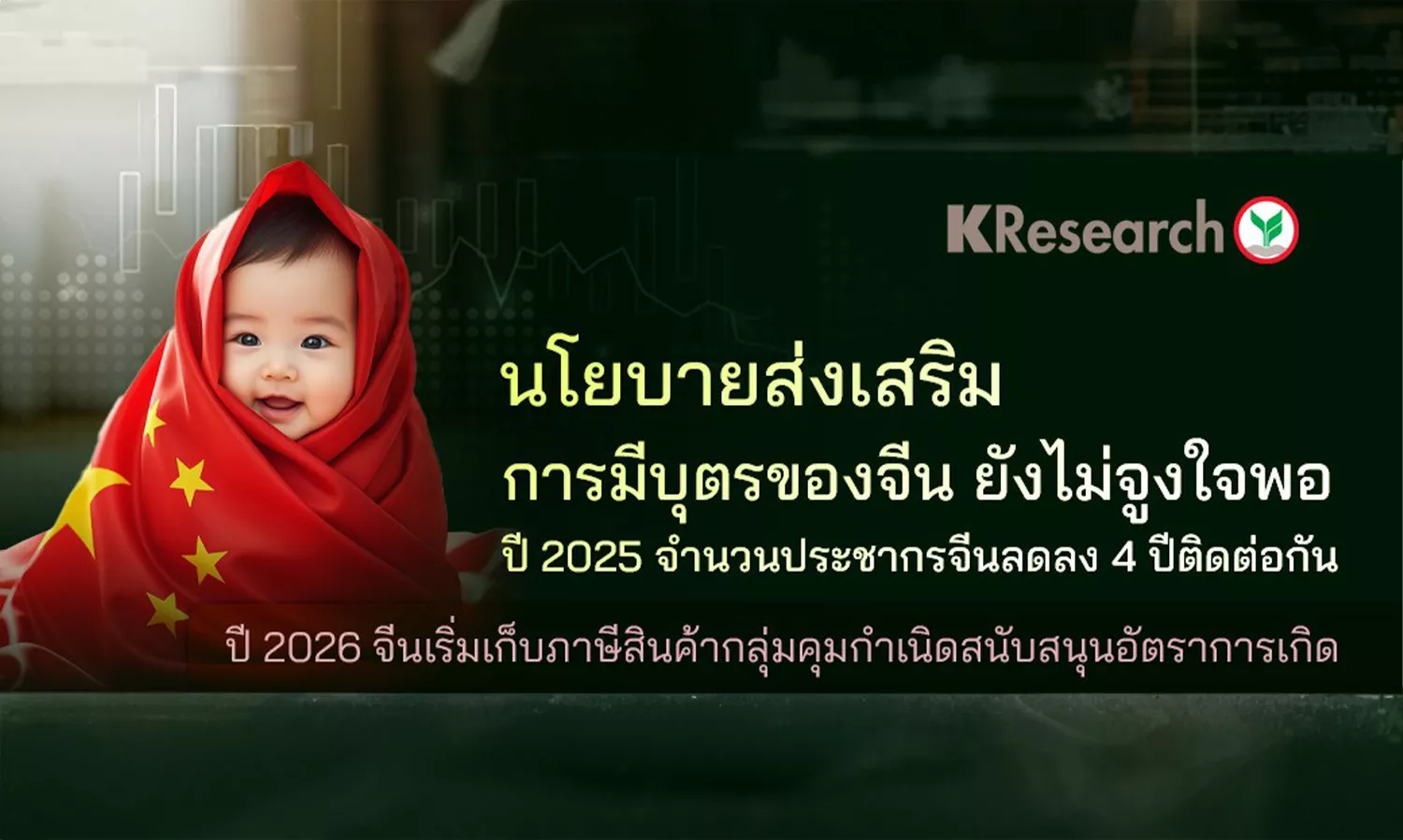
China's Childbirth Promotion Policy Still Lacks Incentives; Population Decline for Four Consecutive Years by 2025 (Kasikorn Research Center Infographic)
China's policy to promote childbirth has not significantly reversed the population trend, resulting in a continuous decline in the Chinese population for the fourth consecutive year by 2025. This reflects deeper structural limitations beyond short-term policies.
Despite China introducing financial incentives, such as subsidies for childcare for children under three years old, recent data indicates that the birth rate in 2025 is at a historic low. The main reasons remain high childcare costs, income instability, and housing burdens in major cities.
The idea of imposing a value-added tax on contraceptives in 2026 has been brought up for serious policy discussion, with an indirect goal of supporting the birth rate. However, many scholars and economic media in China believe that such measures may have limited effects and risk creating social backlash if not accompanied by a reduction in living costs.
The population decline is having a clear structural impact on China's economy, both in terms of a shrinking working-age labor force and the continuously increasing burden of elderly care costs, which will pressure the social security system and long-term growth potential. Overall, it reflects that mere "subsidies" are insufficient unless the issues of urban living costs, job security, and work-life balance are addressed. China's next policy direction is likely to shift from targeted measures to structural reforms, such as housing, dual-income families, and childcare systems.

Reliable sources:
– Kasikorn Research Center, Analysis of China's Economy and Population Structure
– National Bureau of Statistics of China, Annual Population and Birth Rate Data
– Reuters and Bloomberg, Reports on China's Population Policy for 2024–2025
– World Bank, Report on Aging Population and Labor Force in China