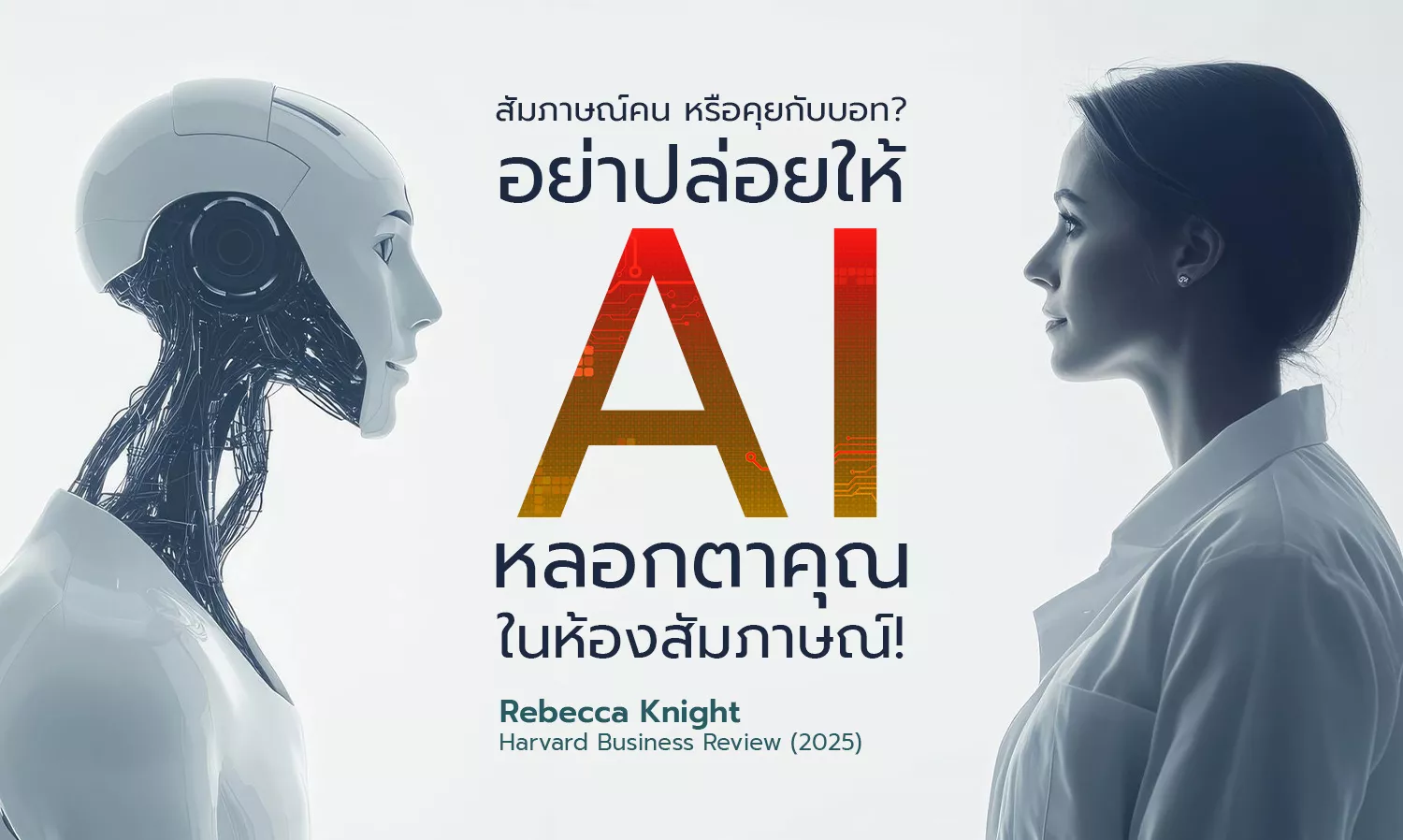
Interviewing a Person or Chatting with a Bot? Don't Let AI Deceive You in the Interview Room!
Have you ever felt a sudden "wait a minute" during a job interview? The candidate's answers seem too polished and flawless (perhaps too much), there’s a slight delay before they respond, or their gaze appears distant as if they are reading something. You might be wondering, "Am I talking to a person or am I chatting with ChatGPT?"
In an era where technology can help candidates prepare to the extent of "assisting with interview answers," organizational leaders face new challenges. Instead of trying to catch them out like a detective or asking them to share their screen to prove their authenticity (which might just create unnecessary distrust), Professor Tiziana Casciaro from the University of Toronto suggests that the goal should be to create an interview where "reading a script from AI will never work"
Here are 5 Human Skills that AI cannot replicate, and you should focus on to filter out the "real deal" for your team:
1. Game Reading and Social Cues
Even if a candidate seems nervous and appears to be using AI, what AI cannot do is "emotional intelligence" (EQ).
-
Technique: Start with casual conversation to observe their normal speaking style.
-
Gauge: Try changing your tone, gestures, or gently challenge their answers to see if they notice and adapt to the situation. Those with high EQ will read the atmosphere and respond naturally.
2. Critical Thinking and Data Linking
Anyone can use AI to help think, but the "thinking method" cannot be copied.
- Technique: Avoid asking general knowledge questions like "What do you know about X?" Instead, ask "How would you handle this situation?"
-
Gauge: Present a complex problem with no definitive answer. Candidates who can think critically will demonstrate logic, connect information, and build on ideas, while those relying on AI will merely repeat what AI has told them.
3. Sharp Questioning (Curiosity)
Assess candidates by observing what they are "curious" about.
- Technique: Give them ambiguous or incomplete tasks, such as "How would you close the month-end accounts?" or "How would you create a Data Pipeline from A to B?"
-
Gauge: If they respond with broad patterns, it indicates they’ve read a script. However, if they "ask back" for more information or delve into details, that’s a sign of a real worker who can think critically.
4. Adaptability in Challenging Situations
Observe their reactions when the conversation strays from the prepared script.
-
Technique: Surprise them by asking to share their screen and explain past work, projects, or code they’ve written, or directly ask, "How often do you use AI?"
-
Gauge: A seasoned worker won’t panic; they can explain their thought process and decision-making on the spot. Questions about AI usage will reveal whether they understand its limitations and how to use the tool wisely.
5. Collaboration and Problem-Solving (Collaboration) Group Interviews are the Bitter Pill for AI Users
-
Technique: Conduct interviews with multiple candidates via Video Call and give them a task to solve together.
-
Gauge: In a fast-paced and fluid conversation, AI will struggle to keep up. You will see who is a good listener, who helps build on others' ideas, and who tends to talk over others. These relationship management skills are crucial in real work environments.
Don’t fear that candidates will use AI; instead, shift your perspective to "If your interview can be passed by a Chatbot, that’s not the candidate's fault... it’s your problem!" It’s time to revolutionize job interviews to seek skills that AI can never replace in humans.