Growth Direction of Real Estate Investment Trusts (REITs)
Currently, over 40 countries around the world have laws supporting the establishment of Real Estate Investment Trusts ("REITs"), reflecting their appeal as a source of funding for property owners and an investment option for investors. REITs have been around for more than 60 years, first emerging in the United States. Countries with high economic growth, such as India and China, only introduced REIT legislation in 2019 and 2020, respectively.
The benefits of REITs meet the needs of property owners by allowing income-generating properties (Recurring income property) with a proven track record to be included in the REIT, enabling them to access capital for purposes such as debt management, business expansion, or realizing profits from sales. For investors, investing in REITs offers distinct advantages compared to other investment forms, such as:
- REIT income primarily comes from rent, which tends to increase with inflation, making REIT investments a form of inflation protection, unlike bonds.
- Regular rental income is generally less volatile than corporate earnings, and REITs distribute at least 90% of their net profits as dividends, unlike equities or common stocks.
- REITs offer liquidity in trading units on the stock exchange and can be invested in with relatively low initial amounts, unlike direct real estate investments.
However, not all REITs are equally attractive in the long term. REITs that can develop and adapt are likely to attract long-term investor interest. Globally, REITs are undergoing significant changes in four main areas, although the importance of each factor may vary by market:
- REITs are increasingly focusing on specialized real estate investments rather than diversified ones, reflecting expertise in specific property types.
- REITs are likely to expand in scale by investing in additional assets for portfolio diversification, increasing trading liquidity to attract investors, especially institutional ones, and achieving economies of scale, which may include accessing loans at lower costs than smaller funds.
- REITs that embrace innovation, such as data centers or properties with modern management practices (e.g., automation to reduce energy costs, touchless entry systems), can lower management expenses and enhance competitiveness.
- REITs that prioritize sustainability, with management and investment strategies considering environmental, social, and governance (ESG) factors, are increasingly valued by financial institutions and investors, particularly institutional ones.
Main Trends (Megatrends) of REITs and Listed Real Estate in Each Market
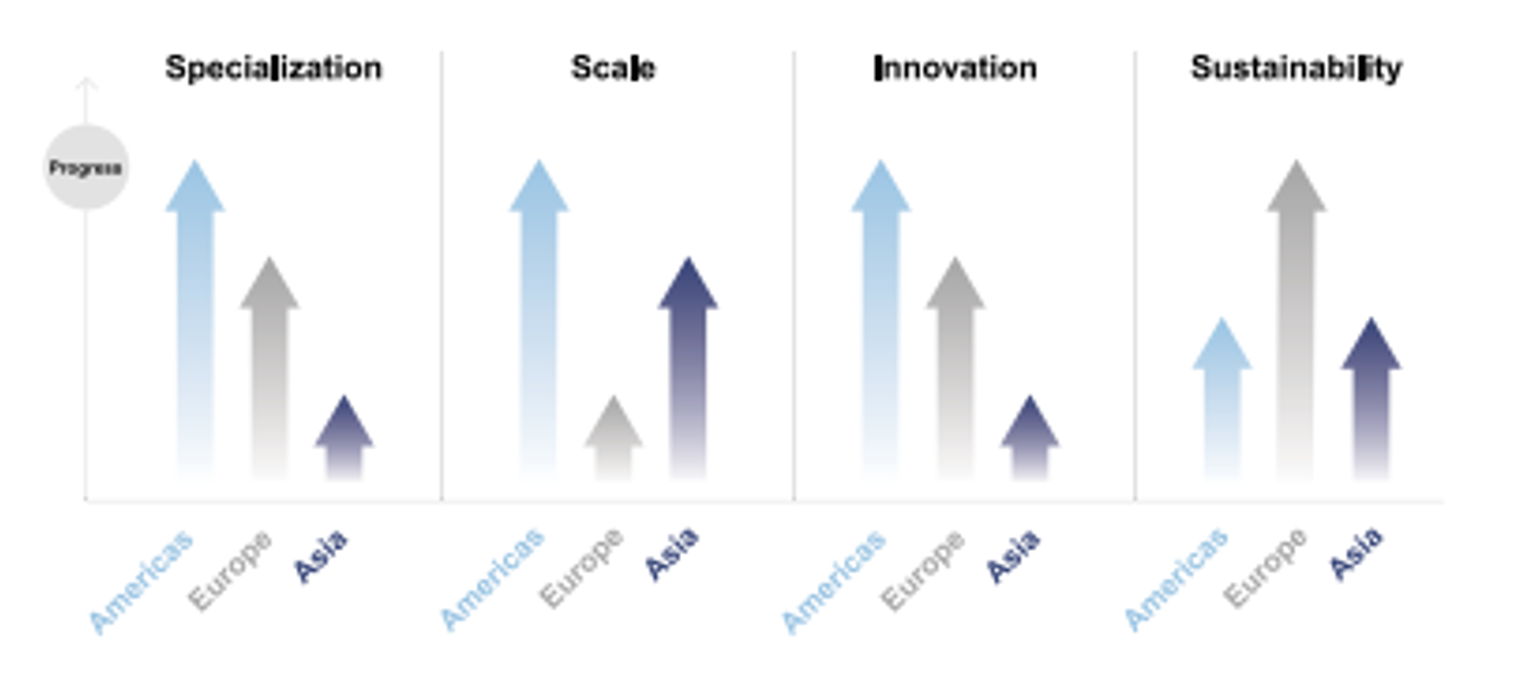
Source: FTSE Russell, EPRA, NAREIT (Data from 2025)
From the above data, the REIT market in America emphasizes growth in nearly all areas but places less importance on sustainability compared to the European market. Meanwhile, the Asian market focuses on scaling and enhancing sustainability. In Thailand's REIT market, most REITs tend to specialize in specific property types (Specialized REITs) or have a primary property type, such as CPNREIT and ALLY (retail REITs), WHART and FTREIT (industrial REITs), and may face limitations in adopting innovations based on property type and the structure of benefits. For instance, some REITs receive fixed rents even if innovations are implemented in the properties. Therefore, REITs that have growth potential, prioritize sustainability, and maintain good performance with consistent returns are likely to attract investor interest.