An Alternative Investment in Diversified Real Estate Investment Trusts (Diversified REIT)
When investing in real estate mutual funds and real estate investment trusts ("REITs"), one of the first questions investors often consider is the type of property the REIT invests in, whether it be shopping malls, office rentals, warehouses, or hotels, as each type may yield different returns based on the business conditions of that property type.
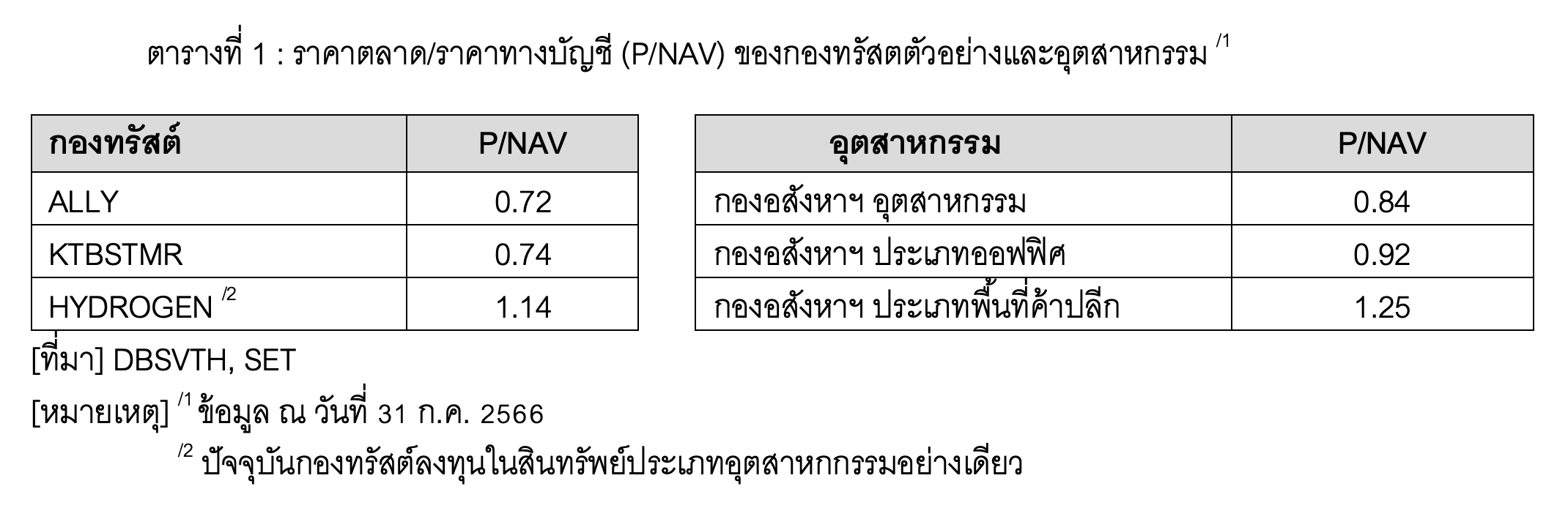
Investors may notice that most REITs in the market tend to focus on one specific type of property (Specialized REIT), such as WHART, which focuses on warehouse rentals, or LHHOTEL, which focuses on hotels. However, there are no strict rules dictating that a REIT must invest in only one type of property, leading to the emergence of real estate trusts with policies to invest in multiple property types (Diversified REIT). In the market, there are funds that invest in various property types, such as ALLY, KTBSTMR, and Hydrogen REIT, which include multiple property types in their portfolios.
When comparing investments in Diversified REIT to Specialized REIT, there are advantages and disadvantages as follows:
Advantages of Diversified REIT:
- Reduces reliance on income from any single type of property.
- Increases opportunities for rapid growth as it can invest in a variety of properties.
- In cases where investments are made in multiple property types within the same project (Mixed-use development) or in the same area, management costs may be reduced due to economies of scale or synergy. For example, a project may include both a hotel and a shopping mall, where the mall attracts customers to book the hotel, while hotel guests help generate traffic for the mall. Additionally, both areas may engage in joint promotions and marketing.
Disadvantages of Diversified REIT:
- Limits the choice of property types for investors, especially institutional investors who often adjust their investments based on the market conditions of those properties at different times. For instance, an investor may prefer hotels but not office rentals, yet a diversified REIT invests in both types, leading the investor to consider investing in a specialized REIT focused solely on hotels.
- Creates challenges in analyzing and comparing investment returns. For example, if a Hotel REIT and an Office REIT in the market yield returns of 8% and 7% respectively, an investor in a diversified REIT must analyze returns in comparison to both property types.
- The investment in multiple property types by a Diversified REIT may raise questions about the expertise of the management team in effectively managing all types of properties. For example, CPNREIT invests in rental factories, while WHA's REIT invests in shopping malls.
Regardless of whether it is a diversified REIT or a specialized REIT, each has its own advantages and disadvantages as mentioned above. The performance of diversified REITs tends to be less volatile than that of specialized REITs. For instance, currently, office buildings face high competition while warehouses still have strong demand, making diversified REITs that include both types likely to achieve more consistent performance. However, they may also suffer from lower popularity among investors, resulting in market prices that may be lower compared to their book value.