Real Estate Market Slows in First Half of the Year, Hopes for Government Measures to Stimulate Second Half
Mr. Pornariss Chuanchaisit, President of the Thai Real Estate Association, revealed that the real estate market in the first quarter of 2023 is experiencing a slowdown in both sales and new project launches. This is due to buyers waiting for measures to reduce transfer and mortgage fees, as well as the temporary relaxation of LTV regulations by the Bank of Thailand. Additionally, financial institutions have become stricter in granting housing loans, leading to a decline in sales in the mid to lower-end housing market. The launch of new projects, both condominiums and housing estates, has decreased due to ongoing economic uncertainty and rising household debt, causing developers to delay investments in real estate.
For the second quarter of 2023, projects priced at 7 million baht and above are showing positive trends due to the relaxation of LTV regulations to 100% for properties priced at 10 million baht and above.
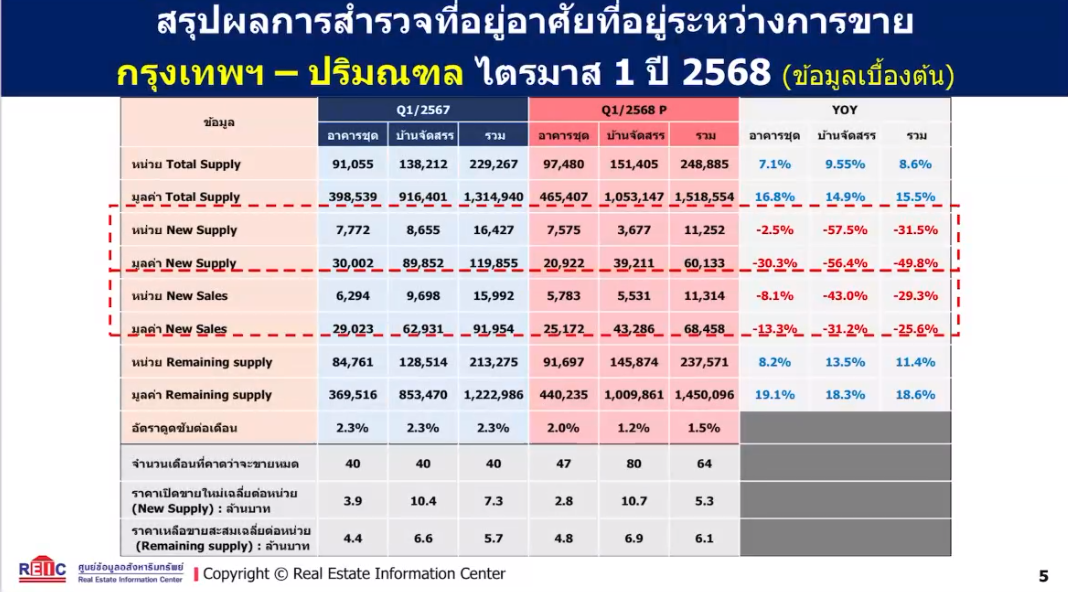
Top 5 Best-Selling Housing Estate Locations Q1/2023
The locations with the highest sales are mostly in the outskirts of Bangkok. The top spot is “Bang Phli–Bang Bo–Bang Sao Thong” with 827 units sold and an absorption rate of 1.6% per month, reflecting strong demand and the area's potential due to convenient transportation and urban expansion. Meanwhile, “Khlong Samwa–Min Buri–Lat Krabang” has lower sales but the highest absorption rate at 1.7% and the lowest months of supply at just 56 months, indicating fast-moving products and continuous buying demand.
Overall, the housing estate market has an average absorption rate of only 1.2% per month, with over 145,000 units remaining for sale, which is considered high. Competition in the market remains intense, especially in areas with a large number of unsold units, such as “Bang Yai–Bang Bua Thong–Bang Kruai–Sai Noi,” which has the highest supply of over 20,000 units.
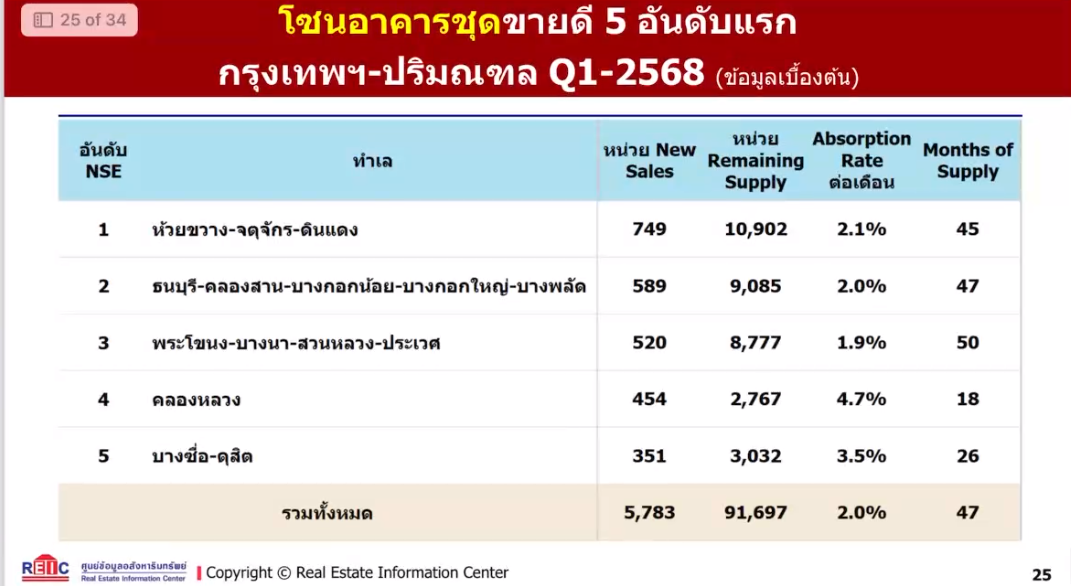
Top 5 Best-Selling Condominium Locations Q1/2023
The condominium location with the highest sales is “Huai Khwang–Chatuchak–Din Daeng” with 749 units sold and an absorption rate of 2.1% per month, which is above the market average, indicating stable demand in the city center and areas with convenient transportation connections. The locations “Thonburi–Khlong San–Bangkok Noi–Bangkok Yai–Bang Phlat” and “Phra Khanong–Bang Na–Suankluai–Prawet” also have similar absorption rates (2.0% and 1.9%), reflecting ongoing popularity in the western and eastern parts of the city with growth potential. Notably, “Bang Sue-Dusit” has the lowest sales among the top five but boasts an absorption rate of 3.5% and the lowest months of supply at just 26 months, indicating strong demand in this area, possibly related to infrastructure development projects like Bang Sue Grand Station and surrounding urban development.
Should LTV Measures be 'Temporarily Relaxed' or 'Permanently Unlocked'? Mr. Pornariss Chuanchaisit stated that looking back to 2003, before the LTV measures were implemented, the real estate market experienced speculation and cash-back loans, leading to artificial demand and a bubble in the real estate business. However, currently, speculation has decreased, and from the perspective of operators, the Bank of Thailand can adjust LTV according to the market situation at that time.
Currently, over 60% of property transfers are for second-hand condominiums, while new projects account for less than 40% due to reduced purchasing power as banks tighten loan approvals.
What is the Situation for the Second Half of the Year? With measures to reduce transfer and mortgage fees and the temporary relaxation of LTV regulations effective from May 1, 2023, to June 30, 2024, along with the easing of earthquake impacts, it is expected that the situation will improve. However, challenges remain due to economic issues and rising household debt, making it difficult for banks to grant loans, which affects purchasing power.