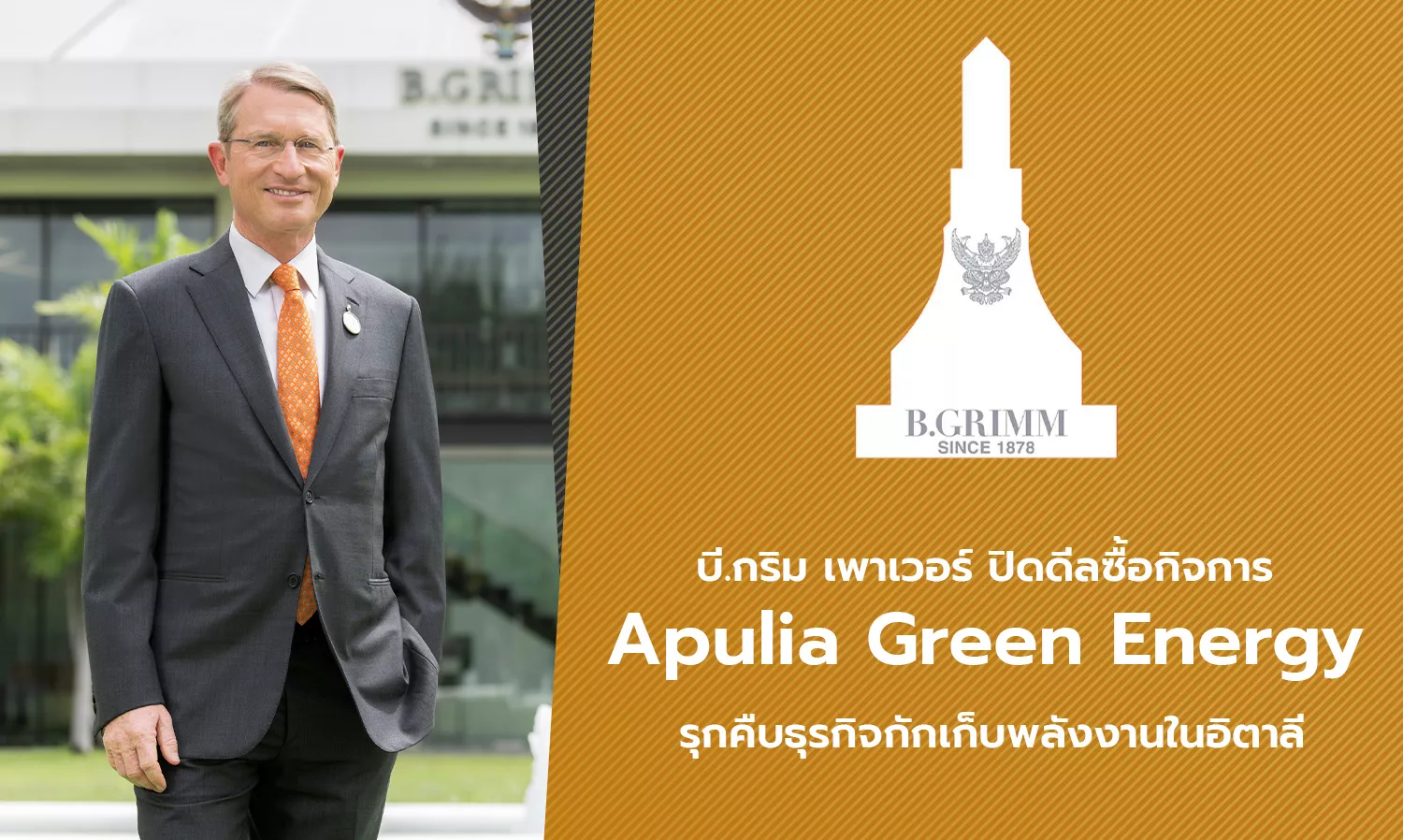
B.Grimm Power Completes Acquisition of Apulia Green Energy, Expands Energy Storage Business in Italy
According to a report from B.Grimm Power Public Company Limited, submitted to the Stock Exchange of Thailand on June 27, 2025, RES Company Sicilia S.r.l., a subsidiary of B.Grimm Power, has acquired all shares in Apulia Green Energy 01 S.r.l., a company established under the laws of the Republic of Italy, from LT Service S.r.l., an unrelated party, for a total value of 10,000 euros to advance its battery energy storage business in Italy.
Dr. Harald Link, CEO of B.Grimm Power Group, stated that Apulia Green Energy 01 S.r.l. has a battery energy storage system (BESS) project under development with a total capacity of 218 megawatts located in southern Italy. Additionally, RES Company Sicilia S.r.l. has partnered with LT Service S.r.l. to establish a new subsidiary named Cerignola BESS S.r.l. in Italy to develop a battery energy storage system with a capacity of 378 megawatts, also located in southern Italy, with a shareholding ratio of 51% and 49%, respectively, and a registered capital of 10,000 euros.
This initiative by B.Grimm Power in battery energy storage is part of a broader strategy to expand its renewable energy portfolio and enhance energy security. The acquisition of 100% of Apulia Green Energy 01 S.r.l. and the establishment of a new subsidiary in Italy will increase B.Grimm Power's total energy storage capacity under development to 600 megawatts.
This collaboration marks another advancement in Thailand's renewable energy sector, aimed at improving energy efficiency while supporting stable and environmentally friendly energy use. It aligns with the “GreenLeap – Global and Green” strategy and the vision of “Empowering the World Compassionately” of B.Grimm Power, which seeks to expand its customer base and partnerships in the renewable energy business to adapt to the rapidly changing global energy market. The goal is to become a leading global energy producer, with a target to increase the share of renewable energy to over 50% by 2030 and achieve net-zero carbon emissions by 2050.