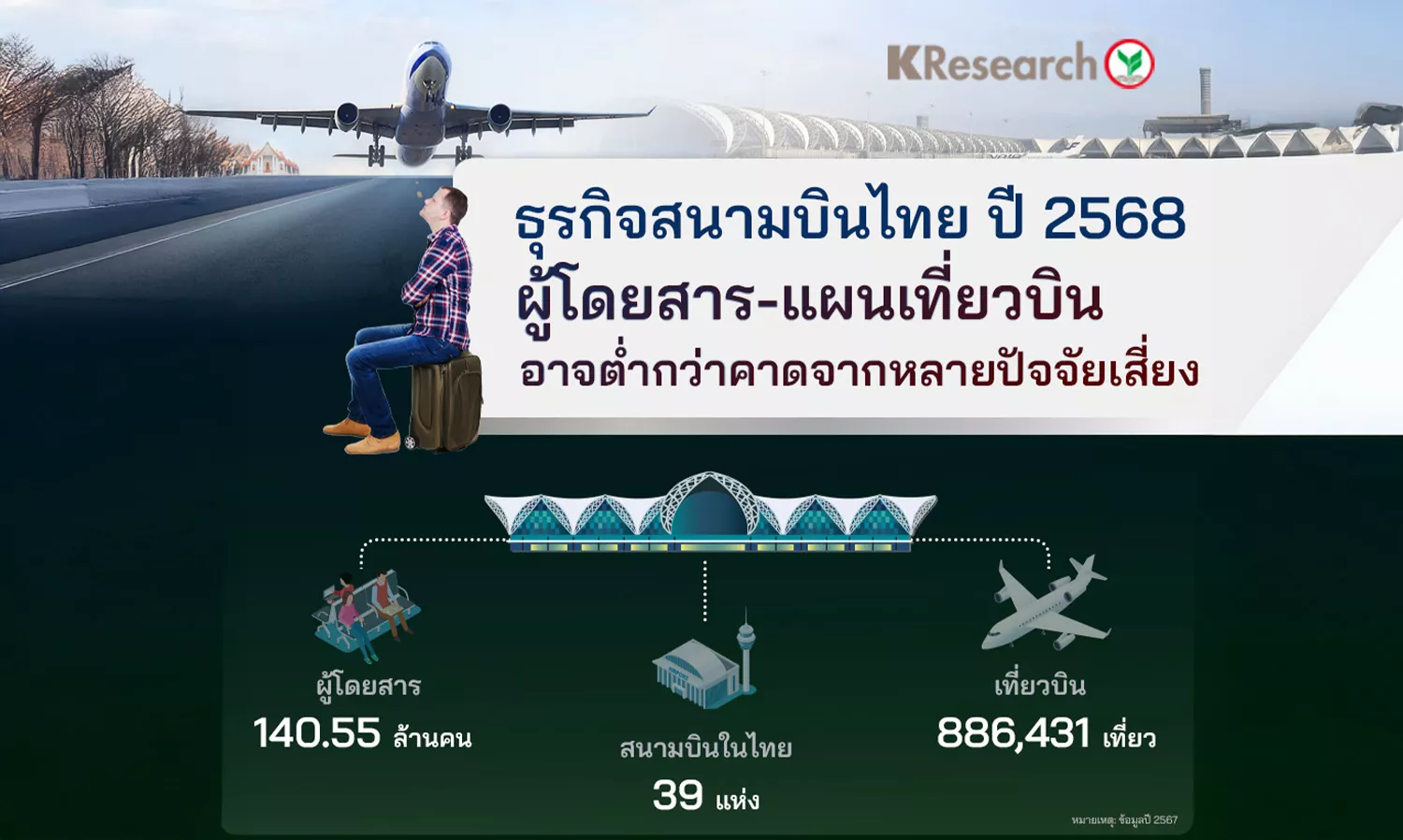
Trends in the Thai Airport Business
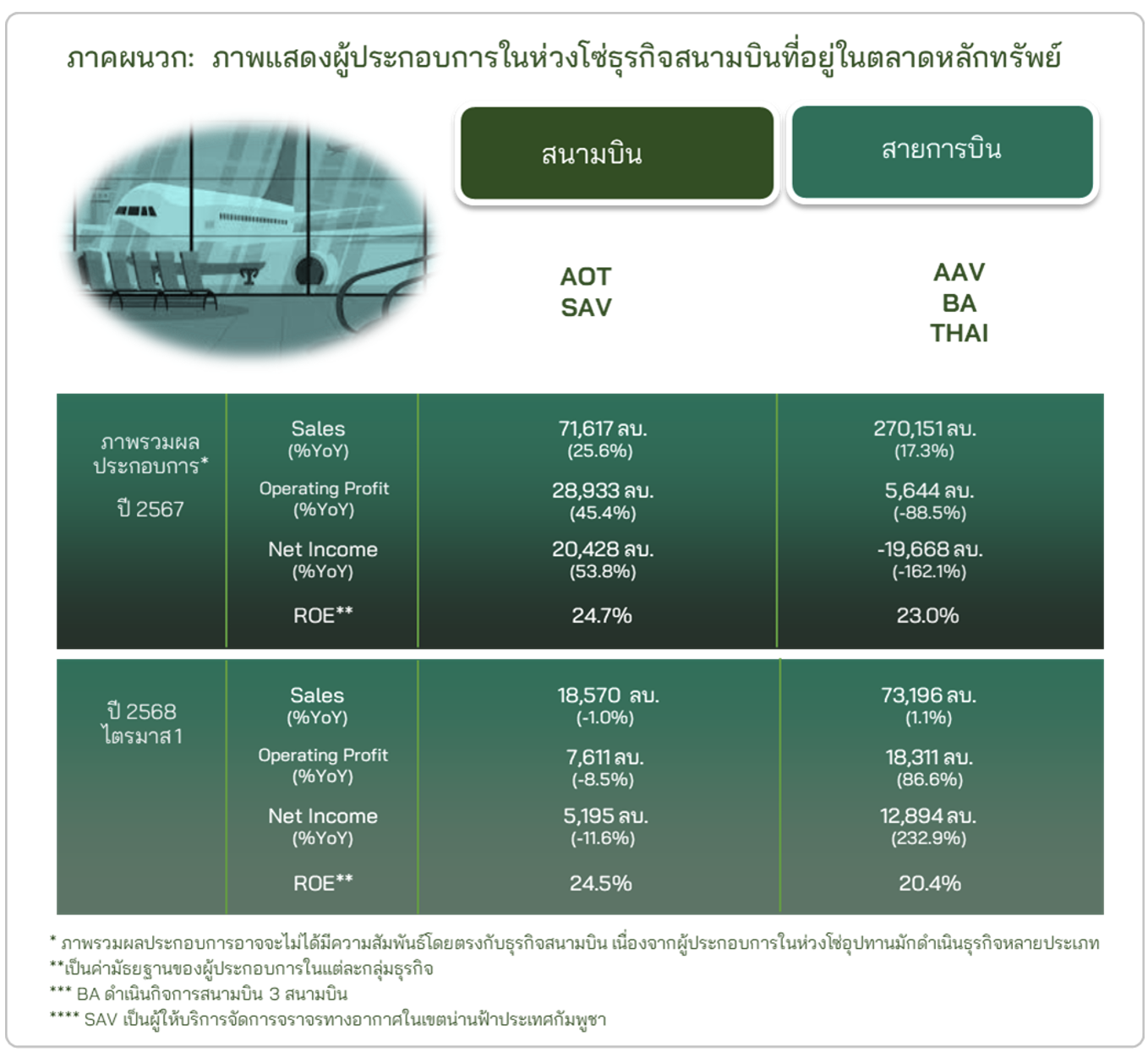
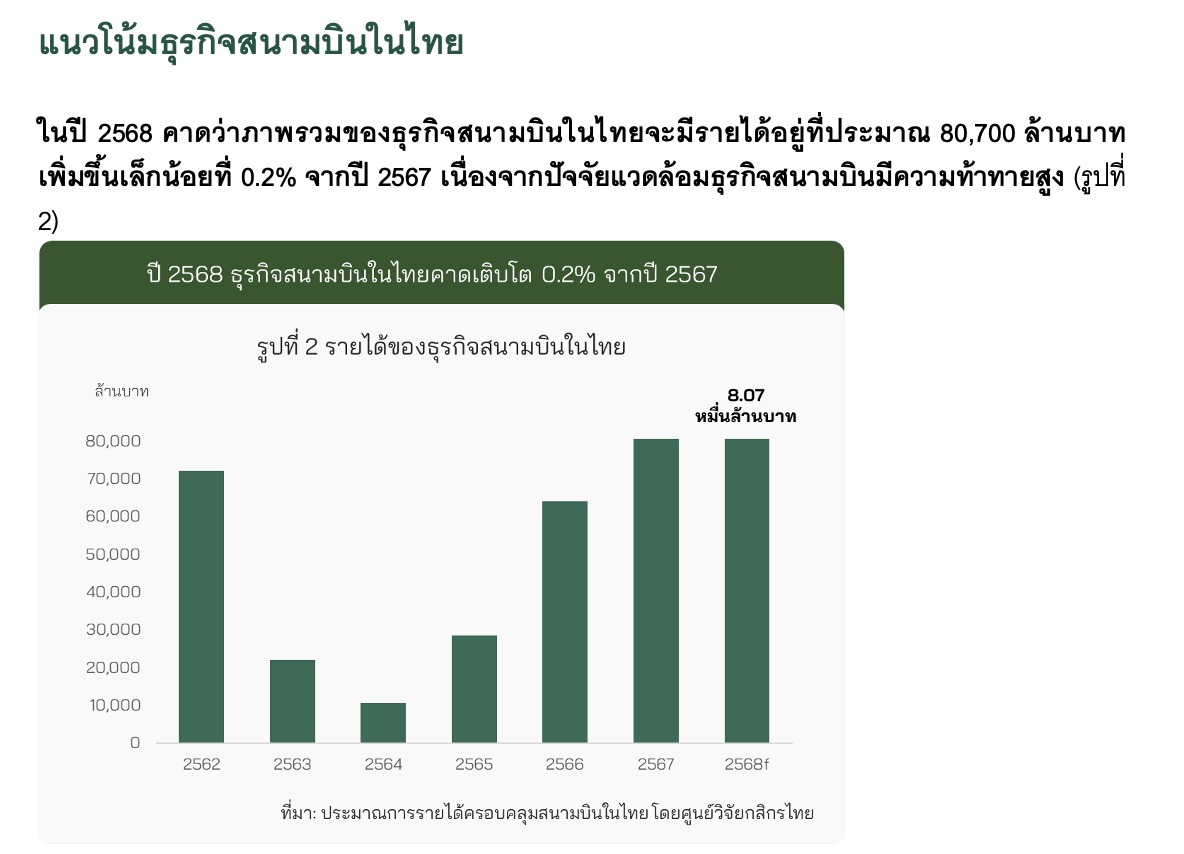
- In 2025, airport business revenue is expected to reach 80.7 billion baht, representing a growth of 0.2%, a slowdown from 2024. The revenue support factors include: 1. The number of passengers is expected to be around 145.4 million, an increase of 3.4%, although this is a slowdown from 2024 due to a decline in foreign tourists visiting Thailand compared to the previous year, and 2. The flight plans from international airlines to Thailand in the first nine months of 2025 still reflect a positive outlook.
- Moving forward, the airport business in Thailand faces high challenges due to the risk that the number of passengers and airline flight plans may decrease more than anticipated. This is influenced by the slowing economic conditions both domestically and internationally, as well as geopolitical issues that affect international travel, which will impact aviation-related revenue and consequently non-aviation-related revenue. The concession may also be affected by a decrease in revenue share.
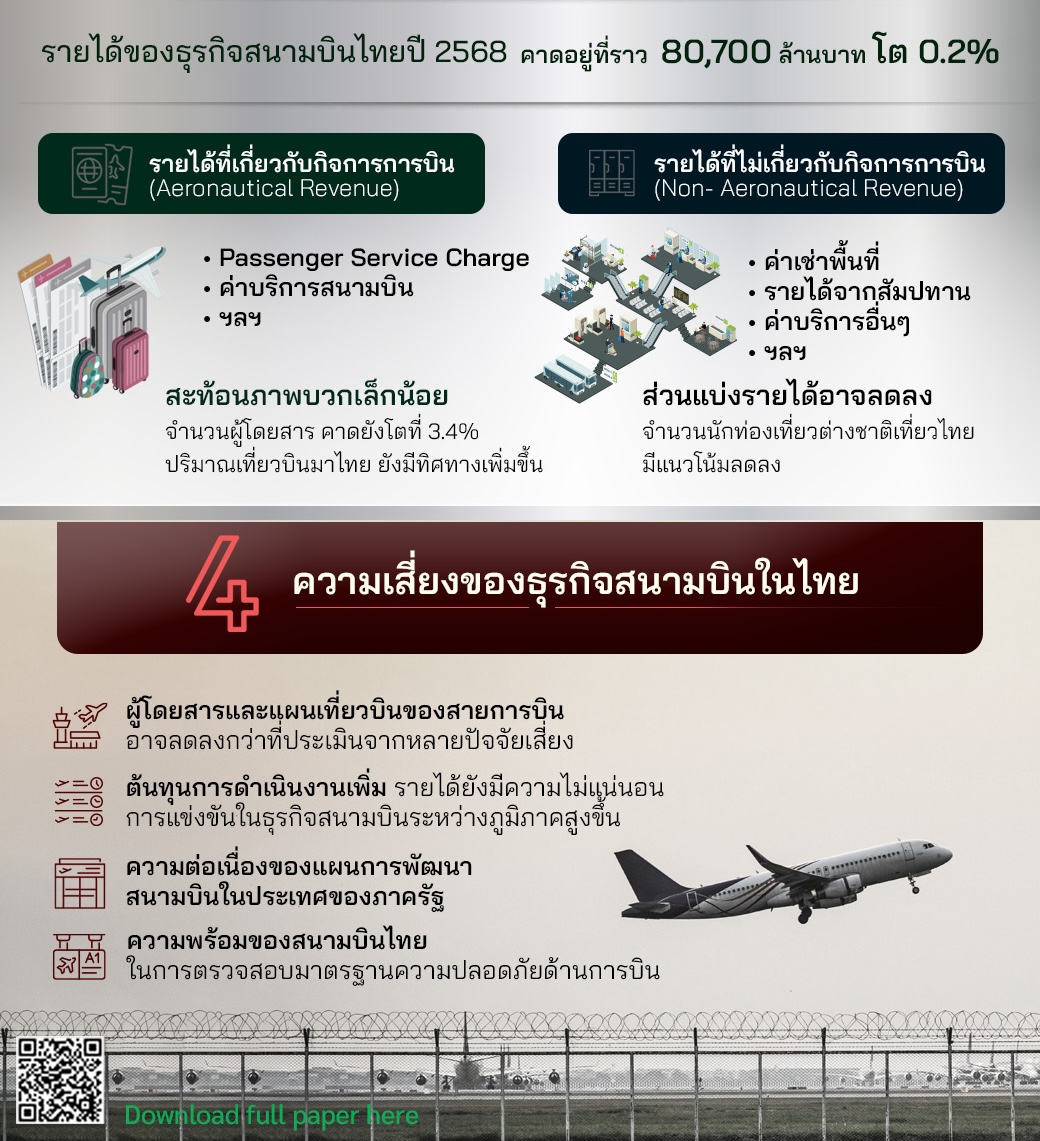
Airport business revenue is divided into two categories:
- Aviation-related revenue (Aeronautical Revenue), such as passenger service charges for international and domestic departures (Passenger Service Charge: PSC) and airport service fees.
- Non-aviation-related revenue (Non-Aeronautical Revenue), such as rental income, concession revenue, and other service fees, including utility charges, check-in counter services, and other airport services.
The revenue structure ratio depends on the size of the airport. In the case of small airports, the majority of revenue, or more than 80%, comes from aviation-related revenue, while in large airports, the revenue from both categories is approximately equal.
In 2025, the business environment for airports faces high challenges, impacting the growth of airport business revenue in Thailand, which is slowing down. Key factors affecting airport business revenue include:
- Aviation-related revenue (Aeronautical Revenue) is expected to show slight positive signs, supported by:
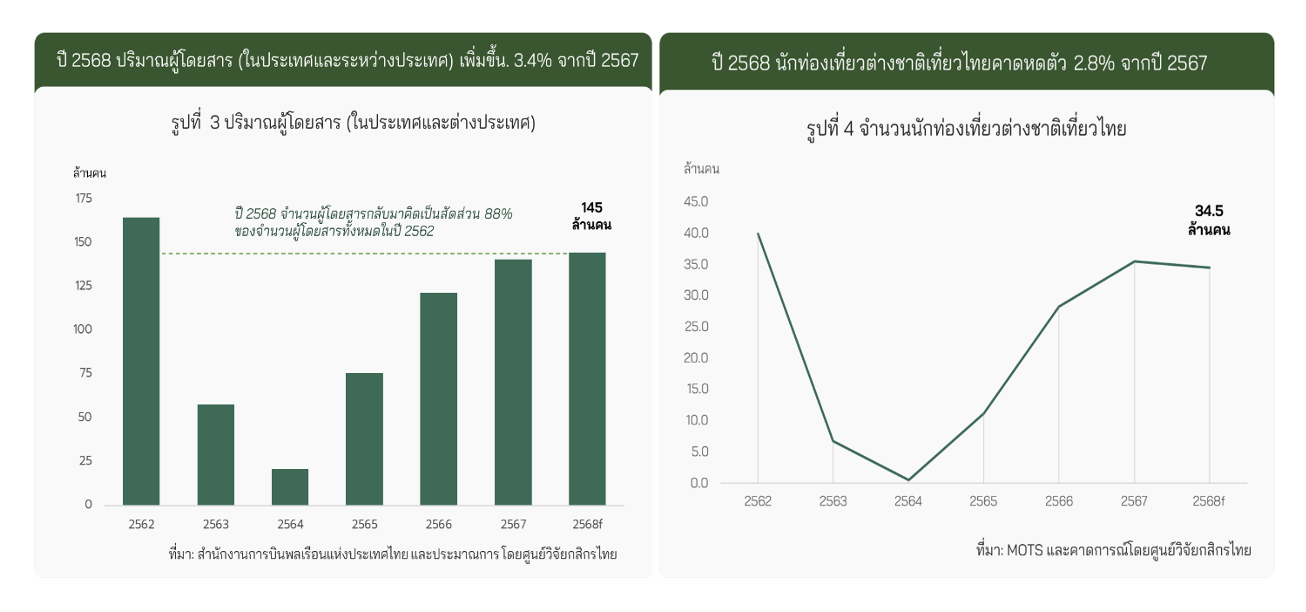
- The volume of passengers using the airport (including both Thai and foreign travelers traveling domestically and internationally) is expected to be around 145.4 million, an increase of 3.4%, but a slowdown from 2024, which grew by 15% (see Figure 3).
The increase in the number of passengers using airports in Thailand is positively influenced by international and domestic travel by Thais, business travel, and this year, Thailand is hosting several international events such as the SEA Games and the Women's Volleyball World Championship 2025.
However, the slowdown in passenger numbers is primarily due to the expected 2.8% decrease in foreign tourists visiting Thailand in 2025 compared to the previous year (see Figure 4). The reduction in foreign tourists directly impacts revenue from international passenger service charges.
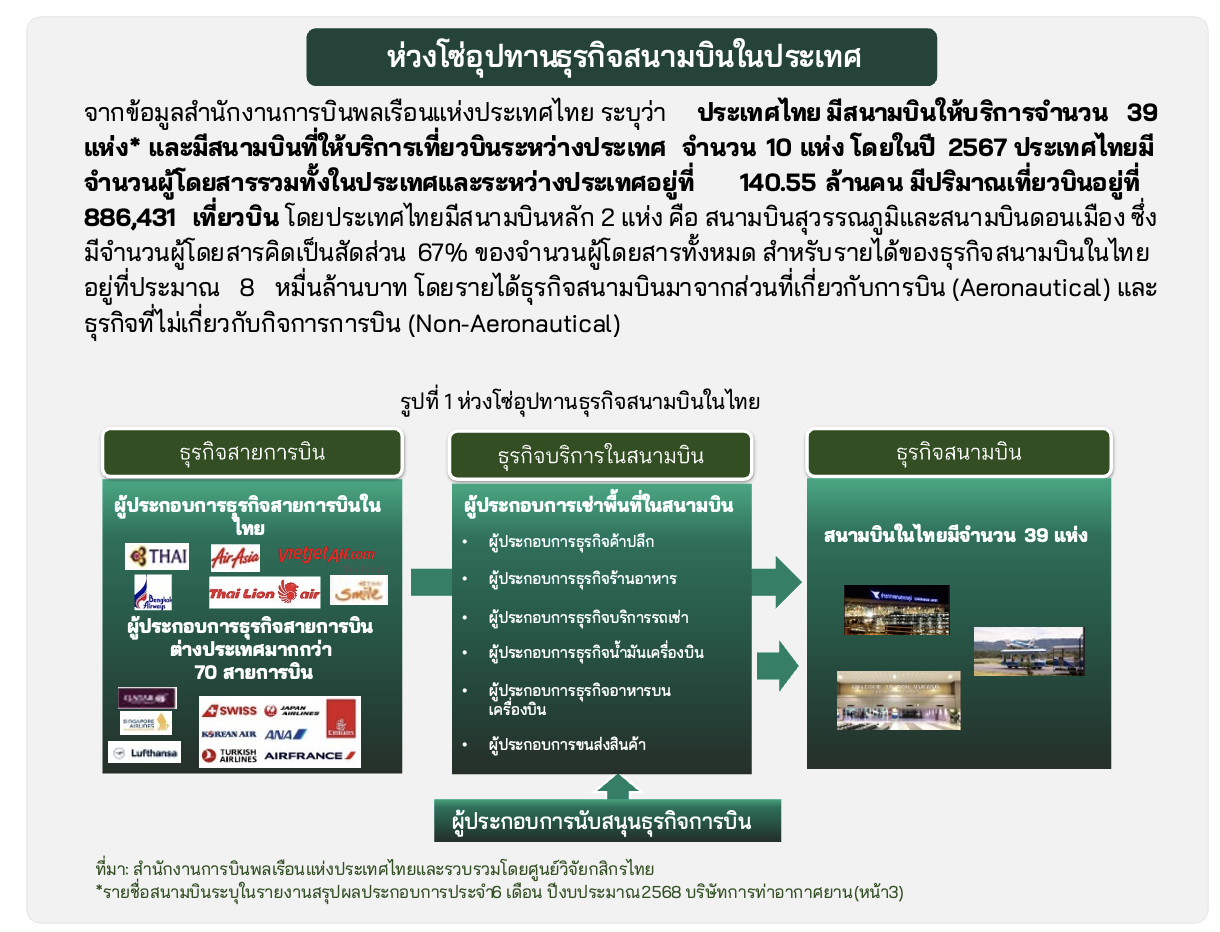
Airport business revenue is divided into two categories:
- Aviation-related revenue (Aeronautical Revenue), such as passenger service charges for international and domestic departures (Passenger Service Charge: PSC) and airport service fees.
- Non-aviation-related revenue (Non-Aeronautical Revenue), such as rental income, concession revenue, and other service fees, including utility charges, check-in counter services, and other airport services.
The revenue structure ratio depends on the size of the airport. In the case of small airports, the majority of revenue, or more than 80%, comes from aviation-related revenue, while in large airports, the revenue from both categories is approximately equal.
In 2025, the business environment for airports faces high challenges, impacting the growth of airport business revenue in Thailand, which is slowing down. Key factors affecting airport business revenue include:
- Aviation-related revenue (Aeronautical Revenue) is expected to show slight positive signs, supported by:
- The volume of passengers using the airport (including both Thai and foreign travelers traveling domestically and internationally) is expected to be around 145.4 million, an increase of 3.4%, but a slowdown from 2024, which grew by 15% (see Figure 3).
The increase in the number of passengers using airports in Thailand is positively influenced by international and domestic travel by Thais, business travel, and this year, Thailand is hosting several international events such as the SEA Games and the Women's Volleyball World Championship 2025.
However, the slowdown in passenger numbers is primarily due to the expected 2.8% decrease in foreign tourists visiting Thailand in 2025 compared to the previous year (see Figure 4). The reduction in foreign tourists directly impacts revenue from international passenger service charges.
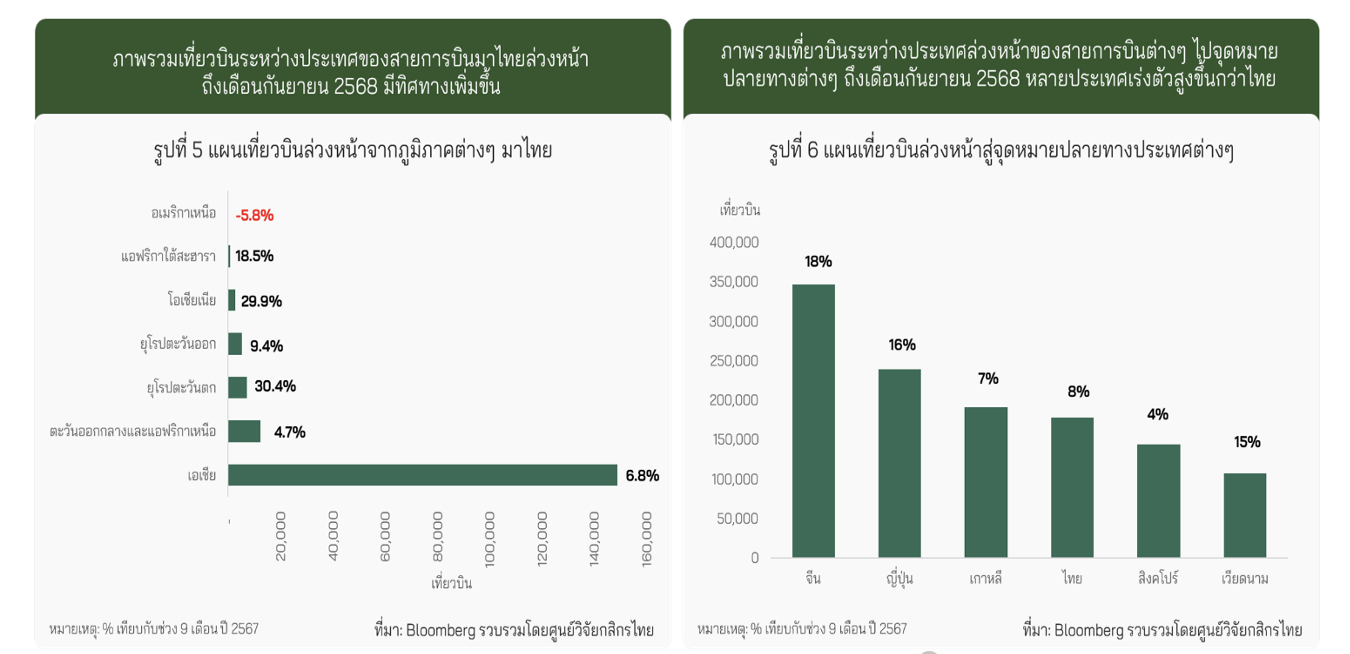
- The volume of international flights is still on the rise, as indicated by the international flight schedules of airlines planned up to September 2025, showing that the number of flights from various regions to Thailand is mostly growing, except for North America, which has decreased due to seasonal travel (see Figure 5).
However, moving forward, the business environment is highly uncertain, which still depends on government policies to attract investment and foreign tourists, as well as the travel demand of foreign tourists. This is reflected in the airlines' flight plans moving forward, responding to interest in new destinations. Compared to other countries in the same region, international flights to China have grown by 18% (first nine months of 2025 compared to the first nine months of 2024), Japan has grown by 16%, while Thailand has only increased by 8% (see Figure 6).
- Non-aviation-related revenue (Non-Aeronautical Revenue) in 2025 is also affected by the trend of decreasing foreign tourists visiting Thailand, which may impact revenue share.
Risks of the Airport Business in Thailand
- Risks from the number of passengers and airline flight plans that may decrease more than estimated, which will affect aviation-related revenue (Aeronautical Revenue), accounting for over 50% of airport business revenue (depending on the size and operations of the airport). In the remaining part of 2025, key risk factors include:
- The economy both domestically and internationally is expected to slow down, affecting travel plans for both Thai and foreign travelers. The trade war issues impact the economy and purchasing power in many countries, including Thailand. In April 2025, the International Monetary Fund (IMF) projected that the global economy in 2025 would grow by 2.8%, down from the previously expected 3.3% (forecasted in January 2025). Meanwhile, the Thai economy faces several negative factors, with Kasikorn Research Center estimating that the Thai economy in 2025 is expected to grow by 1.4%.
- Geopolitical issues that may impact airlines and travel. Although the situation between India and Pakistan has ended and airlines have resumed normal flight operations, the situation in the Middle East, including the Russia-Ukraine war, is still ongoing, which will continue to affect flight route plans, the number of flights, and international travel.
- High competition in international tourism, while ongoing negative news affects the confidence in safety and travel experiences for some tourists visiting Thailand. This is reflected in the continuous decline in foreign tourists visiting Thailand, with a 0.3% decrease in the first four months of 2025 (compared to the first four months of 2024), while Japan grew by 25% and Vietnam by 6.3%. The decrease in foreign tourists traveling to Thailand may impact airport business revenue in the future, thus requiring all sectors to urgently address and improve to restore confidence quickly.
- Rising operational costs while revenue remains uncertain, and increased competition in the airport business between regions.
- Many airports in Thailand still need to improve operational efficiency and airport safety to meet international aviation safety standards, which requires significant investment, such as plans to expand passenger terminals and runways to reduce congestion at airports and enhance service, as well as the adoption of technology to improve operational efficiency and safety, including investments in environmental matters or Green Airports.
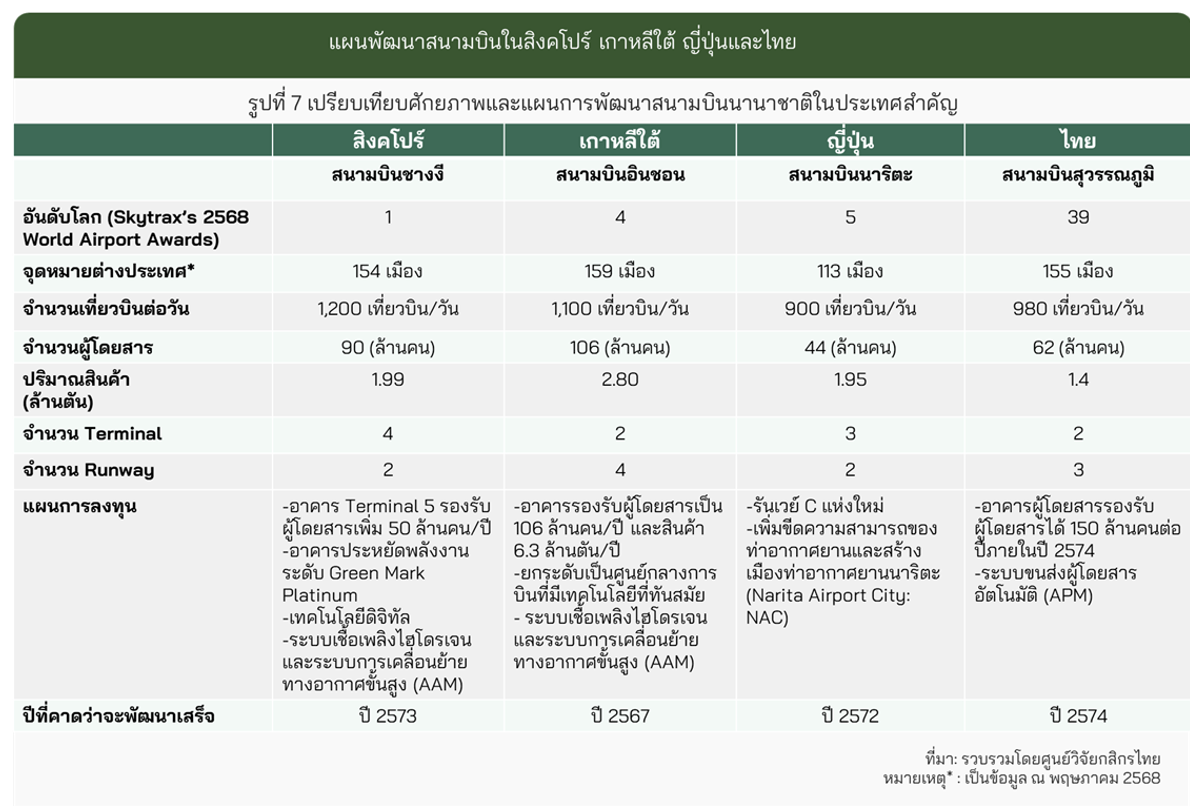
- Competition with regional airports. Many countries have plans to invest in developing international airports to accommodate the growth of passengers and flight volumes, with modern technology systems to facilitate users, attracting airlines to use their services or choose to be a connecting point between countries. This may lead to increased competition in services and prices in the airport business, potentially affecting costs, revenue, and operational profits, as Thai airports will need to develop and improve to compete with rivals (see Figure 7).
- The continuity of the government's airport development plans is one of the key factors affecting the airport business. The risk of uncertainty in government policy implementation may delay airport development, impacting planning, investment, and long-term business growth.
- The readiness of Thai airports to meet aviation safety standards must be monitored, particularly the results of safety standard inspections by the International Civil Aviation Organization (ICAO) in August 2025.