Kearney's 2025 Foreign Direct Investment Confidence Index Survey Reveals Growth in the Asia-Pacific Region Driven by Innovation Amid Rising Global Pressures
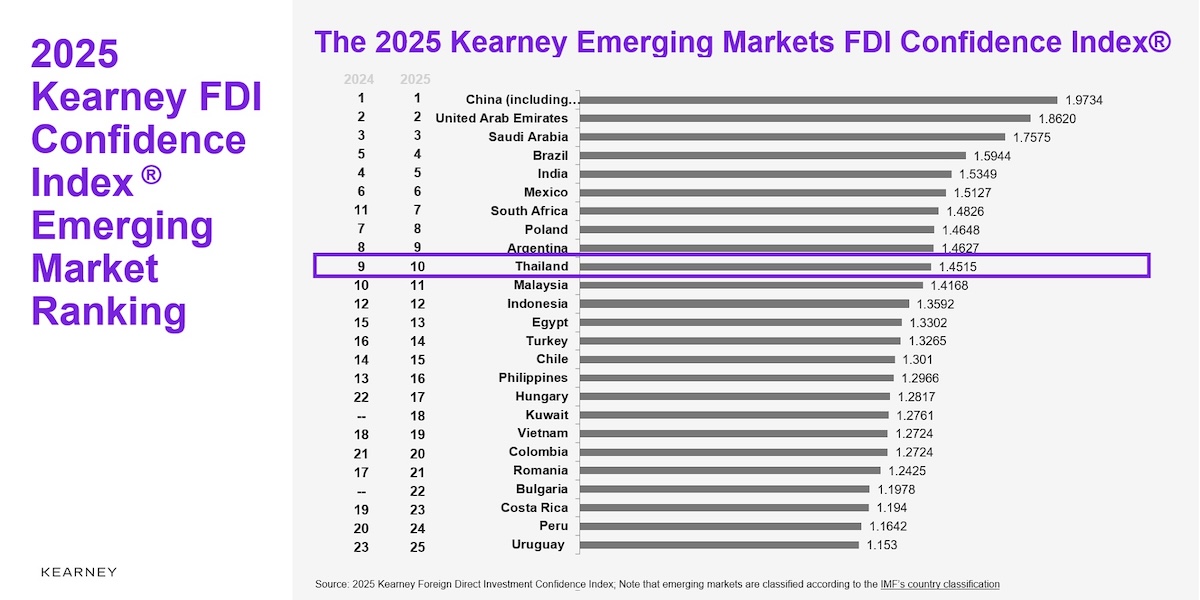
Thailand ranks among the top 10 investment markets in the Foreign Direct Investment Confidence Index for emerging markets, according to Kearney's 2025 survey.
·Eight markets in the Asia-Pacific region are among the top 25 in Kearney's Foreign Direct Investment Confidence Index for 2025.
·Rising commodity prices, regulatory challenges, and geopolitical tensions have led to a decline in positive outlooks.
·New U.S. tariffs have heightened the urgency for planning to address potential scenarios and highlighted vulnerabilities in various sectors, particularly manufacturing and automotive.
Kearney's Global Business Policy Council, a global business consulting firm specializing in strategic advice, has announced the results of the Foreign Direct Investment Confidence Index (FDICI) for 2025, which reflects investors' views on the flow of FDI over the next three years, including perspectives on Thailand.
The 2025 FDICI, now in its 27th year, reflects investors' perspectives as the world faces significant turning points. Despite impactful events occurring after the survey was conducted in January, the main insights from this study continue to provide interesting data, particularly regarding investors' emphasis on the efficiency of legal processes and regulatory enforcement, as well as the economic performance of countries and their technological and innovative potential.
This year, eight Asia-Pacific markets made it to the top 25 globally, matching last year's count, including Japan (4th), China (including Hong Kong) (6th), Australia (10th), South Korea (14th), Singapore (15th), New Zealand (16th), Taiwan (23rd), and India (24th).
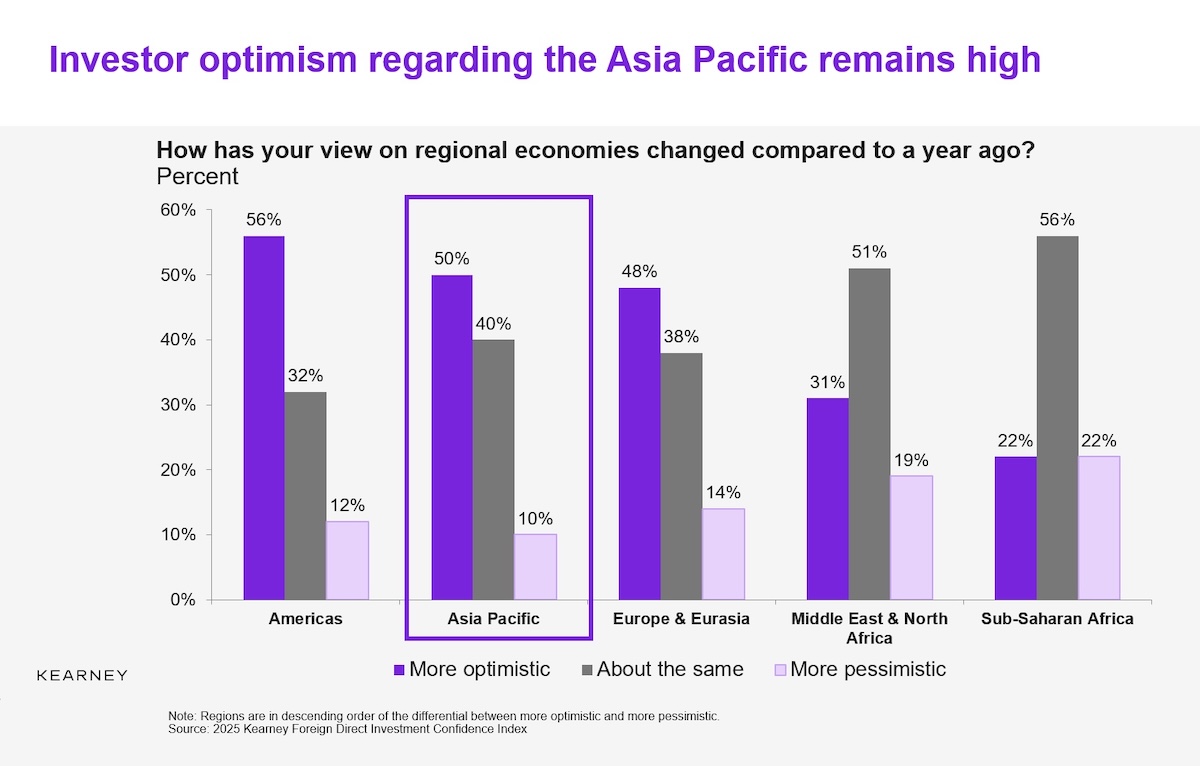
Kearney's FDICI survey found that investors place significant importance on technological advancements and the economic performance of certain markets in the Asia-Pacific region, while challenges from a complex global geopolitical environment have negatively impacted investor sentiment towards other markets.
Thailand ranks 10th in the FDICI among emerging markets.
The FDICI survey for emerging markets was launched for the first time in 2023 to highlight attractive emerging markets for FDI over the next three years. Thailand ranked 10th among all emerging markets, with many investors citing the skills and capabilities of the Thai workforce as the primary attractive factor for investment in Thailand (34%), followed by ease of doing business (24%) and natural resources (24%), which were rated equally as secondary attractive reasons.
Chanchai Tanatkatrakul, Managing Director of Kearney Thailand, stated, "Thailand has taken a proactive role in promoting investment and reducing barriers for foreign investors. However, the intense competition to attract FDI from multiple markets necessitates continuous innovation development and enhancement of competitive capabilities, with a focus on developing skilled personnel and creating targeted investment attraction measures for key industries."
Mr. Chanchai added, "The new U.S. tariffs will inevitably impact Thailand, as the U.S. is Thailand's largest export market. Industries expected to be severely affected include electronics and electrical appliances, machinery and industrial equipment, and automotive, all of which are already facing cost and regulatory challenges."
"Despite facing various challenges, Thailand continues to maintain strengths that attract investors, including a capable workforce, ease of doing business, and abundant natural resources. With proactive policies and appropriate strategic investment promotion measures, Thailand can unlock its potential for long-term value creation amid a volatile global environment," Mr. Chanchai concluded.
Strong technology and economy drive growth in the Asia-Pacific market.
The Asia-Pacific region continues to gain investor confidence, supported by technological advancements and a stable economic foundation. Japan, for instance, has moved up from 7th to 4th place, exemplifying a market that leads in technological innovation and strong economic growth, bolstered by a vibrant labor market and record-high wage increases.
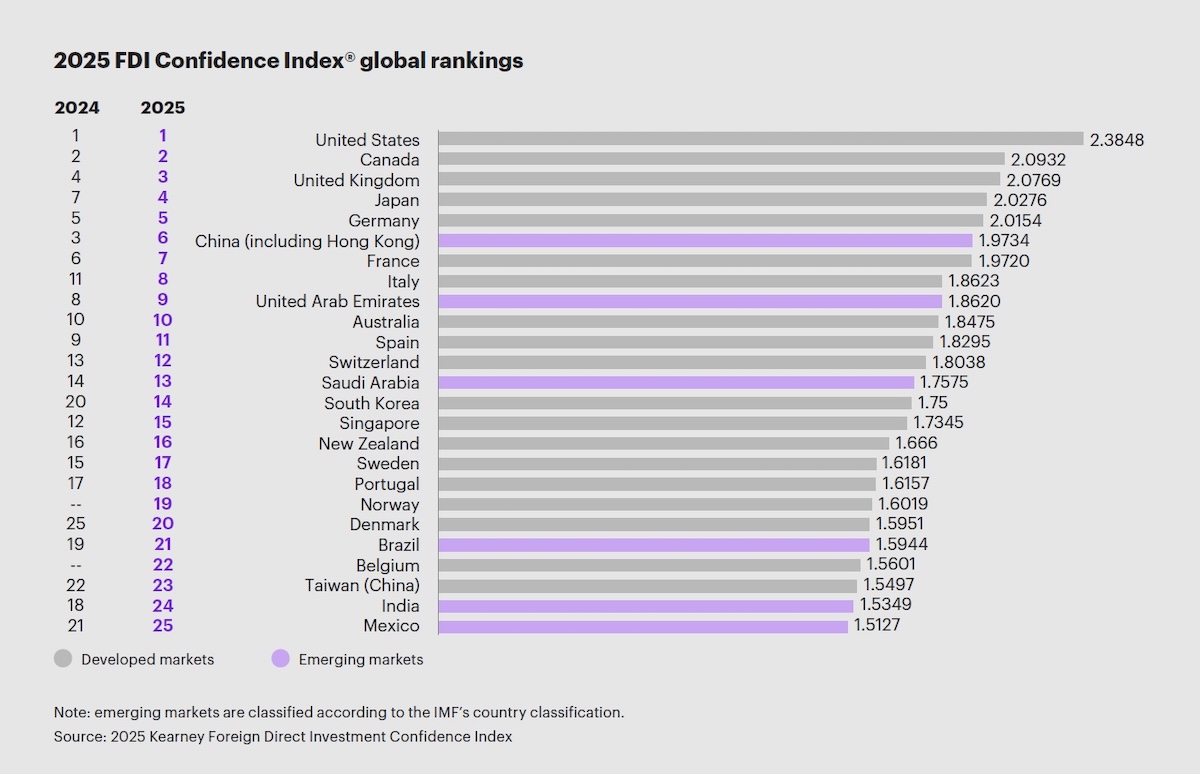
Similarly, South Korea has shown its best performance ever in the survey, moving up from 20th to 14th place, with 41% of investors indicating that the country's continuously developing technology sector is a key factor in restoring confidence. Significant government investment in the semiconductor industry has also influenced this ranking change.
The survey also found that 82% of investors in the Asia-Pacific region plan to increase their FDI over the next three years, and 50% have a more positive outlook on the region's economy compared to the previous year.
Regional factors create pressure on investor confidence.Investor confidence has been affected by increasing uncertainty.
Approximately 43% of investors surveyed in the Asia-Pacific region view rising commodity prices as the most likely trend to occur in the next year, an increase of 14% from the previous year. This heightened forecast reflects investors' concerns about global conflict situations that may impact supply chains and drive up commodity prices.
The second anticipated change for investors in the Asia-Pacific region in 2025 is the trend of stricter business regulations in developed markets, with 36% of investors holding this view, up 2% from the previous year. The third position sees two issues tied at 28%: increasing geopolitical tensions and a tightening regulatory environment in emerging markets.
China has dropped from 3rd to 6th place, reflecting ongoing economic challenges, particularly the unresolved real estate crisis and escalating trade tensions between China and the U.S. Nevertheless, China remains prominent in technological innovation, as evidenced by the recent launch of DeepSeek AI.
Additionally, Singapore's drop from 12th to 15th place and India's fall from 18th to 24th place reflect increasing investor concerns regarding trade risks and regulatory complexities.
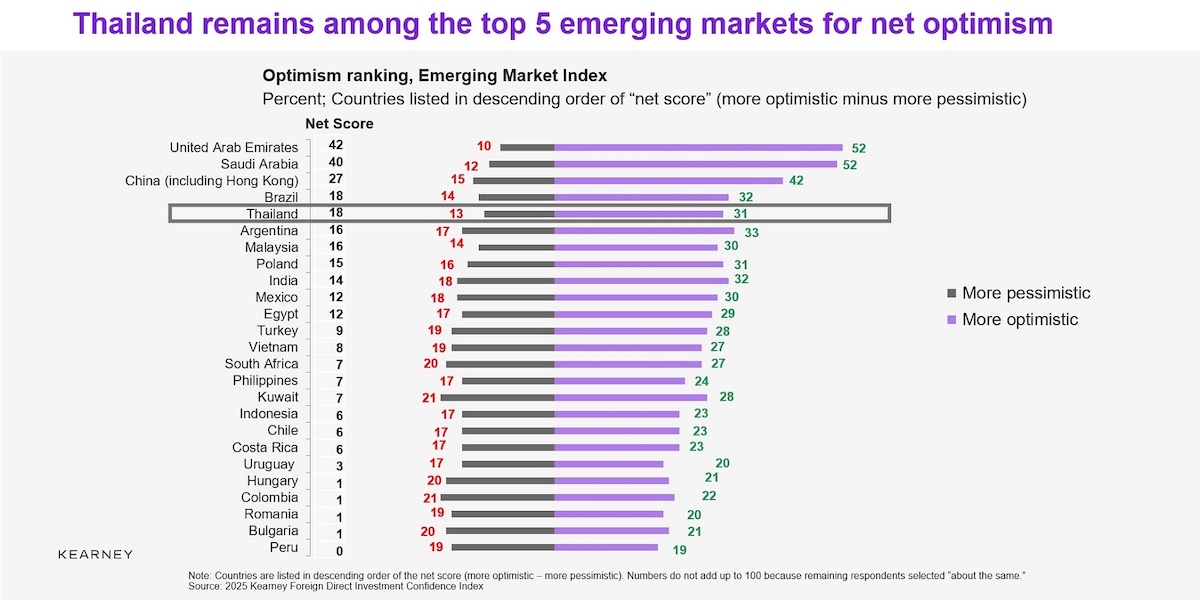
Thailand stands out with positive net investor confidence among emerging markets.
The survey found that investor confidence in the Asia-Pacific region remains high despite pressures from various factors, and markets in Southeast Asia continue to be strong, with Thailand, Malaysia, Vietnam, and the Philippines ranking among the top 15 countries for positive net investor optimism in emerging markets. Thailand maintains its position at 5th for positive net investor confidence in 2025.