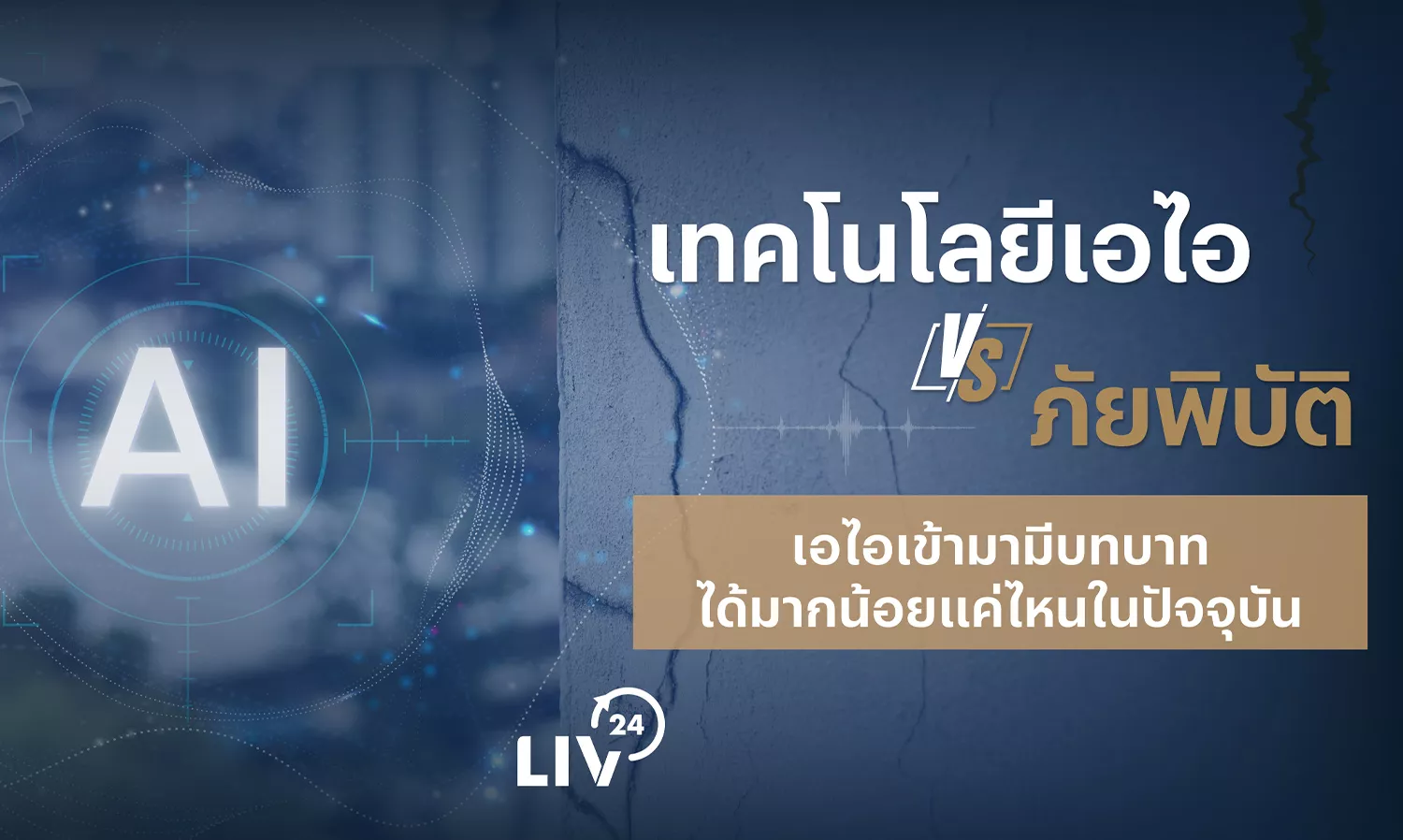
AI Technology vs. Disasters: How Much of a Role Does AI Play Today?
Natural disasters are one of humanity's greatest challenges. From wildfires and earthquakes to floods and storms, each event causes immense damage to lives, property, and economies. In recent years, artificial intelligence (AI) technology has taken on a significant role in disaster forecasting, early warning systems, and emergency management. However, the crucial question is: how far has AI developed in assisting humans to cope with disasters, and what limitations still need to be addressed to maximize the effectiveness of this technology?

Ms. Niramon Direkmahamongkol, Managing Director of LIV-24, a leader in Smart Tech Solutions, revealed that AI is currently being utilized in three main areas of disaster management: forecasting, alerting, and post-disaster recovery and management. This technology has demonstrated superior potential compared to humans in certain cases, particularly in processing large data sets and conducting in-depth analyses.
1. Forecasting and Monitoring
AI significantly enhances the accuracy of disaster forecasting. For instance, AI systems for wildfire detection can analyze satellite images alongside data from thermal sensors and weather conditions to identify high-risk areas before fires spread. Additionally, AI is used to analyze underground tremors to predict earthquake trends. While it cannot forecast events days or hours in advance, it can detect early warning signs seconds before they occur, giving people time to evacuate.
For flooding issues, AI uses data from weather radars, river water levels, and rainfall amounts to create models predicting which areas will be affected and when. These systems are increasingly being used in several countries that frequently face flooding, such as India and Bangladesh.
2. Disaster Alerting
AI systems are employed in advanced disaster alert systems, such as Japan's earthquake warning system, which can send alerts 5-10 seconds before severe tremors occur, helping to reduce damage to buildings and infrastructure. Furthermore, Google has developed AI Flood Forecasting, which can alert people to impending floods via mobile phones, allowing them to prepare more effectively.
3. Recovery and Post-Disaster Management
AI and automated drones are used to survey areas damaged by earthquakes or storms. These systems can identify the most severely affected spots and help rescue teams access areas in need of assistance more quickly. Additionally, AI is utilized to analyze satellite images after disasters to monitor changes in the landscape and plan recovery efforts.
Limitations of AI in Disaster Management
While AI plays a crucial role in disaster response, several limitations still need to be addressed.
1. Data Limitations
AI performs well when there is a large amount of high-quality data. However, for certain types of disasters, such as earthquakes or tsunamis, the available data is still insufficient for AI to make more accurate predictions. Currently, the network of earthquake detection sensors is not globally comprehensive, especially in resource-limited countries.
2. Infrastructure Limitations
Although AI can effectively assist in disaster alerts, many areas frequently facing disasters, such as developing countries, may lack the necessary internet and sensor infrastructure to support these technologies. Moreover, while AI alert systems work well in major cities, people in remote areas may not have access to devices capable of receiving alerts.
3. Development and Implementation Costs
AI technology and related sensors are costly, making them difficult for many low-income countries to access. Although there are AI development projects for public benefit from the private sector and international organizations, expanding AI capabilities to cover all regions remains a challenge.
4. Reliability of AI
Even though AI is becoming increasingly accurate in disaster alerts, ultimately, human judgment is still necessary. In some cases, if AI makes a false prediction, such as alerting for a flood that does not occur, it can cause unnecessary panic.
The Future of AI in Disaster Management
Despite its limitations, future trends indicate that AI can become a primary tool in disaster management, with advancements in technology such as:
- Using AI in conjunction with the Internet of Things (IoT) to connect smart sensors for real-time disaster monitoring.
- Integrating AI with 5G technology to increase data transmission speeds, allowing alert systems to operate more quickly.
- Combining AI with Quantum Computing to analyze more complex disaster data.
While AI may not be able to prevent disasters completely, its ability to help humans respond better and effectively reduce losses has proven that this technology is moving towards a future that enhances recovery capabilities and helps us withstand natural disasters more effectively.
Ultimately, while AI can improve disaster forecasting and management, relying on human experience and critical decision-making remains essential. At LIV-24, we are committed to developing 'technology with a heart,' which means integrating AI with human efforts in a way that neither replaces the other but rather enhances overall efficiency. Furthermore, sustainable disaster management requires collaboration across all sectors, whether governmental, private, or community, to build a foundation that is truly prepared to face future challenges. AI will continue to be a vital tool in enhancing disaster response capabilities across multiple dimensions.