Thai Construction Sector Stands Strong, Emphasizing Safety Standards to Boost Confidence in the Real Estate Sector
The earthquake that occurred on March 28, 2025, caused panic among the general public, raising questions about safety standards. Sansiri, in collaboration with national partners throughout the supply chain, delves into the standards for high-rise construction, confident in the expertise of professionals in Thailand.
The safety of our residents is something we cannot compromise.
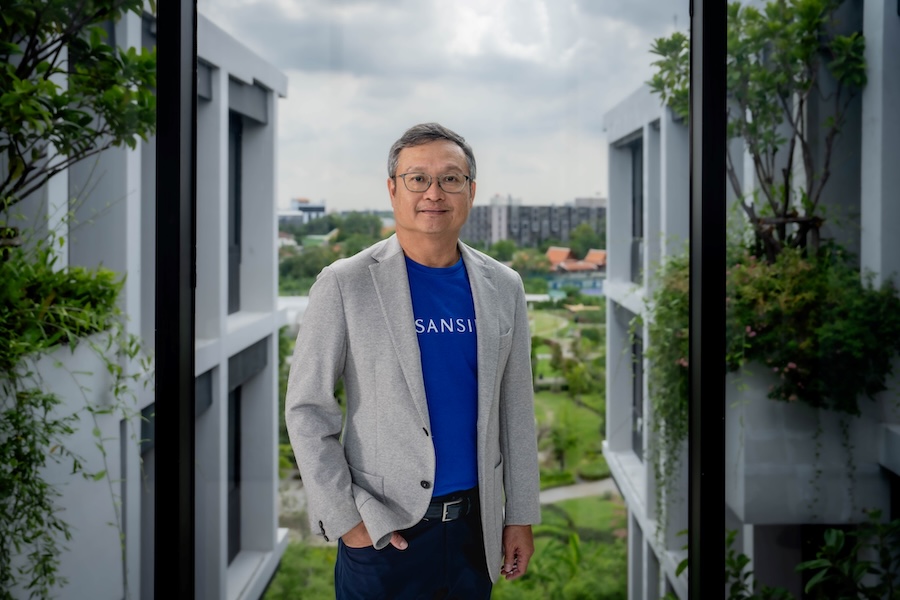
Uthai Uthaisangkhok, CEO of Sansiri Public Company Limited, stated that every project by Sansiri undergoes a rigorous inspection process, from design to delivery. There are clear working procedures, and random checks are conducted by external organizations in collaboration with national experts to ensure that "every project by Sansiri" is built to the highest standards of strength and safety.
In 2017, Sansiri supported leading public educational institutions, including Chulalongkorn University, Thammasat University, and eight leading private design firms, to develop the "Guidelines for Structural Design in High-Rise Buildings" to serve as a reference for engineers contracted by Sansiri for structural engineering design and verification of calculations. The content mainly relates to analyzing the effects of earthquakes, wind forces, and foundation design for high-rise buildings in accordance with existing standards in Thailand, supplemented by international standards. This has been reviewed and updated to align with changing circumstances.
The construction process of Sansiri projects undergoes inspection at every step by the Quality Control team, and the working process involves licensed engineering professionals who check data at each stage to confirm that the design and construction meet the strength and safety requirements as per the building regulations established by the Ministry of Interior in 2007 regarding load-bearing, resistance, and durability of buildings, as well as the earthquake-resistant design standards set by the Engineering Council and the Department of Public Works and Town & Country Planning standards 1301/1302, which are the standards for high-rise building design in Thailand.
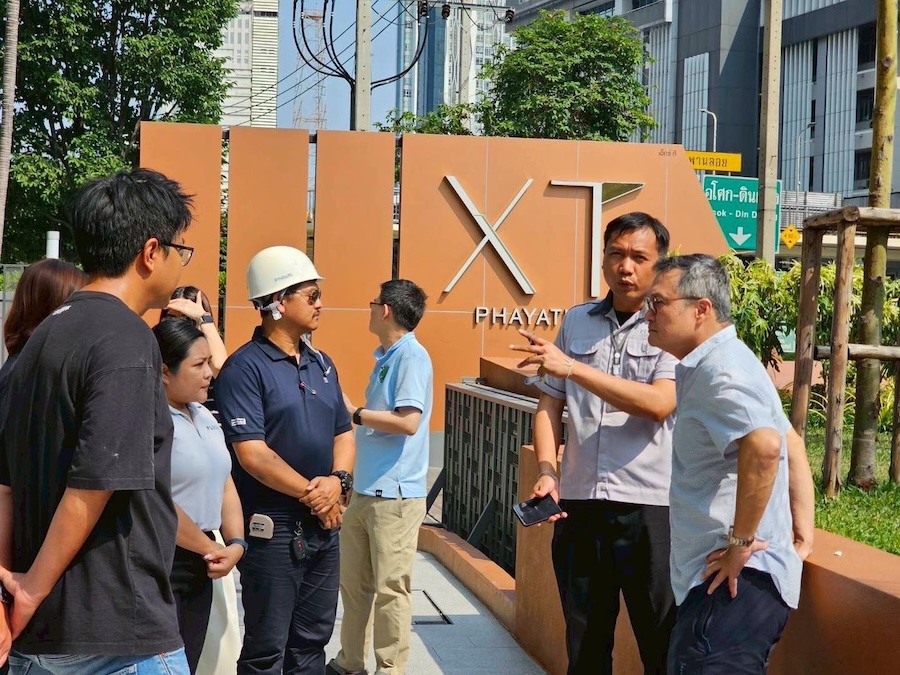
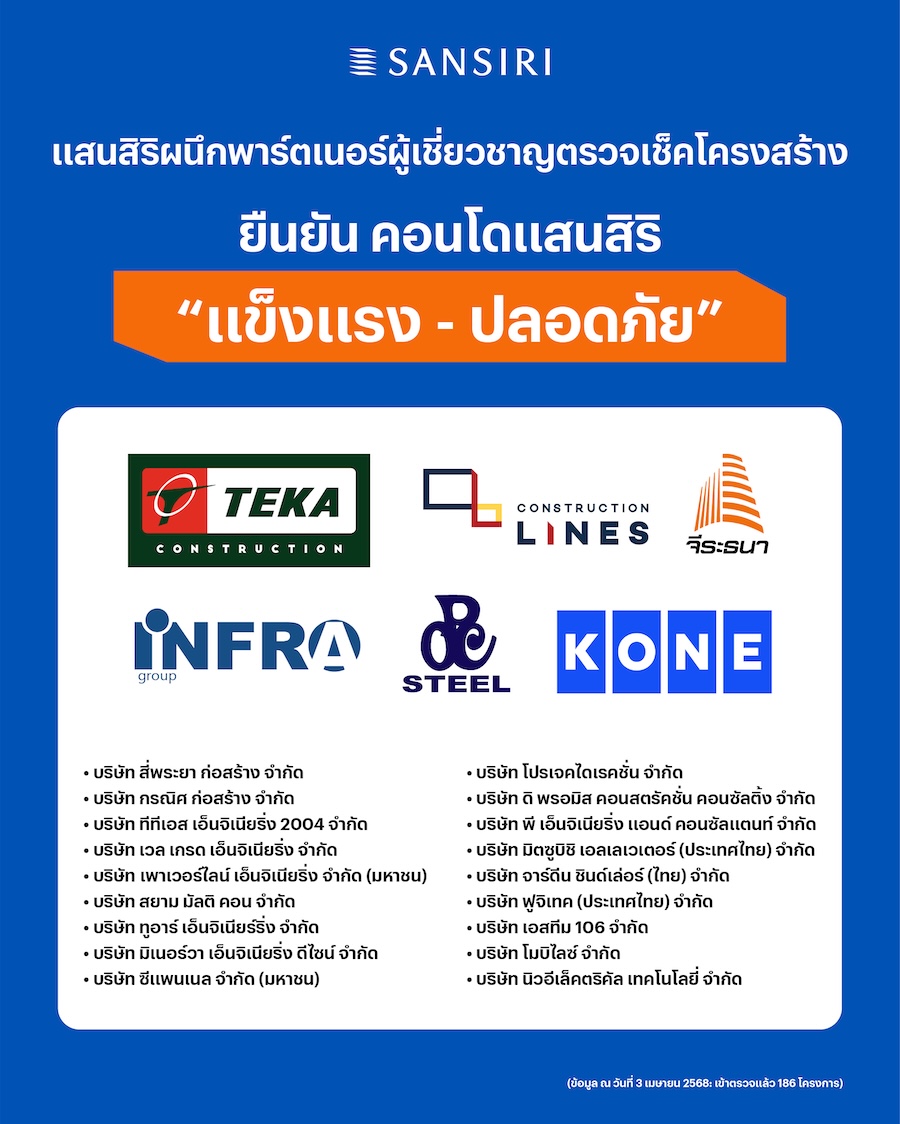
The Sansiri engineering team and partner experts will expedite quality checks for all condominium projects we develop to ensure maximum peace of mind. As of April 3, 2025, 186 projects have been inspected.
Standards that exceed general requirements.
Dr. Weerasak Wanichwat, CEO of Thika Construction Public Company Limited, emphasized that the core of the company's operations, which has been in business for over 41 years, is to prioritize safety, strength, and a systematic inspection process, certified under ISO 45001 (international standard for occupational health and safety management systems) and ISO 9001 (international quality management standard). The company was also one of the first contractors in Thailand to adopt BIM technology in construction and has continuously implemented various applications to reduce errors in work.
"Construction standards fundamentally depend on correct engineering design, using quality materials that are safe according to scientific principles. The working system must maintain quality and safety at every step, with thorough checks of all work, and instilling a safety consciousness among engineers and construction workers to be aware of potential hazards at all times."
In terms of innovation development, I hope to see more use of prefabricated construction materials, such as lightweight metal-framed walls that are strong and soundproof. In the event of cracks, such as from an earthquake, they can be repaired more easily than concrete walls. I also hope to see collaboration between the public and private sectors to seriously develop safety innovations.
Jaruwat Jiramana-pong, Managing Director of Jirathana Construction Company Limited, expressed confidence in the standards of Thai construction, stating that all buildings constructed after 2007 are required by law to meet construction standards that account for earthquakes. Following the recent earthquake, it was observed that most building structures in Thailand did not suffer severe damage, although some components, such as systems and walls, were affected. For buildings that collapsed, the true cause must be investigated, as this is an anomaly that should not occur.
"Our company does everything on paper, analyzing before actual work begins. If mistakes occur, they can be corrected on paper without waiting to encounter problems on-site, as the damage would be much greater. We prioritize proper work sequencing and conduct training for employees on quality requirements every six months. We are also developing software to utilize AI for checking construction equipment. Those in this industry must compete with academia, technology, speed, and quality, which are crucial for elevating the safety standards of Thai construction."
"Large real estate companies do not compromise safety for reputation, nor do site supervisors trade their profession for gain, as it is not worth the risk. Each company must undergo rigorous inspections to obtain each license. Thai engineers are world-class, and I believe the overall construction standards in Thailand are sufficient."
Meanwhile,Warintorn Srimahachota, Executive Director of Construction Lines Company Limited, another contractor working with Sansiri, stated that the heart of their construction standards, built over 35 years, adheres to the principle of "Plan Do Check Action" and is managed under ISO 9001 standards. The company has its own team of junior engineers to oversee its work.
"We do not just construct according to the plans provided; we also verify whether the plans are correct. If they are not, we will inform the project owner of our concerns. Following the Plan Do Check Action principle helps mitigate risks, as once a problem arises, it cannot be fixed retroactively. Discipline in the working process is the most important aspect of the construction industry. There must be a third party to verify, and choosing a contractor that meets standards is crucial. We also recommend increasing the use of construction innovations to enhance safety, such as investing in Formwork Systems or aluminum scaffolding that locks the entire building together to prevent scaffolding collapse, which our company has utilized for over five years."
As for areas where the Thai construction industry should further develop to elevate safety standards, he emphasized that every construction project should have a third party involved in inspections and adhere to standards, including re-verifying that the designs are strong and safe.
Case studies of building collapses abroad stem from multiple causes.
Kritsada Thaeprasart, Managing Director of Infra Group Company Limited, stated that the company specializes in high-rise buildings concerning wind and earthquake forces, with experience in designing and inspecting problematic buildings. He noted that lessons from the recent earthquake regarding standards and quality of construction design indicate that in the case of the Office of the Auditor General (OAG) building that collapsed during construction, experts are currently investigating the cause. However, he believes that what occurred is quite abnormal, as even older buildings not designed to withstand earthquakes in Thailand have not collapsed. In his personal opinion, the collapse may have resulted from several bad conditions combined, which cannot be generalized to all buildings. This should serve as a case study for the inspection committee to reveal the full truth so that engineers, contractors, and supervisors understand why this incident occurred.
Most case studies of building collapses abroad occur due to multiple combined causes, often not stemming from a single issue. Sometimes, it may be a minor oversight, such as a single connection point that was not completed. When realized, it may seem trivial, but when combined with changes in the building's function and underground water conditions, it can lead to unexpected collapses. If any one of these factors were absent, the collapse would not have occurred. Often, it is along these lines, but if work is conducted with caution from the outset, such incidents can be entirely avoided.
"Good design requires good contractors and supervisors, as well as project owners who understand and support the need for increased costs. What has happened will test the performance of contractors, designers, and builders together. We must respect the profession, be responsible, and strive for excellence. Good work will reflect the performance of the building, and I urge all sectors to maintain the quality standards of design and construction, particularly regarding construction materials, especially steel and concrete, which must meet quality standards. There should be random quality checks on-site, not just in laboratories, as many cases have shown that on-site materials do not match the quality tested in laboratories."
High-standard construction materials are certified by industry standards.
Janya Sawangjit, CEO of P. Overseas Steel Public Company Limited, a partner of Sansiri, discussed the company's working standards that exceed general industry requirements, stating that the company selects products for distribution, focusing on reputable Thai manufacturers with a long history and industry certification.
Regarding the quality inspection process for materials, especially structural steel, the factories selected by the company will inspect product quality before delivery to the site, and Sansiri will test steel samples from a central institute quarterly according to the TOR. The steel standards in Sansiri projects will be EF steel, which ensures consistent production quality.
"The steel bars supplied to Sansiri are produced using the EF (Electronic Arc Furnace) process, which melts scrap steel using electric arc methods, resulting in cleaner and more environmentally friendly steel compared to the older IF (Induction Furnace) method, which cannot consistently control steel quality and is more polluting to the environment."
Innovation: Earthquake Detection in Passenger Elevators
Pennpaisit Janprom, Managing Director of Kone Public Company Limited, a supplier of elevators, escalators, and automatic walkways, stated that following the earthquake, the company's core operational focus, which exceeds general standards, is "speed and safety" in crisis management. Therefore, they have established an urgent action plan called 3Rs, which includes Recover, Repair, and Rebuild. A team of technicians and engineers was immediately dispatched to ensure elevators are operational as quickly as possible while adhering to the highest safety standards.
"The company prioritizes every project, including those of Sansiri, by implementing the 3Rs plan seriously. Recover involves restoring at least one elevator in the building to operational status within the first 48 hours. Repair involves conducting thorough inspections, replacing equipment, and detailed repairs to ensure that all passenger elevators are safe for continuous use. Rebuild involves upgrading and improving passenger elevators to reduce long-term damage in the future and enhance safety, especially in supporting earthquake detection functions and preventive maintenance."
Regarding construction innovations, Pennpaisit stated that following the earthquake in Thailand, designers or building owners must prioritize protection against potential earthquake hazards. The company has technology called "earthquake detection technology in passenger elevators" that enhances safety and effectively reduces risks that may arise from future emergencies.
This sensor detects vibrations from earthquakes and automatically stops the elevator while traveling to the nearest floor, allowing passengers to exit safely. This innovation can be implemented in both new buildings and retrofitted into existing elevators to provide this service.
All of this guarantees the construction standards of Sansiri's real estate projects, a leading property developer in Thailand, for completed projects, those under construction, and future projects, ensuring the highest safety standards from partners throughout the supply chain.