“Budget-Friendly Solutions to Combat PM2.5 Dust”
By Mr. Praphansak Raksaiwan
Managing Director
LWSS Wisdom and Solutions Co., Ltd.
From December to March each year, this period has become synonymous with PM2.5 dust levels affecting many areas across Thailand. According to reports from the Ministry of Public Health, approximately 38 million Thai citizens live in areas where PM2.5 levels exceed standards. Among them, 15 million are considered at risk, including the elderly, young children, individuals with chronic illnesses, and bedridden patients. This situation has led to healthcare costs soaring to 2,000-3,000 million baht and has reduced the average life expectancy of Thais by 1.78 years.
Data from the Department of Disease Control indicates that in the fiscal year 2024, there were a total of 1,048,015 patients suffering from diseases related to PM2.5, including respiratory diseases, skin conditions, eye diseases, and heart diseases. Monitoring data from October 11, 2024, to January 9, 2025, revealed that 53 provinces exceeded the standard, with 14 provinces experiencing levels that posed health risks.
The continuous rise in PM2.5 levels has led residents in affected areas to become somewhat accustomed to the dust season and to prepare self-protection measures, such as reducing outdoor activities, wearing N95 masks when going outside, and purchasing air purifiers, which come in various options. However, this can be a heavy burden for those with limited financial resources. Therefore, in this article, I have compiled DIY methods to combat PM2.5 dust, developed from the same basic principles, using commonly available materials that can be easily made at a low cost.
1) Air Purifier
Since commercial air purifiers can be quite expensive, especially for larger homes or those with many members and multiple bedrooms, installing an air purifier in every room can be financially burdensome. AiroTEC CMRU (Center for Space Technology and Environmental Engineering) at Chiang Mai Rajabhat University has published information on how to create a DIY air purifier for a budget of only 1,200 – 1,500 baht, depending on the type of equipment chosen.
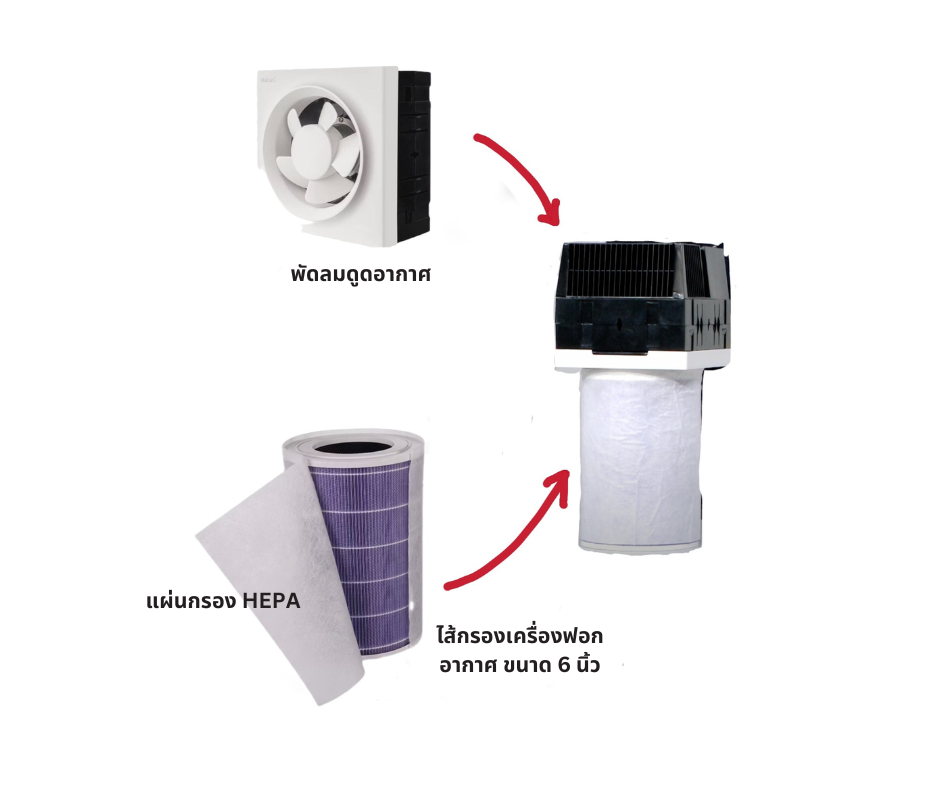
Equipment:
1. 6-inch air purifier filter
2. An exhaust fan that matches the diameter of the filter core
3. Glue gun/tape
4. HEPA filter
Steps to Assemble:
Attach the exhaust fan to the air purifier filter by placing the fan upside down.
Secure the exhaust fan to the filter using a glue gun or tape to prevent air leaks at the joints.
Wrap the HEPA filter around the air purifier filter to enhance filtration efficiency and extend the filter's lifespan, as HEPA filters are inexpensive and can be replaced frequently.
Plug it in and turn it on.
The installation position should not be placed close to walls; there should be at least 10 cm of space from surrounding walls to allow for adequate air intake. It should not be installed in bathrooms or areas with high humidity, as this could lead to mold growth on the filter and the purifier.
2) Creating a Positive Pressure Environment
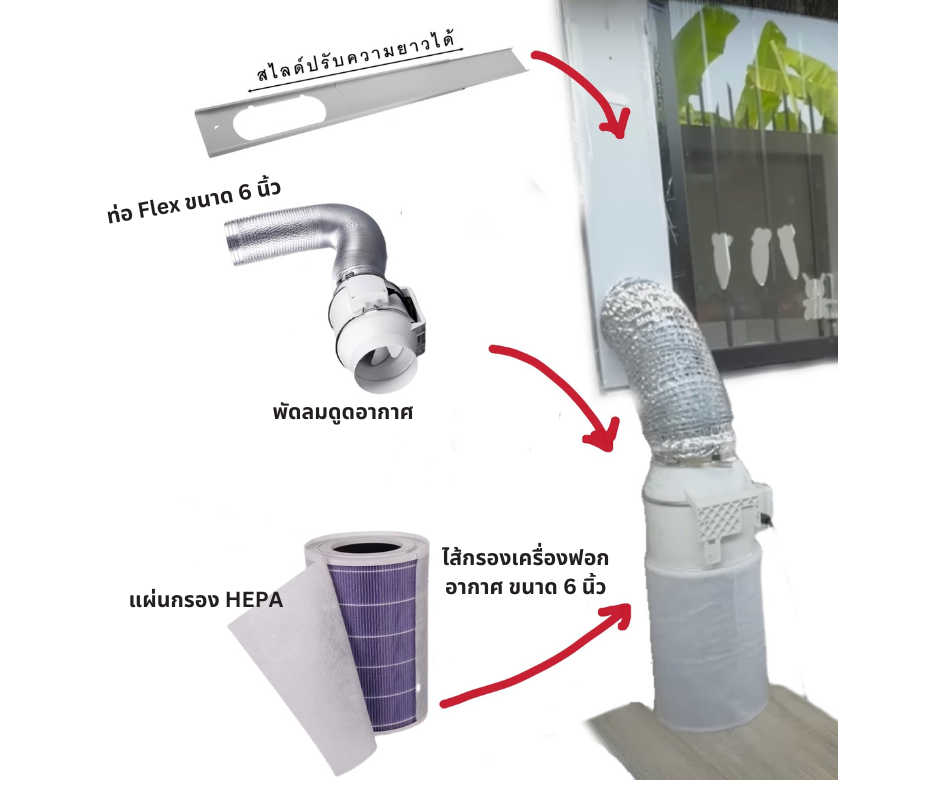
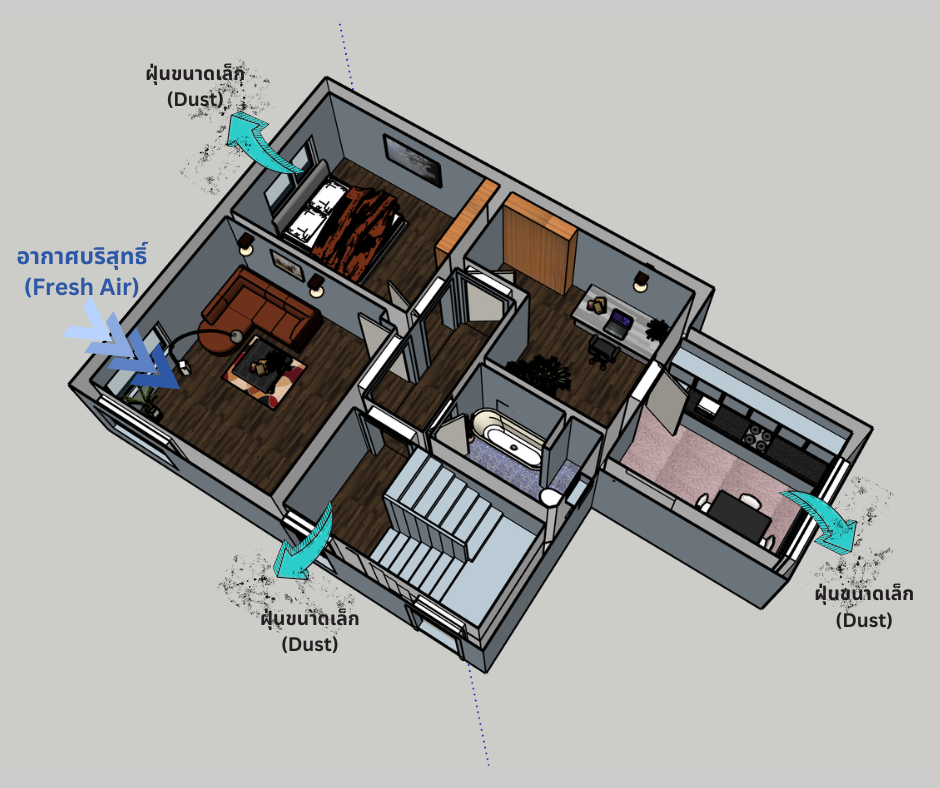
While using an air purifier can help reduce PM2.5 levels indoors to some extent, it may not be sufficient, as tiny particles can infiltrate through various gaps, especially small openings in doors and windows. Creating a positive pressure environment inside buildings is an interesting supplementary method, which involves maintaining higher air pressure inside than outside to prevent PM2.5 and other particles from entering. The positive pressure system works in conjunction with an external ventilation system that has been filtered, allowing clean air to continuously flow into the building. This method not only helps reduce PM2.5 but also lowers carbon dioxide levels and improves indoor air quality. This can also be done DIY-style, with easy installation and removal, and is also based on information from AiroTEC CMRU, with a budget of 2,000 baht.
Positive Pressure Environment
Equipment:
1. 6-inch air purifier filter
2. An exhaust fan that matches the diameter of the filter core, in a round mask style
3. Glue gun/tape
4. HEPA filter
5. 6-inch Flex duct
6. Air slide plate (used with portable air conditioners)
Steps to Assemble:
Attach the exhaust fan to the air purifier filter, similar to the air purifier assembly steps.
Cover the Flex duct over the back duct of the exhaust fan.
Install the air slide plate at the window opening to allow air to enter the house without needing to drill into the wall. Choose a room that does not frequently have people entering and exiting.
Connect the other end of the Flex duct to the air slide plate, sealing the joints with a glue gun or tape.
Plug it in and turn it on.
The positive pressure system should be installed in a shaded area, away from direct sunlight and rain, as moisture can lead to mold growth, and heat can cause the incoming air to be excessively warm, putting extra strain on the air conditioning system.
3) Dust-Proof Nets
The “Dust-Proof Net” project is an innovation that modifies ordinary cotton nets to create PM2.5 dust-free zones, initiated by the Department of Health, Ministry of Public Health, building upon the DIY air purifier concept by using clean air from the air purifier inside the net.
Tests have shown that the dust-proof net can reduce PM2.5 levels by over 80% within 2-3 minutes, making it suitable for low-income individuals living in open homes with gaps or who cannot seal off rooms to create dust-free environments. This is especially beneficial for vulnerable groups, such as bedridden elderly, young children, and at-risk patients with respiratory diseases, skin conditions, conjunctivitis, asthma, and lung cancer.
The dust-proof net can be made using just four main components: a cotton net, an air purifier (or DIY version), a PM2.5 dust meter, and an emergency bell, with the net size tailored to the user.
Health Center 1 in Chiang Mai has produced 300 dust-proof nets as prototypes to distribute to at-risk patients and has collaborated with various agencies to expand this project to other areas.
While the dust-proof net effectively reduces PM2.5, caution should be exercised, especially for bedridden patients. Symptoms should be closely monitored, and emergency equipment should be readily available. Maintenance should include hand-washing the net and regularly changing the air purifier filter, especially in high-dust areas.
4) Dust-Reducing Plants
The Forest Research and Plant Species Conservation Office, Department of National Parks, Wildlife and Plant Conservation, Ministry of Natural Resources and Environment, published a list of “Dust-Reducing Plants” in 2020, compiling species effective at trapping general dust using morphological characteristics, such as dense foliage and branches, which increase leaf and branch surface area, rough leaf surfaces, and rapid growth (absorbing pollutants and releasing water or oxygen). Planting a mix of different species can further enhance dust-trapping efficiency.
Planting areas and styles can be categorized into seven types:
1) Shade-tolerant shrubs - Suitable for planting in shaded areas receiving less than 3 hours of sunlight, such as under elevated roads. Recommended species include Koy, Kaew, various Weeping Figs, Chai Koy, Jang, Yellow Palm, and Mok Ban, etc.
2) Sun-tolerant shrubs - Require at least 3 hours of sunlight daily, suitable for planting as hedges. Recommended species include Kanikarn, Thong Urai, Yitho, Khem, and various native shrubs or bamboos, such as Ruk Bamboo and Leang Bamboo.
3) Shade-tolerant trees - In shaded areas with pollution that require more care than usual, they should be watered frequently. Suitable for planting in partially shaded sidewalks with 2-3 hours of sunlight, such as under electric trains. Recommended species include Mangrove, Pikul, Lamduan, Sok Nam, Sok Khao, and Sok Lueang, etc.
4) Sun-tolerant trees in limited areas - Suitable for open sidewalks 2-5 meters wide with full sunlight. Small or easily pruned trees with non-invasive roots are recommended, such as Pradipat Pine, Honeycomb, Talung Pling, Jang, and Tamarind, etc.
5) Sun-tolerant trees in wide areas - Large trees 20-30 meters tall, suitable for open areas without buildings or power lines. Recommended species include Sea Pine, Nontree, Tamarind, Pikul, Huakrajong, and Kalpaphruek, etc. When planting on sidewalks, it is advisable to alternate with other shade-providing trees or climbing plants.
6) Climbing plants - Plant to create trellises with materials for climbing. Drought-resistant and disease-resistant climbing plants that receive at least 3 hours of sunlight daily are recommended for areas larger than 6 square meters, such as Nail Flower, On Vine, Pukwan, and Pukwan, etc.
7) Climbing plants with wall-adhesive roots - Climbing plants that adhere well to walls should be pruned if they grow too quickly. They require watering once or twice a week, depending on the season. Recommended species include Yellow Chatchawan, Geckos, Money Plant, and Variegated Pothos.
Indoor plants
Research indicates that Jang, Indian Rubber Tree, Boston Fern, and Australian Sword Fern help reduce dust and absorb carbon dioxide. Snake plants release oxygen at night, making them suitable for bedrooms.
See you again next month!
References
https://www.hfocus.org/content/2025/01/32758
https://www.hfocus.org/content/2024/04/30243
http://www.stinglessworks.co.th/hivetech/positive.php
https://youtu.be/oyw-SsaoJdA?si=iE0Ihiq6Mbhx3MTf
https://youtu.be/iC6Chos9Jdo?si=tWUt2cp6QqqdgiXw