Trends in the Thai Automotive Dealer Business (Kasikorn Research Center)
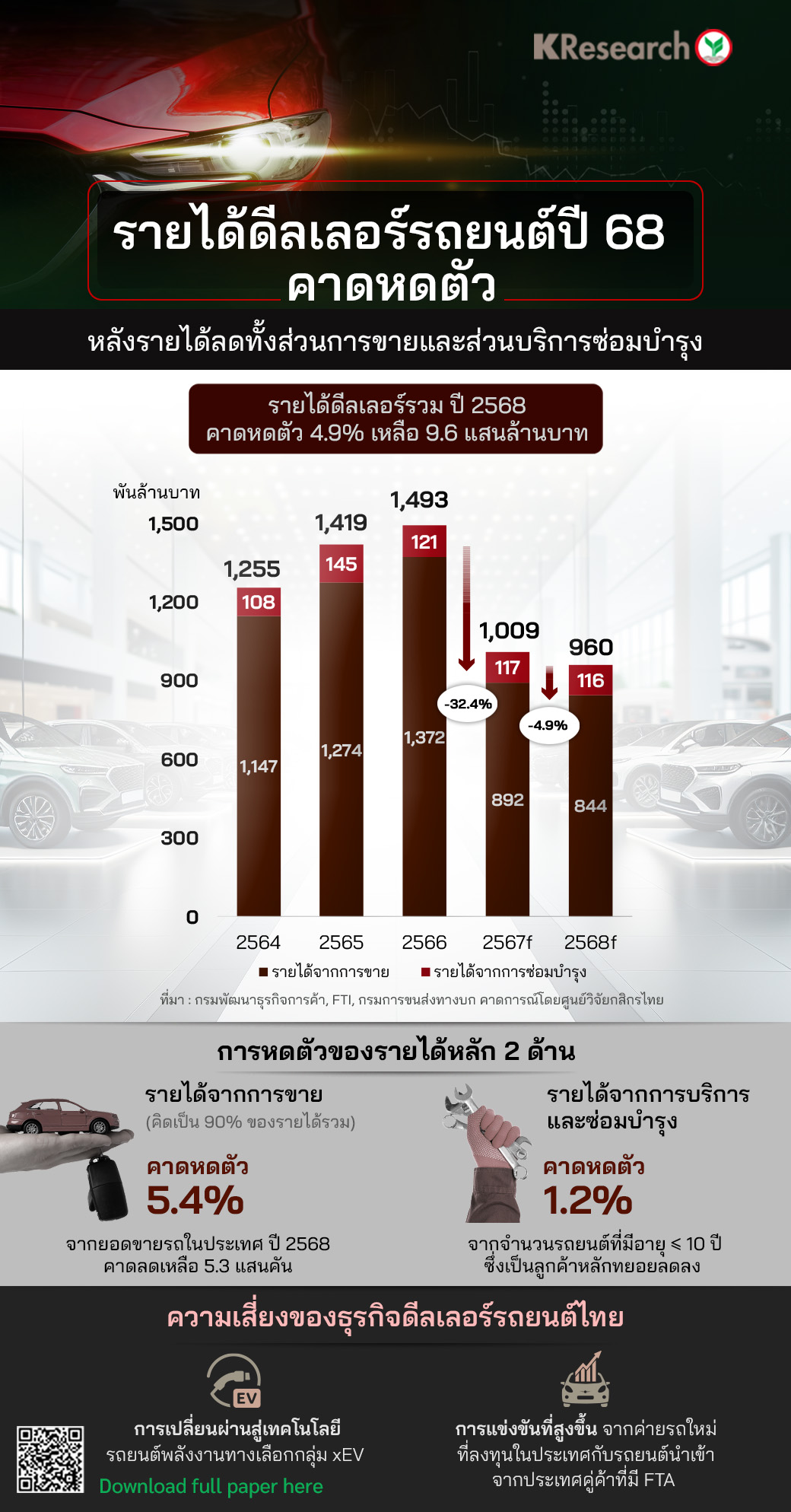
- The automotive dealer business is expected to face ongoing challenges in 2025, with overall revenue for car dealers projected to shrink by 4.9%.
- This decline is primarily driven by a 5.4% drop in sales revenue due to anticipated domestic car sales falling to 530,000 units in 2025, particularly in the commercial vehicle segment, which is expected to contract significantly due to purchasing power risks compared to passenger cars. Meanwhile, passenger cars may see a decline in traditional internal combustion engine (ICE) vehicles, in contrast to the expanding xEV segment, which includes HEVs, PHEVs, and BEVs. It is expected that luxury BEVs will grow faster than the overall BEV market, as buyers in this segment tend to have stable incomes.
- Revenue from maintenance services is also expected to decline by 1.2%, as the number of vehicles aged 10 years or less, which are the main customers, is projected to gradually decrease to 8.89 million units following a series of crises affecting car sales.
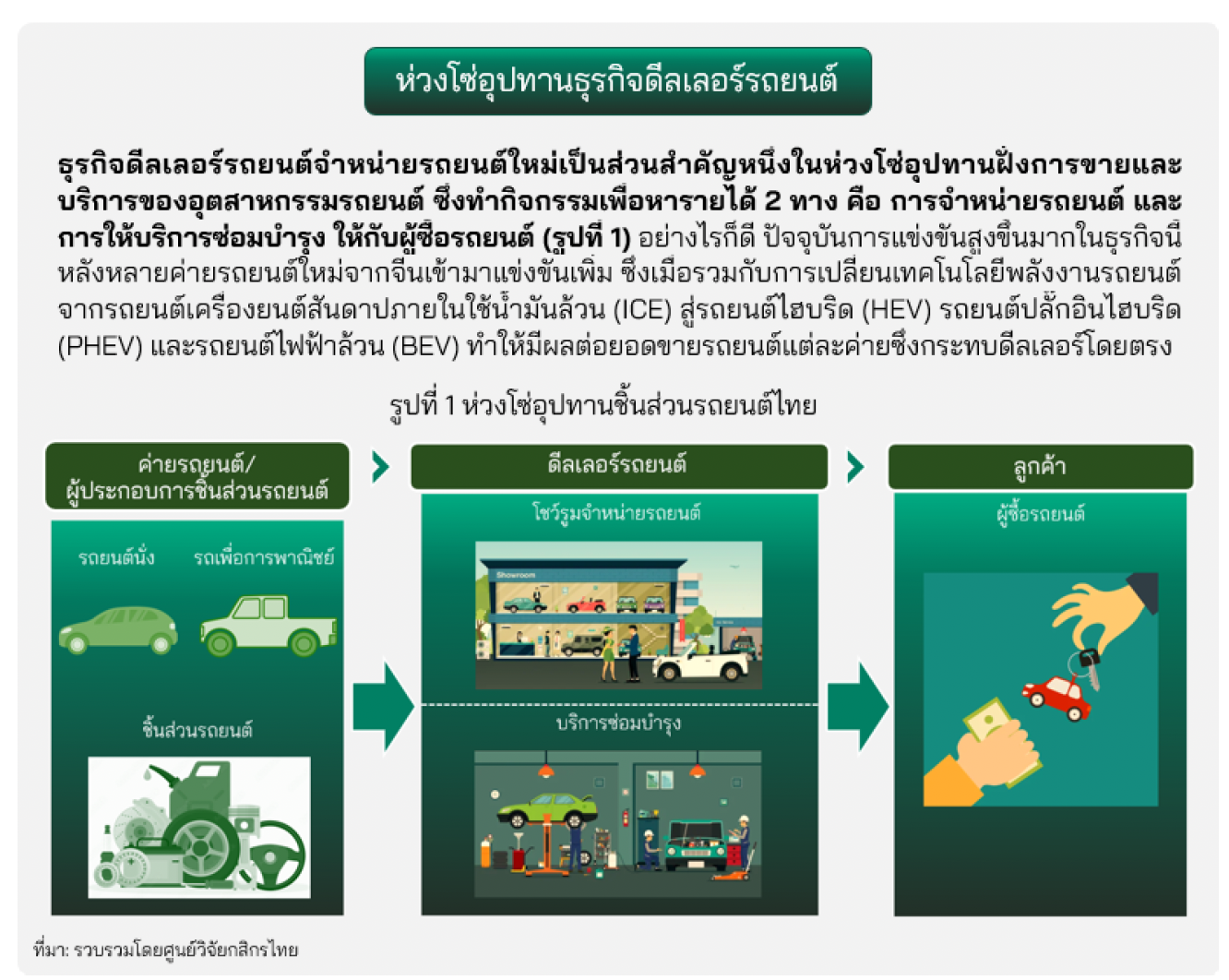
In 2024, the automotive dealer business in Thailand will face difficulties from the start of the year due to a significant decline in new car sales and intensified price competition. This has led to reduced revenue from car sales for dealers and increased costs as they bear the burden of unsold vehicle stocks and interest expenses on loans. Consequently, dealers with insufficient financial resilience are expected to shut down, leading to a projected 1.4% decrease in the number of car dealers in 2024.
Continuing into 2025, it is anticipated that the various issues affecting the domestic automotive market will not be resolved quickly, as they represent significant challenges that require time to address. This will compel automotive dealers to adapt in various ways to find new revenue streams, even though it will not be easy. This includes seeking additional income from maintenance services and expanding or transitioning to represent other car brands that are still performing well in sales.
Revenue trends for automotive dealers in 2025
Total revenue for automotive dealers in 2025 is expected to decrease by 4.9%
Dealer revenue is expected to continue declining from 2024, which saw a significant contraction of over 32.4% (as shown in Figure 2) due to two main factors: (1) a 5.4% decline in sales revenue as domestic car sales are projected to continue decreasing, and (2) a 1.2% decline in maintenance revenue as the number of vehicles serviced decreases.
The decrease in sales revenue stems from the anticipated decline in domestic car sales in 2025.
In 2025, domestic car sales are expected to contract by 5.4%, reaching 530,000 units (as shown in Figure 3), following a 27.8% decline in 2024 due to diminished purchasing power and high levels of automotive debt.
The commercial vehicle segment is expected to be the most affected, with a potential contraction of 6.8% following a projected decline of 38.4% in 2024, led by pickups, which account for 85% of total commercial vehicle sales (as shown in Figure 4). This is due to buyers being from a group with uncertain incomes, significantly impacting their ability to secure loans, indicating that dealers focusing on commercial vehicle sales, especially pickups, may face greater revenue losses than other segments.
The passenger car segment is expected to contract less than commercial vehicles, at 4.4% in 2025, due to a significant anticipated decline in ICE passenger car sales, despite the growth of the xEV passenger car segment, which is expected to increase its market share to 73% of total sales (as shown in Figure 5). The xEV passenger cars with the highest growth are HEVs, followed by PHEVs, while BEVs, although also growing, are expected to do so at a lower rate of 2.9% due to heightened price competition, concerns about usability, resale values, and charging station availability.
However, when considering only the luxury BEV segment, there is an opportunity for growth of 3.8% in 2025, which is higher than the overall BEV passenger car market (as shown in Figure 6). This is due to increased price competition and the stable income of buyers, making them less affected by stringent lending conditions compared to lower-priced BEVs.
The increasing popularity of xEV passenger cars, following heightened price competition, will positively impact the sales revenue of dealers focusing on xEVs, contrasting with ICE passenger car dealers who are experiencing a significant decline in popularity, resulting in reduced sales revenue. This situation is also occurring among dealers of commercial vehicles, who are facing severe sales downturns.
The impact on each dealer's sales revenue will depend on various factors, including future consumer preferences for specific car brands, which may stem from new model launches and promotions, location, and the financial resilience of the business. This will lead to different strategic decisions for coping, ranging from seeking ways to increase maintenance revenue to shifting to represent other car brands or, in the worst-case scenario, exiting the business altogether. We have already begun to see some of these adaptations and expect to see more in 2025.
Maintenance revenue is also expected to decline due to the projected decrease in vehicles aged 10 years or less.
While seeking to increase maintenance revenue to offset losses from sales is a primary adjustment strategy for dealers, it is expected that the results may not be as significant as hoped. In 2025, the number of vehicles aged 10 years or less, which are the main customers for automotive dealers, is projected to decrease by 4.2% to 8.89 million units (as shown in Figure 7), due to recent events affecting the Thai automotive market significantly, including the rush to purchase first cars, the impact of COVID-19, and the recent issue of high bad debts, leading to a continuous decline in the number of vehicles aged 10 years or less on the roads.
Risks for the Thai automotive dealer business
- The transition to alternative energy vehicle technologies, particularly xEVs, will directly impact ICE vehicle sales, causing manufacturers that primarily sell ICE vehicles, especially in the passenger car segment, to face revenue declines as they transition to new technologies faster than others.
- Increased competition from new manufacturers investing in the country and imported vehicles from FTA partner countries may lead to intensified price competition and promotions, resulting in dealers potentially facing reduced profit margins, particularly in lower market share segments that are less competitive than others.
|
This research report was prepared by Kasikorn Research Center Co., Ltd. (KResearch) for general dissemination, based on publicly available information or information deemed reliable at the time of preparation, which may change over time. KResearch does not guarantee the accuracy, reliability, suitability, completeness, or timeliness of such information and does not intend to solicit, recommend, or influence any decision-making. Therefore, you should carefully study the information and exercise caution and discretion before making any decisions. KResearch will not be liable for any damages arising from the use of such information. Any information contained in this research report is the property of KResearch and/or third parties (as applicable). The use of such information (in whole or in part) must acknowledge the ownership rights of KResearch and/or third parties (as applicable) or the source of that information. You may not reproduce, modify, adapt, alter, forward, publish, or engage in any commercial use of such information without prior written permission from KResearch and/or third parties (as applicable). |
[1]HEV refers to hybrid vehicles, PHEV refers to plug-in hybrid vehicles, and BEV refers to battery electric vehicles.