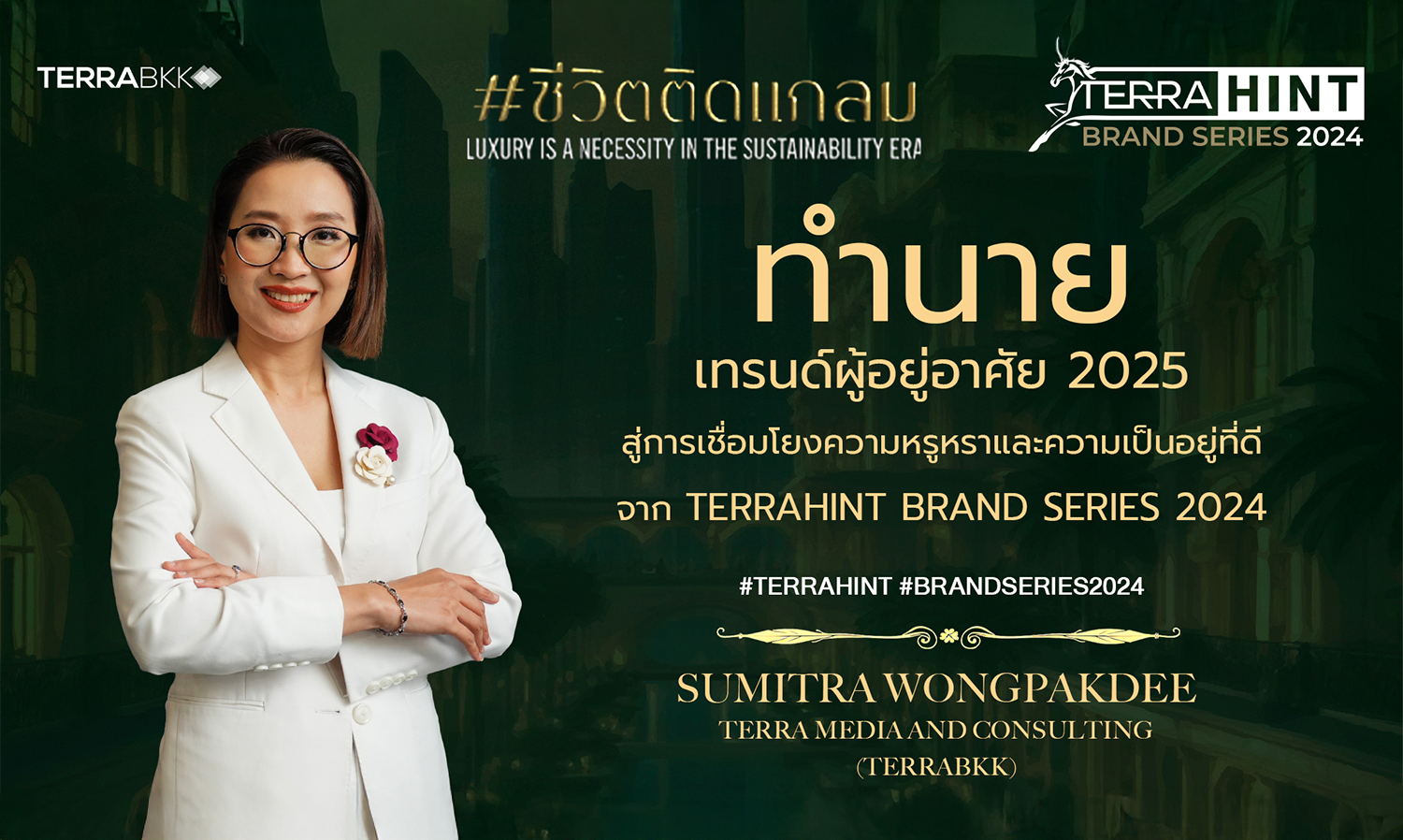
Predicting Residential Trends 2025: Bridging Luxury and Well-Being from the TERRAHINT Brand Series 2024
Last year posed significant challenges for the real estate industry. Although we have moved past the COVID-19 crisis for several years, property developers continue to face various impacts, including changes in resident behavior and economic uncertainties. Every year, TERRABKK (Terra BKK), a Thai real estate media and consulting firm, takes this opportunity to update trends in consumer housing behavior and purchasing for property developers and stakeholders in the industry to use as a compass for residential development through the TerraHint Brand Series seminar.
This year's seminar, marking its 7th consecutive year, is titled TERRAHINT Brand Series 2024: Luxury is a necessity in the sustainability era. #LifeInGlam. It focuses on brand development strategies towards luxury, addressing the sustainability era, to share knowledge in product development, services, and brand creation in the real estate business. This year, the concept of luxury philosophy is integrated with sustainable development and human well-being.
Summary of the research “Brand Powerful & Consumer trend 2025” by Ms. Sumitra Wongphakdee, Managing Director of Terra Media and Consulting Co., Ltd. (TerraBkk.com)
The research for 2024 aims to serve as a compass for real estate development in 2025, focusing on Consumer Insight: The Sense of Luxury and Design for Wellbeing. It delves into consumer and resident behavior under the concept of Luxury is a necessity in the sustainability era, gathering data from a sample group using two methods:
1. Focus Groups (Qualitative Research: Focus Group) consisting of 5 groups. This year differs from previous years as it employs a Design Thinking Process, selecting only those planning to purchase residential properties and grouping them by generation and purchasing preferences.
2. Quantitative Research (Online Survey) from a sample of 4,000 sets, but only 2,500 sets were calculated, selecting only quality samples that meet the criteria. Most (80%) reside in Bangkok and its vicinity, while 20% are from other provinces.
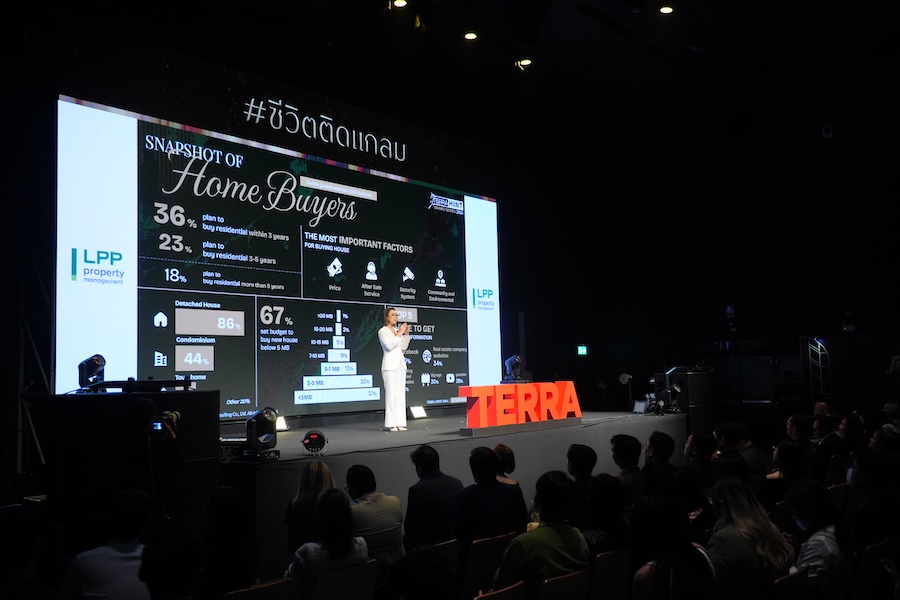
Consumers Delay Purchases - Gen Y Will Make a Comeback
“This year, we found that the sample group with a Household Income of over 200,000 Baht has increased to about 12%, and this year, most are Gen Y. This reflects that the housing market trend for 2025 will see Gen Y returning. In fact, this group has been coming back for 2-3 years, but they lacked purchasing power. However, they are starting to return now. Another finding is that the planning to buy a house is likely to be delayed, as consumers feel there is no rush to buy, even with purchasing power, because they believe it is not the right time to buy and feel that existing projects do not meet their preferences.”
Among all respondents, only 36% believe they will buy a house within 3 years, a continuous decline from 42% in 2023, even though these individuals have surveyed 3-5 projects. Their interest still primarily lies in single-family homes, followed by condos and townhomes, with a focus on budget.
“The upper market housing priced at 20 million Baht and above is still only 1%, indicating that project developers should assess demand in the target area before proceeding, considering whether there is a demand of up to 1%. If the supply in the area exceeds 1%, the project should be postponed.”
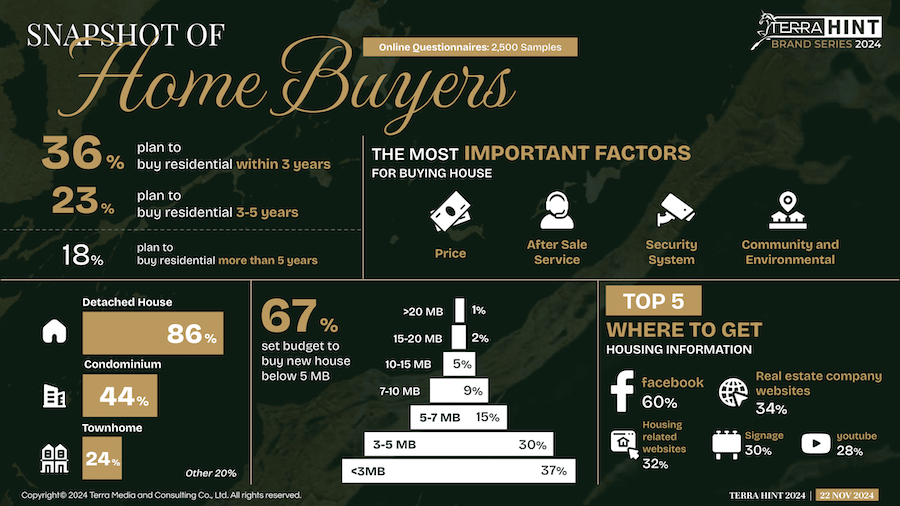
Media Consumption Behavior for Housing: Facebook Leads, Followed by Websites and Signage
In terms of media consumption behavior for housing purchase decisions, respondents indicate that Facebook remains the top source, followed by the developers' websites. Consumers view websites as credible sources for each project, providing information that shows the brand has made commitments to consumers.
Ranked third, consumers also consider news websites or real estate-related sites, as they see other third-party websites discussing projects and brands as confirmations of the credibility and information of those projects and brands.
Moreover, various signage still influences purchasing decisions, as consumers have returned to outdoor activities after the COVID-19 period and often visit actual project sites. Additionally, they value YouTube for its accessibility and the ability to watch videos continuously, finding video content more realistic than still images and providing clearer views of the atmosphere.
Baby Boomers Are Buying More Homes
The research findings indicate that in 2024, the group interested in purchasing single-family homes consists of Gen Y and Gen X, primarily married couples with children, seeking larger living spaces than their current residences, with price being the top priority due to economic uncertainties.
For those interested in condominiums, they are mostly single individuals who not only prioritize budget-friendly prices but also value after-sales service and proximity to BTS stations, alongside brands that reflect their identity.
Meanwhile, the townhome interest group includes both singles and married couples with children, indicating that their current residences do not meet space requirements. They choose townhomes because they want functionalities similar to single-family homes and look for projects that can fully meet their needs, along with attractive promotions.
“Considering data from TerraBkk's research over the past 7 years, it is evident that every generation is extending the timeline for purchasing residences. Interestingly, this year, the Baby Boomers are showing increased interest in buying homes due to their current residences not meeting functional needs and a desire for more comfortable living spaces, both in terms of functionality and location.”
Different Social Media Platforms Have Different Engagement Hooks
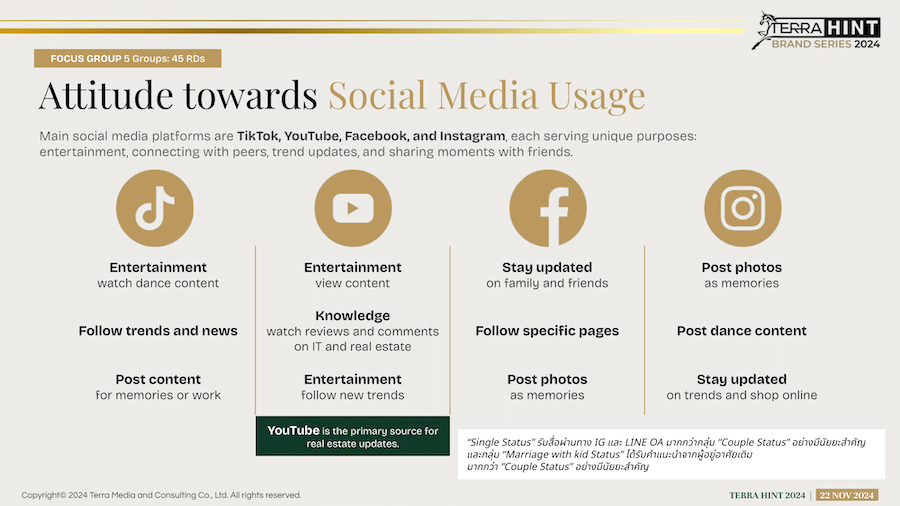
Although social media platforms like TikTok have gained popularity in recent years, for those deciding to purchase housing, TikTok is still primarily an entertainment interest. Therefore, property developers should present project content that feels fun to engage this audience.
In contrast, YouTube is sought for knowledge and longer content, while Facebook is used for news consumption. Users perceive Facebook as a source for news, feeling it serves a role similar to traditional broadcast television. Instagram is used for memory recording and online shopping.
“This survey reflects that property developers should create review content on YouTube and link it on their websites to ensure customers can continuously search for the brand. Consumers are still receiving ads through Facebook, but many express dissatisfaction with lead generation from Facebook, noting that customers who register do not receive immediate follow-up. Feedback from consumers indicates a lack of contact due to brands proposing other projects to them, and issues arising from backend CRM systems more than lead reception.”
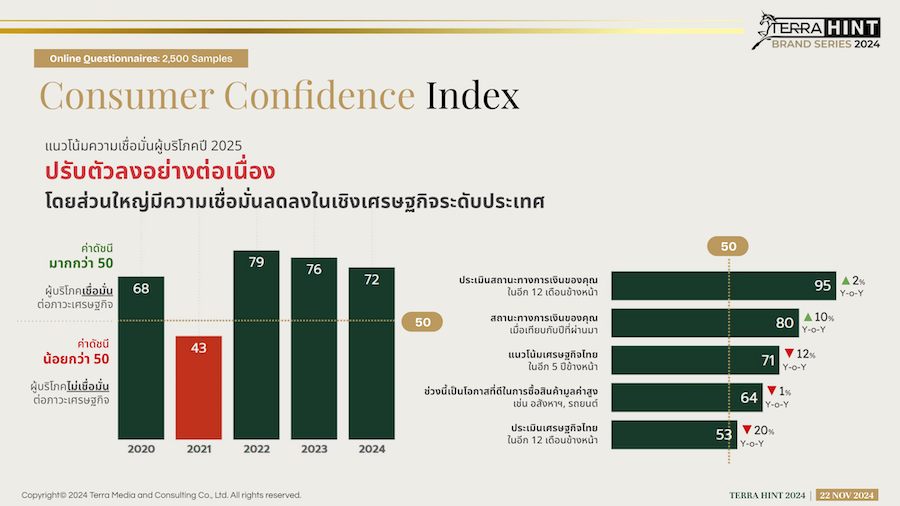
Confidence in the Thai Economy Decreases in 2024
Regarding confidence in the Thai economy over the next 12 months, it has decreased compared to last year. According to TerraBkk's analysis from a real estate perspective, it is expected to improve in the second quarter of 2025, particularly for residences located near industrial estates and educational institutions.
“In the upper market, purchasing for residence is not likely to face issues, but for investment purchases, a niche market will emerge, as single-family homes priced between 10-15 million Baht will be rented to expatriates and SMEs conducting business in Thailand, yielding well, especially for rentals to Chinese nationals, as most Chinese prefer to live in condos in their home country. When they come to Thailand, they seek homes with good facilities. The upper market perceives that in the next 12 months, the economy will not improve significantly due to risks that the upper market is not showing much growth compared to the past two years.”
Exploring Demand for Well-Being Design Homes
When considering the Well-Being Design aspect in housing, it is found that there are three types of Innovation Homes emerging in today's perspective:
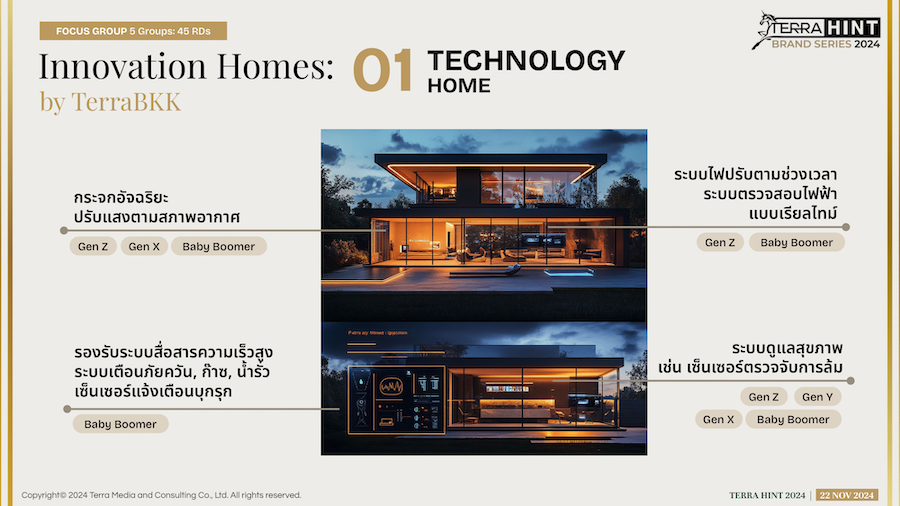
- Technology Home: Consumers of Technology Homes desire time-based lighting systems, health monitoring systems, fall detection sensors, and smart glass that adjusts light. Each generation has different needs.
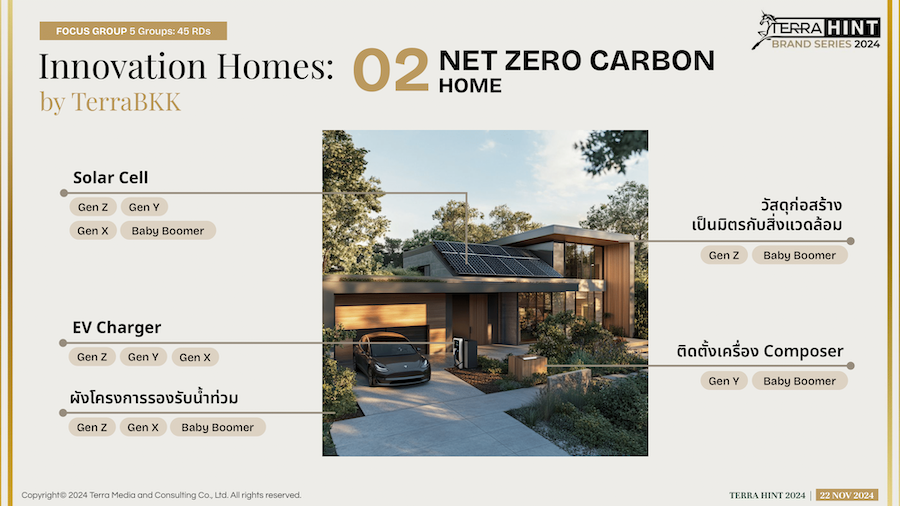
- Net Zero Carbon Home: Must include solar cells, EV chargers, waste disposal systems, and eco-friendly materials. Each generation has different needs.
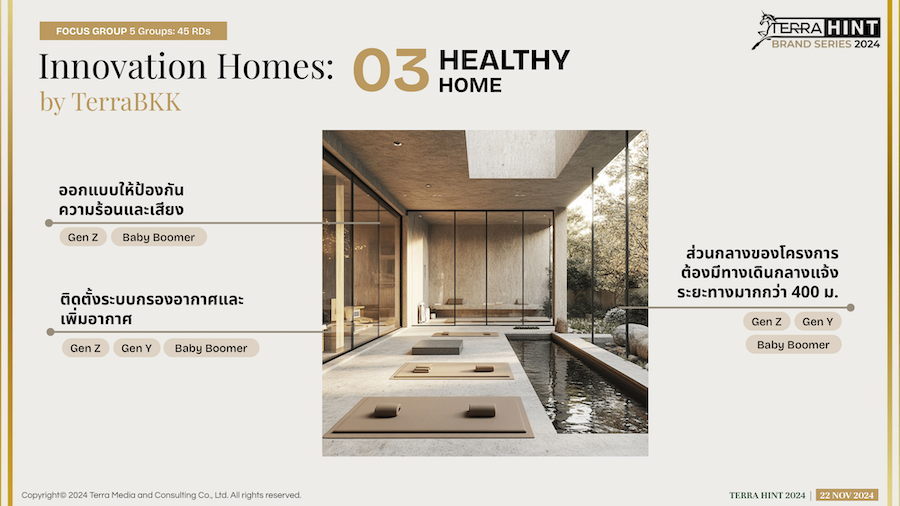
- Healthy Home: A home that promotes good health must incorporate functions related to heat, sound, light, temperature, and provide common areas for actual exercise.
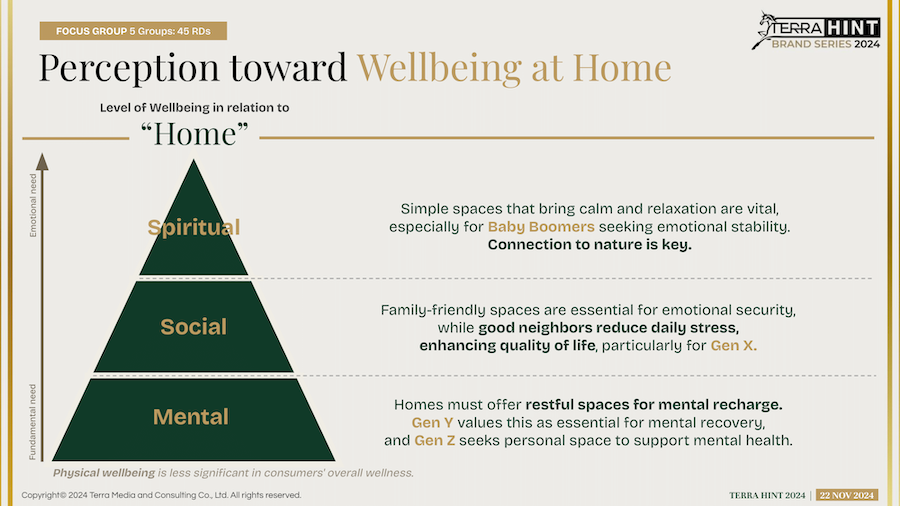
“TerraBkk has been tracking awareness of Well-Being in housing for 3 years. This year, the mental level of Well-Being varies among generations. Gen Y and Gen Z feel that homes must meet their needs and provide happiness, while Gen X seeks social living spaces, desiring friends and community. Baby Boomers want homes that connect with nature and are close to the environment, enhancing both physical and mental health.”
For the Well-Being Space, Gen Z prioritizes three main areas: Family Room, Working Room, and Balcony. Gen Y is interested in the Working Room and Bedroom, while Gen X desires social spaces such as common areas, gardens, and balconies for activities. In contrast, Baby Boomers seek a prayer room for a spiritual area.
Redefining Luxury: Quality, Convenience, and Attention to Detail
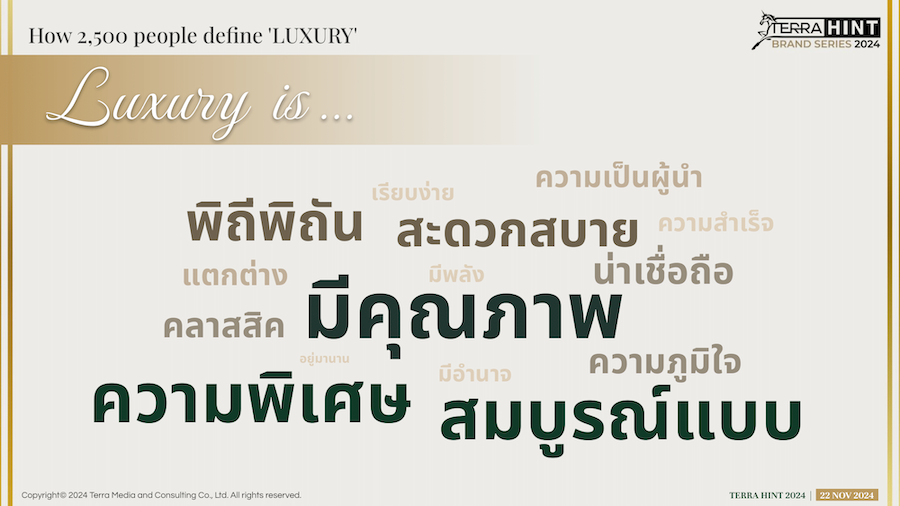
This year's survey is special, exploring perspectives on luxury, revealing that today's definition of luxury focuses on quality, convenience, and attention to detail, no longer tied to price or extravagance. Each generation has different attitudes towards luxury. Gen Z values luxury for its social value, while Gen X and Gen Y seek unique value, desiring distinct experiences. Baby Boomers, on the other hand, seek emotional relaxing comfort, wanting to spend personal time happily to create emotional value.
Luxury goals at the personal level include privacy and comfort, while at the social level, it involves social acceptance. At the ambience level, it seeks tranquility.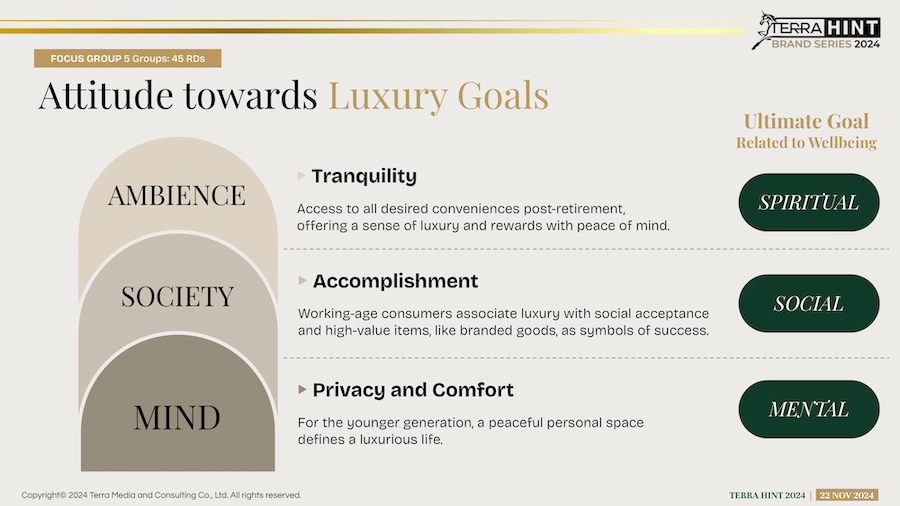
When categorizing luxury lifestyles, they can be divided into four groups:
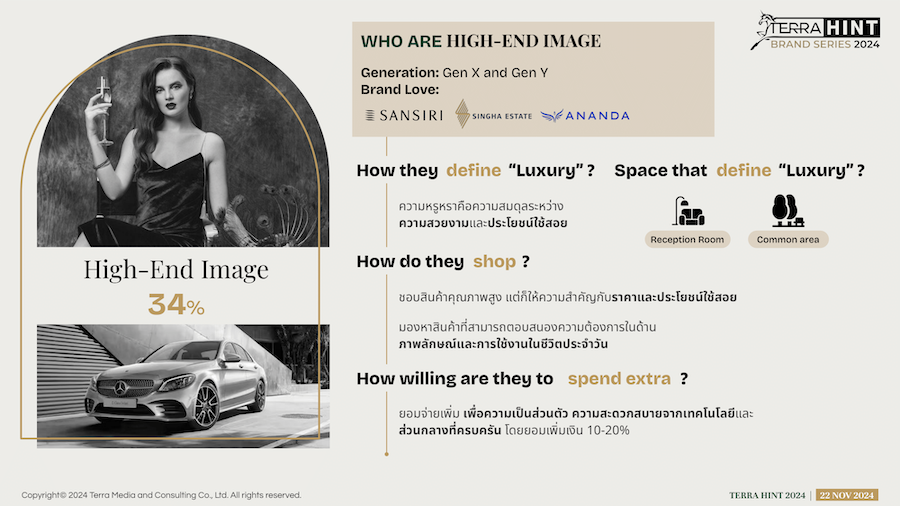
1. High-End Image Group: This group seeks perfection, valuing luxurious living experiences, including the use of branded products that reflect a balance between aesthetic appeal and practicality in daily life, willing to pay an additional 10-20% for privacy and convenience from comprehensive technology and amenities.
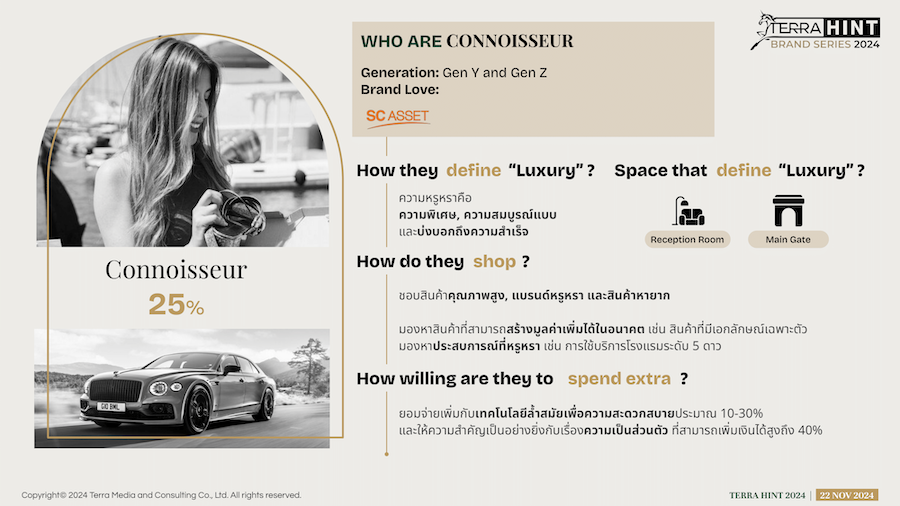
2. Connoisseur Group: This group views “Luxury” as specialness and perfection that signifies success, seeking products that can appreciate in value over time, such as unique items or luxurious experiences like five-star hotel services, willing to pay an additional 10-30% for advanced technology for convenience, and placing great importance on privacy, which they may pay up to 40% more for.
“It is found that Gen Y and Gen Z enjoy art consumption, and the Connoisseur group does not choose based solely on luxury but also requires high quality or rare products, enjoying unique experiences.”
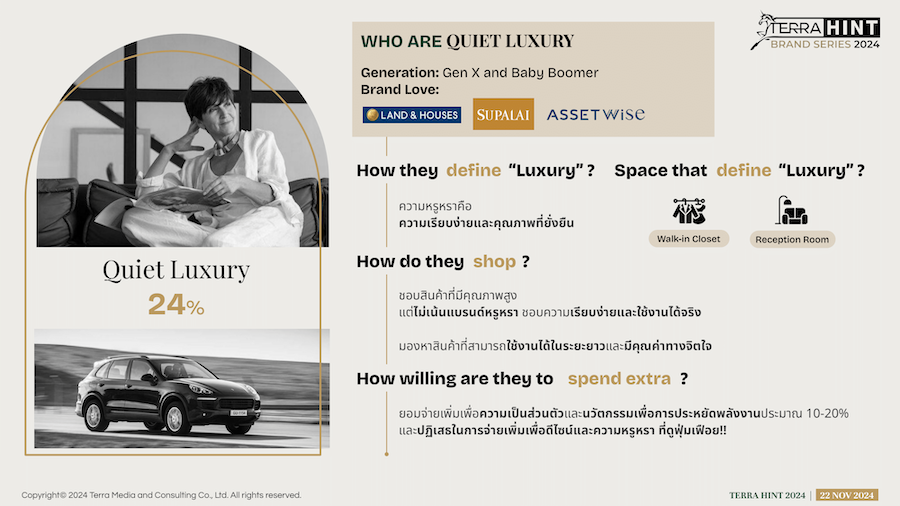
3. Quiet Luxury Group: This group sees “Luxury” as simplicity and sustainable quality, preferring high-quality products without emphasizing luxury brands, focusing on practical long-term use and emotional value, willing to pay an additional 10-20% for privacy and energy-saving innovations, and rejecting additional payments for extravagant designs.
“Porsche is often compared as a Luxury Image, but in reality, it embodies a Quiet Luxury design identity, maintaining its original identity, while many Thais tend to expect it to represent a High-End Image.”
4. Chic Innovator Group: This group sees “Luxury” as living life to the fullest and expressing individuality, enjoying luxury brands, rare products, and the latest technology, seeking luxurious and unique experiences, valuing self-expression through luxury branded products, and not willing to pay extra in many areas, looking for a balance between price and quality.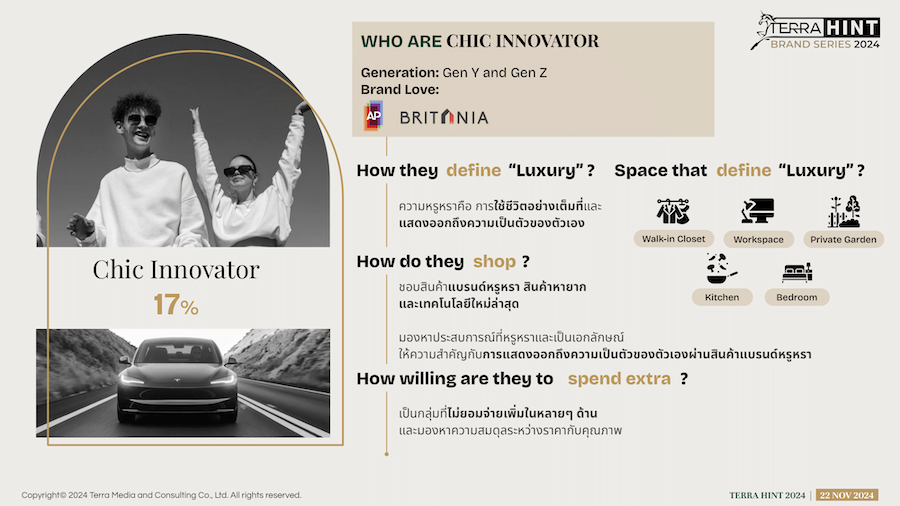
“Overall, when categorizing housing prices, areas indicating luxury for homes priced above 20 million Baht will focus more on common areas and garden spaces within the house, including bathrooms and dining areas. The mass market will be similar, but the dining area is particularly interesting, as it holds significance across each group. Therefore, it is essential to prioritize dining areas.”
TerraBkk hopes that the findings from this research will serve as a tool to enhance the work of real estate professionals and contribute to the advancement of the real estate industry towards new developments.