International Schools in Thailand Continue to Grow Despite Overall Decline in Student Numbers and Schools
-
The international school sector in Thailand continues to grow, contrasting with the overall decline in student numbers and schools in the country, which is attributed to decreasing birth rates. Currently, the popularity of foreign education programs is on the rise, and the number of parents with the financial capacity to invest in education is increasing, leading to a growth in the appeal of international schools.
-
In 2024, the international school market is expected to grow by 13% from the previous year, with a value exceeding 80 billion baht due to an increase in the number of international students and schools, along with rising tuition fees.
-
International schools are also showing a trend of expanding beyond Bangkok, due to limited space in the capital and the competition among schools in the densely populated area.
Trends in the School Sector in Thailand: Student Numbers
The overall number of students in Thailand is continuously declining, in contrast to the number of international students. In the 2024 academic year, the number of students in Thailand decreased by 1.7% from the previous year, while the number of international students increased by 10.2% (see Figure 2).
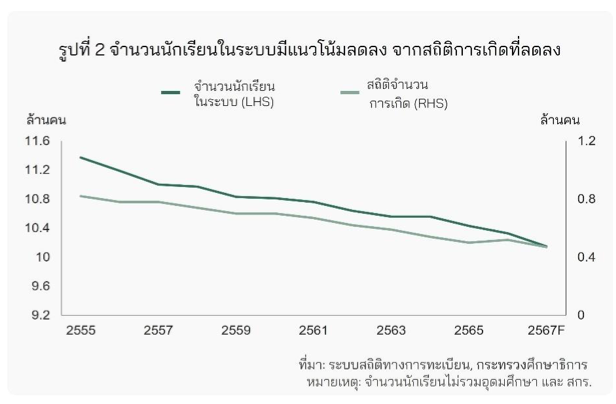
Continuously declining birth rates have resulted in a downward trend in student numbers. Between 2012 and 2024, the average annual birth rate decreased by 4.5%, while the overall decline in the number of students in the entire system was 0.9%. However, the number of international students has shown an average growth rate of 6.9% per year.
The increase in international students in Thailand is driven by several factors, one of which is the rise in foreign students that corresponds with the growing number of expatriates in managerial positions working in Thailand, which has increased by an average of 0.6% per year over the past decade. Additionally, the popularity of foreign education programs has risen due to the development of curricula that are more relevant and adaptable compared to Thai curricula, along with the increasing investment capacity of parents, reflected in the projected 24% increase in the number of individuals with assets exceeding 1 million dollars in Thailand between 2023 and 2027. This is a key factor supporting the growth of international student numbers.
Number of Schools
In 2024, the overall number of schools decreased by 0.5% from the previous year, reaching 33,098 schools. However, compared to the 2012 academic year, this represents a contraction of 6.6%, or about 2,355 schools (see Figure 3).
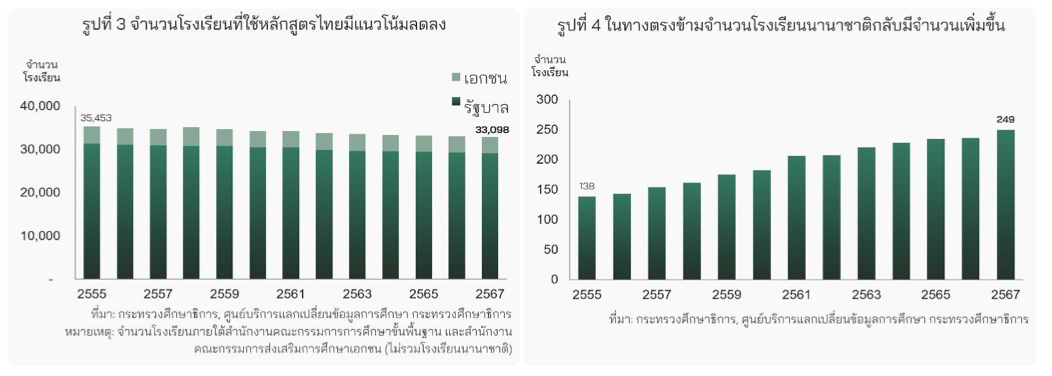
Due to the overall decline in student numbers, there has been a gradual closure of schools between 2012 and 2024, with public schools experiencing an average annual decline of 0.6%, while private schools following the Thai curriculum also saw an average decline of 0.7% per year. In contrast, the number of international schools grew at an average rate of 5.0% per year, in stark contrast to other types of schools (see Figure 4), reflecting the changing landscape of the education sector towards foreign curricula.
Trends in the International School Business
Competition Among International Schools
International schools are increasingly expanding beyond Bangkok. Between 2012 and 2024, the average annual growth rate of both the number of students and international schools located in other regions was higher than that of Bangkok by 4.3% and 6.3%, respectively (see Figure 5).
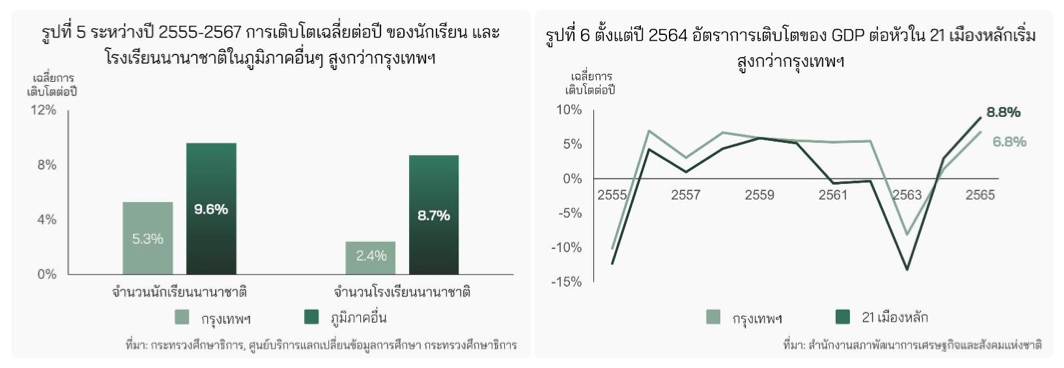
The competition in the international school business has intensified, and the limited space in Bangkok has led international schools to explore new markets in major cities such as Chiang Mai, Rayong, and Phuket. The economies of 21 major cities have grown at rates higher than Bangkok, with a GDP per capita growth rate in 2022 that was 2% higher than that of Bangkok, making markets outside Bangkok more attractive (see Figure 6).
This trend indicates opportunities for expanding international schools into areas outside Bangkok, particularly in the Central and Eastern regions, which are likely to be viable markets due to the number of households with incomes exceeding 100,000 baht per month, second only to Bangkok and its suburbs (see Figure 7). However, since the number of target households in each region is lower than in Bangkok, operators may need to adjust tuition fees to align with the varying income levels of parents in different areas.
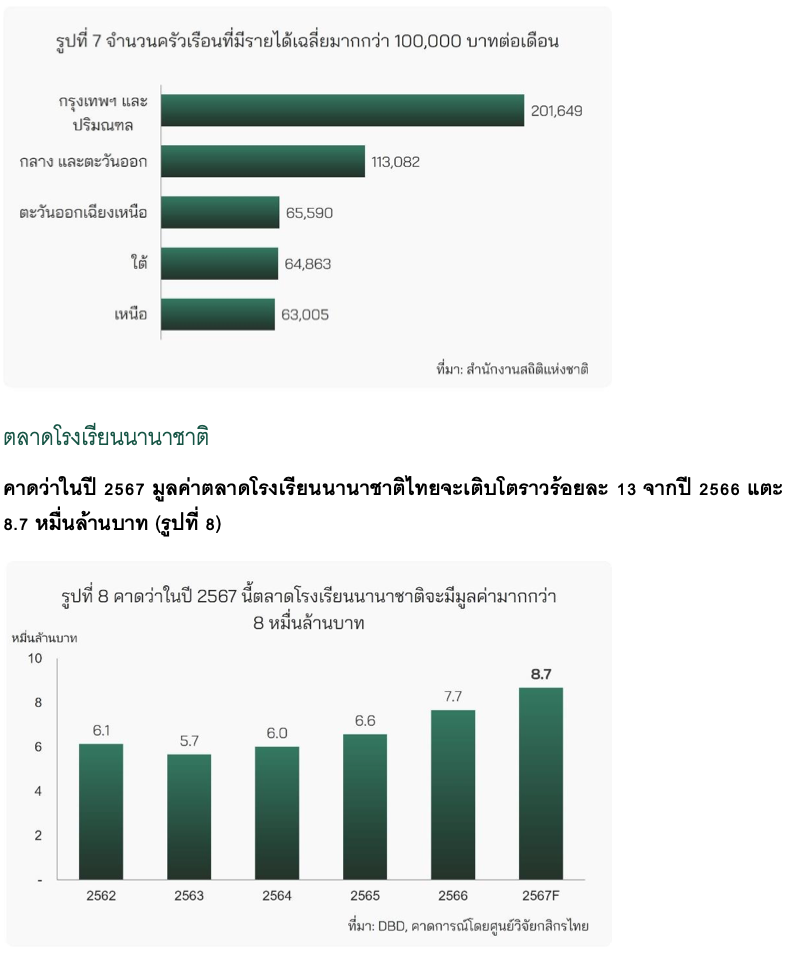
The growth of the market value of international schools in 2024 is driven by the increasing popularity of international curricula and the expansion into new markets, resulting in a 10.2% increase in student numbers from the previous year, along with an average tuition fee increase of 3.8% from the 2023 academic year.
Risks in the International School Business
• The rising tuition fees of international schools may lead parents to consider sending their children to study abroad instead, as the gap between tuition fees has begun to narrow in the 2024 academic year.
The average annual tuition fee for international schools in Thailand is 764,484 baht, while the average annual tuition fee for public schools in New Zealand is approximately 1,150,208 baht.
-
International schools may face challenges from competition with private schools following the Thai curriculum, which are improving in quality and have lower costs. Parents may decide to switch to private schools that offer English programs and teach multiple languages such as Thai, English, and Chinese, which poses a competitive challenge for international schools in the language aspect.
-
Technological advancements have made homeschooling easier, and since the costs of homeschooling are lower than those of international schools, this may impact the number of students in international schools. The cost of GED testing (equivalent to high school graduation in the U.S.) combined with 100 hours of private tutoring is approximately 160,800 baht.