Thai Exports in 2024 Expected to Overcome Severe Crisis, Projected Growth of 2%
The Thai National Shippers' Council (TNSC) forecasts that Thai exports this year can still grow by 1-2% after the first half of the year saw a 2% increase in exports. In June 2024, the trade deficit was 2,489 million baht, urging the government to tighten regulations on foreign investors with low costs flooding the market.
Dr. Chaiyan Charoensuk, President of the Thai National Shippers' Council (TNSC) stated that the international trade situation for Thailand in June 2024 compared to the same month last year (YoY) showed that exports were valued at 24,796.6 million USD, a decrease of 0.3%, while the value in Thai baht was 892,796 million baht, reflecting a growth of 5%. However, when excluding gold, oil, and military equipment, exports in June contracted by 1.6%.
Imports were valued at 24,578.5 million USD, growing by 0.3%, and the value in Thai baht was 895,256 million baht, reflecting a growth of 5.6%. This resulted in Thailand's trade balance in June 2024 showing a surplus of 218 million USD and a deficit in Thai baht of -2,489 million.
The standout products for the second half of the year remain rice, rubber, tires, and food, which are performing well. However, industrial products face challenges, particularly vehicles and components that must compete with electric vehicles (EVs) and electrical appliances.
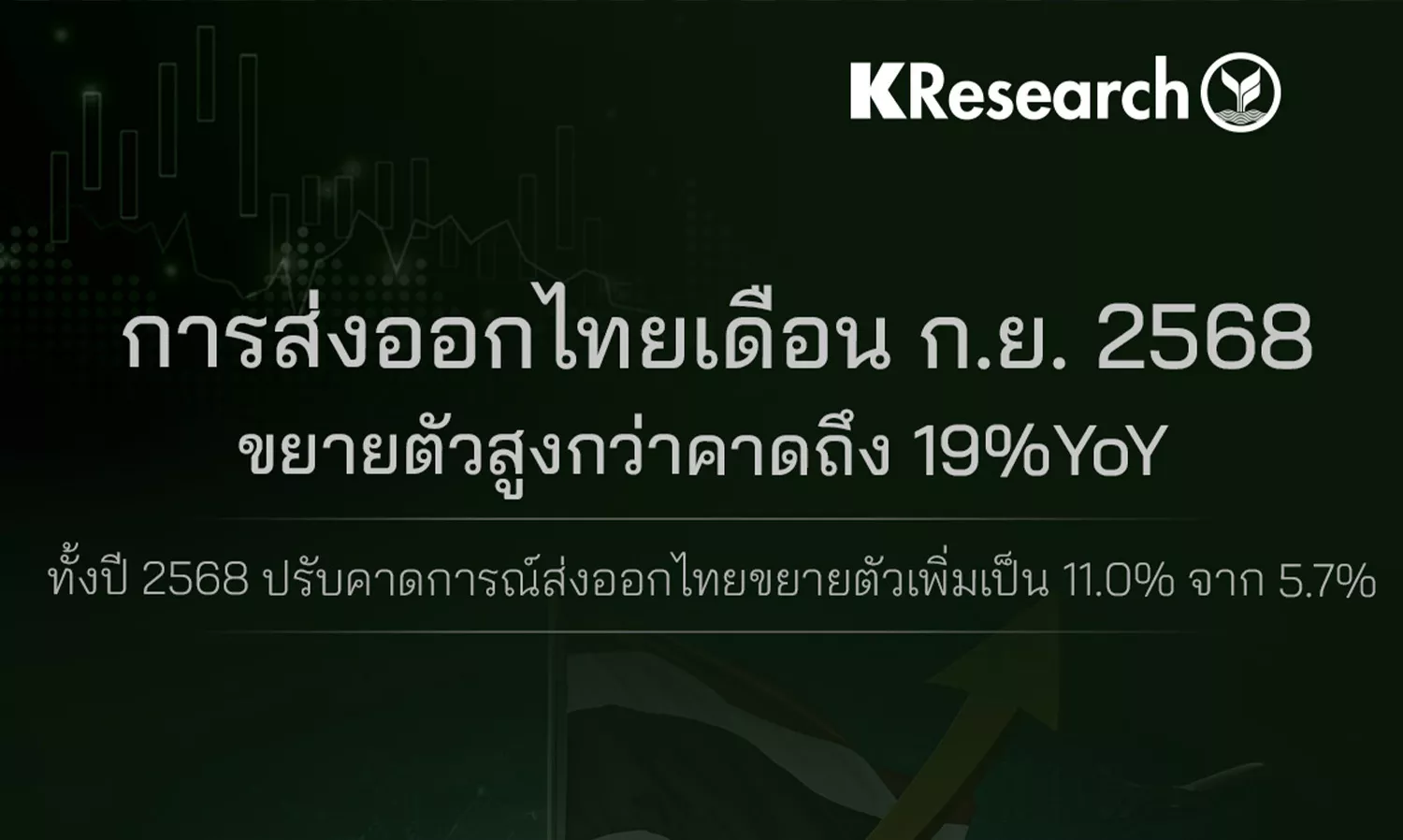
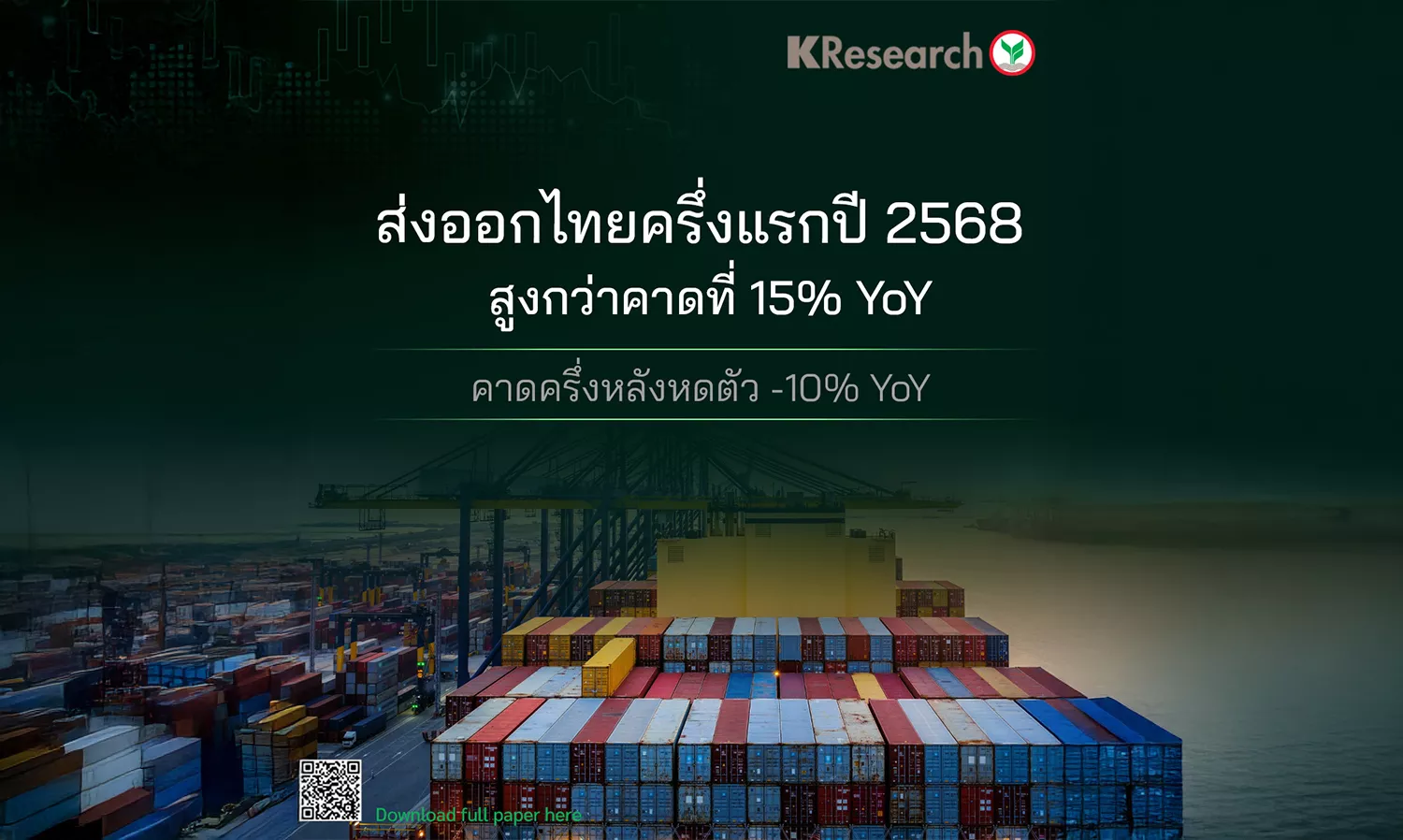
In the first half of 2024, Thailand's overall international trade saw total exports valued at 145,290 million USD, growing by 2%, and the value in Thai baht was 5,191,014 million baht, reflecting a growth of 7.4%. However, when excluding gold, oil, and military equipment, exports from January to June grew by 3.1%. Meanwhile, imports were valued at 150,532.6 million USD, growing by 3%, and the value in Thai baht was 5,437,480 million baht, reflecting a growth of 8.3%. This resulted in Thailand's trade balance from January to June 2024 showing a deficit of 5,242.7 million USD, equivalent to a deficit in Thai baht of 246,466 million.
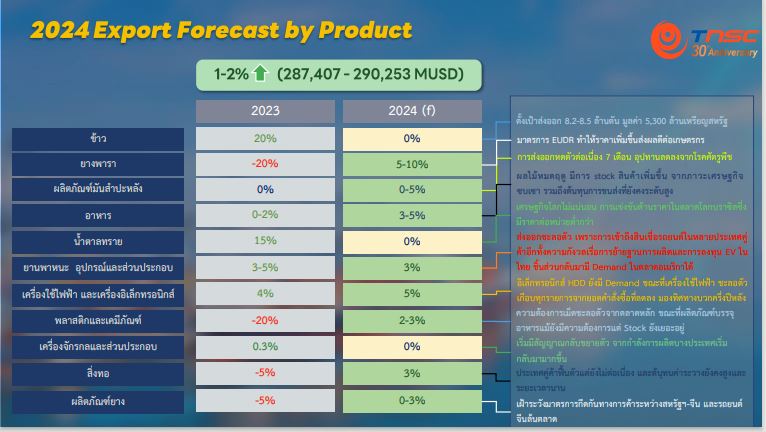
The TNSC maintains its export growth forecast for 2024 at 1-2% (as of August 2024), with several risk factors to monitor in the second half of the year: 1) Ongoing geopolitical issues and the US-China trade war affecting global trade and the economy, particularly the outcome of the US presidential election in November, which may impact trade and environmental policies.
2) The ongoing labor union issues in the US that have yet to reach an agreement could lead to production stoppages and affect imports in the manufacturing sector.
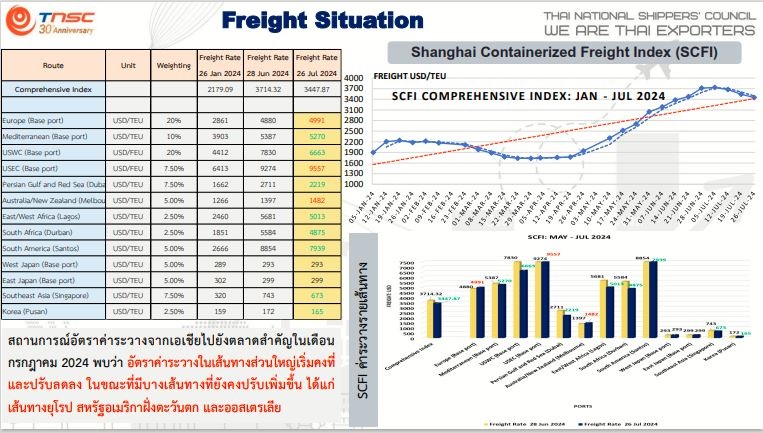
3) Shipping costs and additional charges (surcharges) remain high but are showing signs of reduction on several routes. However, the situation in the Red Sea remains a significant risk factor for shipping routes to the Middle East and Europe.
4) The oversupply of goods from China entering the global market has led to low-cost products flooding into Thailand, competing with Thai products in international markets. 5) Ongoing issues with access to credit for the manufacturing sector are causing liquidity problems for operations.
Nevertheless, the TNSC urges the acceleration of projects to boost Thai exports to support competition and long-term growth, aiming to become a Trading Nation while seeking new markets to create opportunities for Thai products in the eyes of international partners and consumers. Exporters must plan their shipping by booking space in advance and manage their inventory appropriately.
Additionally, the government is requested to regulate products and foreign investment that should benefit the domestic supply chain, as well as oversee the influx of low-cost goods that impact domestic producers, especially SMEs, and promote access to sufficient funding sources for cash flow and production for exports.