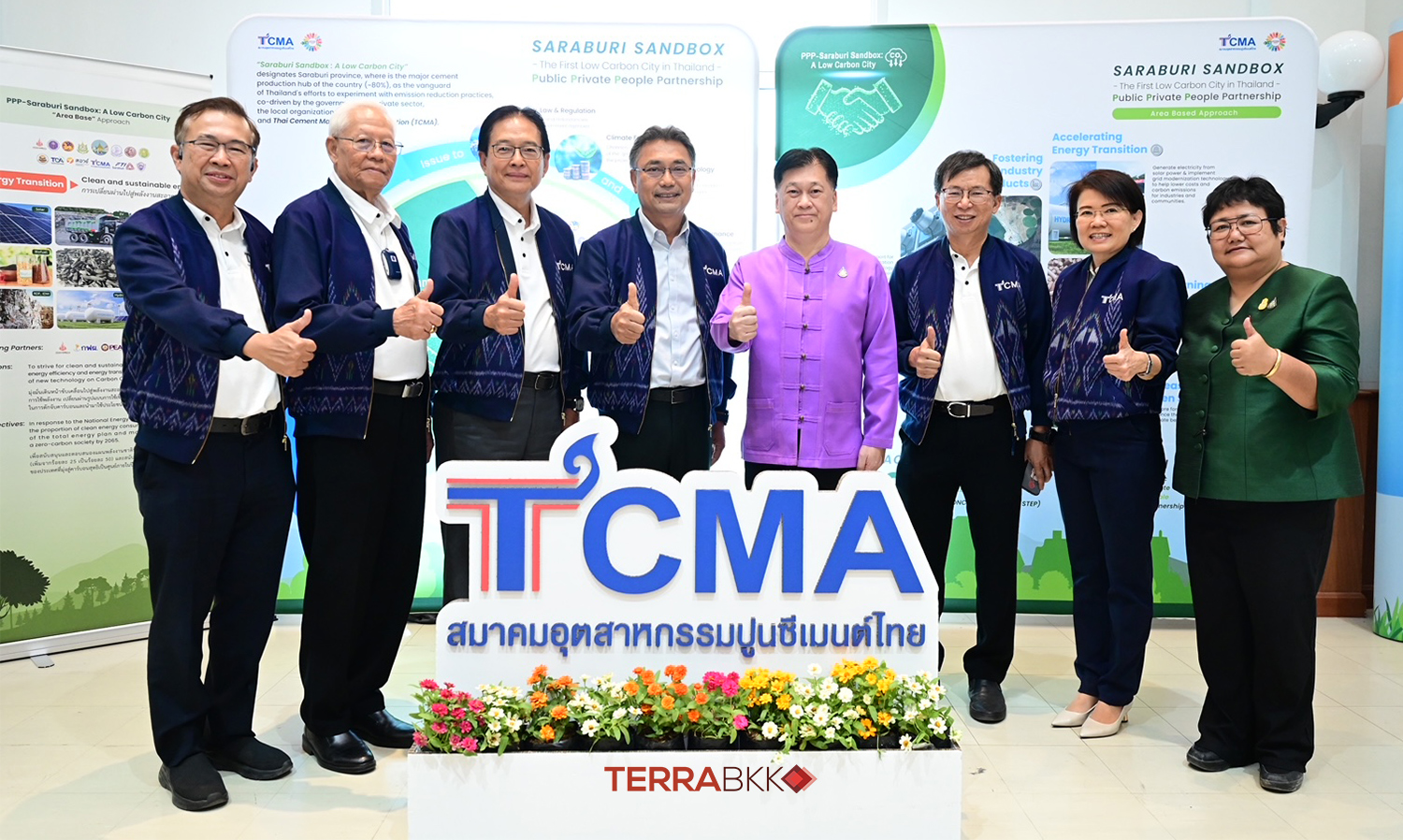
TCMA Leads the Cement Industry in Driving 'Saraburi Sandbox' to Transform Saraburi into a Low-Carbon City through Waste Management
Saraburi Province unites the efforts of 18 agencies including government bodies, local administrative organizations, networks, and the Thai Cement Manufacturers Association (TCMA) to sign a memorandum of understanding (MOU) aimed at propelling Saraburi towards a low-carbon city through waste management under the initiative “PPP-Saraburi Sandbox: Waste to Value.” This project will pilot 10 model waste banks, encouraging all parties to properly segregate waste, create value from waste materials, and seize three opportunities: generating income for the community, reducing waste volume, and mitigating the global warming crisis, thus advancing the 'Saraburi Sandbox' in achieving effective waste management.
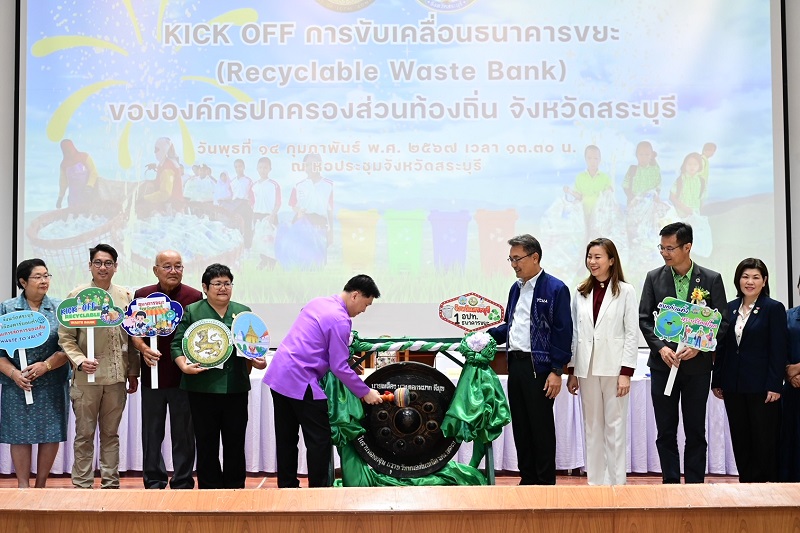
Governor Banchak Chawarin of Saraburi Province stated that the signing ceremony of the MOU between the government, local administrative organizations, and 18 partner agencies, including the Office of Local Administration Promotion, the Provincial Natural Resources and Environment Office, the Pollution Control Department Region 7 (Saraburi), the Provincial Agricultural Office, the TCMA, the Saraburi Provincial Industry Council, and the Institute of Science and Technology Research, marks a significant step in the project “Saraburi Sandbox” and is one of the five key areas in transforming Saraburi into a low-carbon city.
The progress of “PPP-Saraburi Sandbox: Waste to Value,” resulting from the collaboration between Saraburi Province and TCMA, is being concretely implemented through a working group established to launch 10 model waste banks (Recyclable Waste Banks) to further develop the practices of these model banks.
The waste banks will support citizens in segregating recyclable waste at home and encourage local administrative organizations to adopt the concept of a circular economy in managing waste and refuse, based on the 3R principles: Reduce, Re-use, and Recycle. Additionally, they will promote awareness and understanding, fostering a sense of responsibility among local residents to participate in reducing waste volume and segregating recyclable materials for sale, generating income for the community. This initiative will also alleviate the budget burden for local administrative organizations in waste collection and transportation.
“Saraburi Province is confident that if everyone works together, nothing is impossible. The key mechanism comes from the private sector, while the government’s role is to support the continuation of all operations. Today, the PPP-Saraburi Sandbox has successfully raised awareness, as evidenced by the ongoing interest from agencies and educational institutions seeking to observe our work. We hope this model can be expanded to other provinces,” said Governor Banchak.
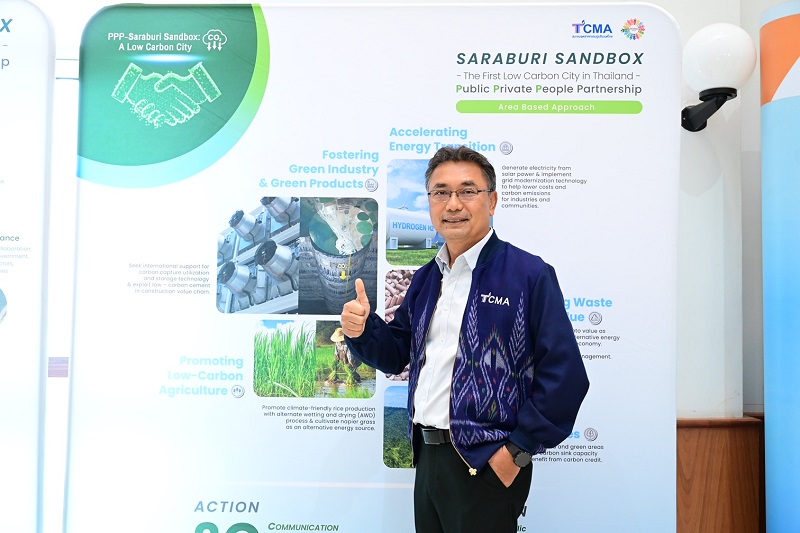
Dr. Chana Poomi, President of the Thai Cement Manufacturers Association (TCMA) stated that TCMA is part of the driving force behind the “PPP-Saraburi Sandbox,” which develops a collaborative working model in an area-based approach that allows all sectors to work together to solve problems and drive Saraburi towards becoming a low-carbon city, including in green industry, waste management, low-carbon agriculture, and increasing green spaces.
The collaboration “PPP-Saraburi Sandbox: Waste to Value” is a priority for TCMA, which has been continuously promoted under a plan to create an ecosystem for managing unused materials, focusing on using these materials as alternative raw materials or as alternative fuels in cement production according to the circular economy concept.
The cement industry is ready to leverage its technological strengths to manage unused materials by incorporating them into the co-processing of waste materials in cement kilns, which operate at temperatures up to 1,450 degrees Celsius. This is a sustainable waste disposal method that is safe and effectively protects the environment.
“Managing unused materials by using them as alternative raw materials or alternative fuels is a way to handle waste that has been segregated from the source, adding new value in the form of products or usable items. For example, rice straw, husks, and corn stalks can all be used as energy. This is called Waste to Wealth. If viewed positively, everything around us has value and can be transformed into wealth, termed Turning Waste to Value. This not only helps reduce waste problems but also increases income for communities, leading to a circular economy at both provincial and national levels,” Dr. Chana concluded.
To further transform “Saraburi” into a low-carbon city, TCMA is also working on several other projects concurrently, such as using clean energy to replace traditional fossil fuel-based electricity with the “Napier Grass Planting Project” to provide alternative or clean energy for industries, while also benefiting farmers with increased income. Other projects include “Waste Management for Conversion to Alternative Fuels (Alternative Fuels: AF) and Refuse Derived Fuel (RDF)” and “Research on Utilizing Carbon Capture Technology, Utilization, and Storage,” which involves using captured carbon dioxide for various purposes (Carbon Capture Utilization: CCU) or permanently storing it underground (Carbon Capture Storage: CCS).
Dr. Chana concluded by stating that effective management of unused materials through 100% source segregation, waste management, clustering areas for waste management (Cluster), developing waste processing technologies, and reusing various leftover materials will succeed through collaborative efforts at all levels, including citizens, communities, local agencies, government, and private sectors. This is the essence of “PPP-Saraburi Sandbox: A Low Carbon City,” which develops innovative area-based collaborative working models to drive Saraburi towards a low-carbon city, effectively reducing greenhouse gas emissions and achieving the Net Zero target by 2050.