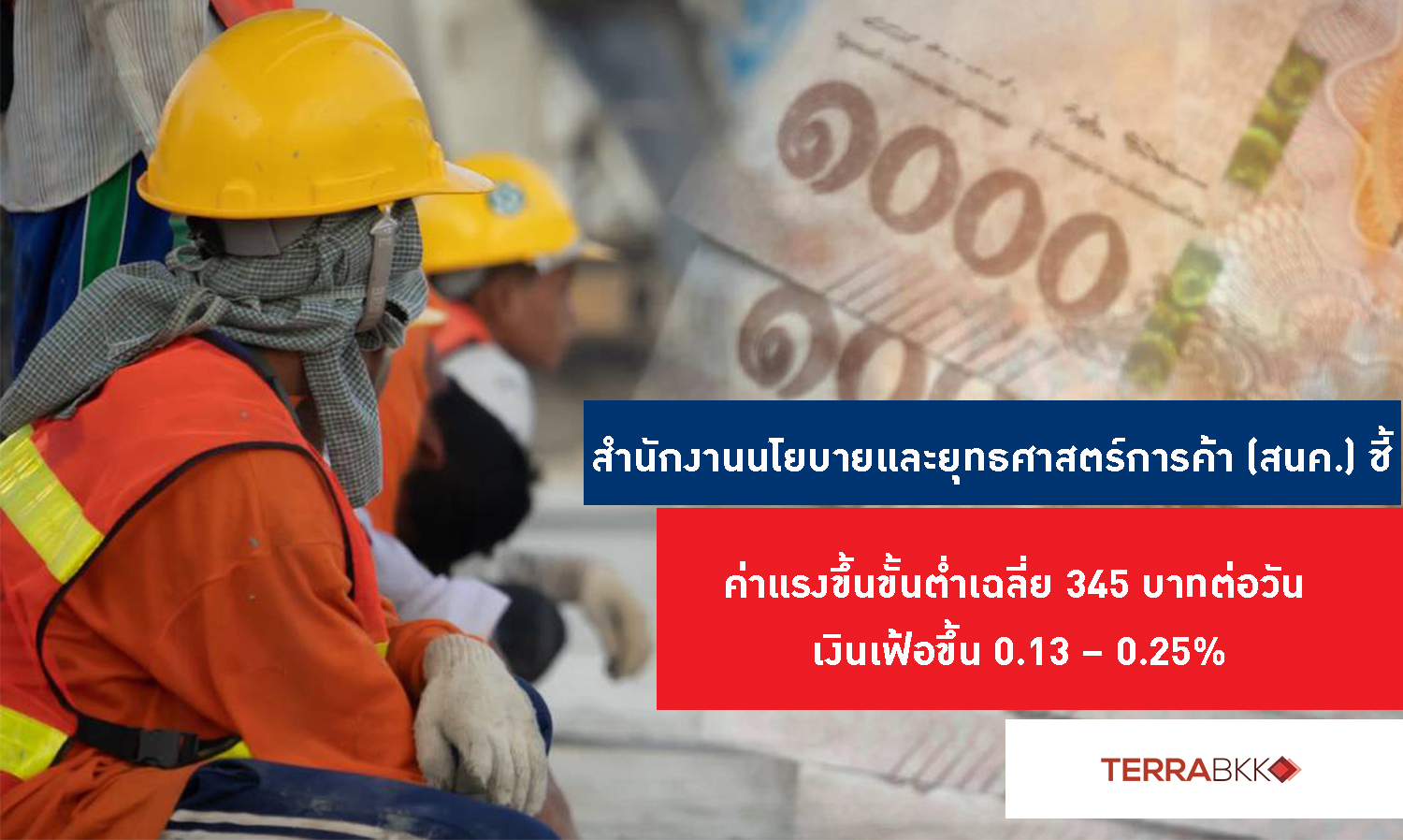
Minimum Wage Increased to an Average of 345 Baht per Day, Inflation Rises by 0.13 – 0.25%
Mr. Poonpong Nainapakhorn, Director of the Office of Trade Policy and Strategy (OTP), stated that if there is an adjustment to the minimum wage rate, the Minimum Wage Committee decided on December 8, 2023, to approve an increase in the minimum wage by 2 to 16 baht per day, averaging an increase of 2.37%. This will have a minor impact on inflation, raising it by only 0.13-0.25%. The current negative inflation for two consecutive months is not a cause for concern and does not indicate an economic recession; rather, it reflects the trend of the Thai economy transitioning towards low inflation. Relevant agencies need to implement appropriate monetary and fiscal policies moving forward.

Currently, the minimum wage is set by a tripartite wage committee (government, employers, and employees). A suitable minimum wage allows workers to maintain a decent standard of living, which positively affects their quality of life. At the same time, labor is a crucial production factor, and an increase in labor costs will inevitably raise overall costs. However, the government has policies to create an environment conducive to the growth of businesses across all sectors. Therefore, a reasonable wage increase that corresponds to labor productivity should not significantly impact employers. In terms of the national economy, a minimum wage that sufficiently covers living expenses will stimulate purchasing power and ultimately reflect positively on domestic consumption growth.
Average Minimum Wage of 345 Baht per Day, Inflation Rises by 0.13 – 0.25%
OTP has analyzed the impact of the minimum wage increase on inflation and found that if the minimum wage is adjusted to an average of 345 baht per day, or an increase of 2.37%, it will lead to an inflation increase of approximately 0.13 – 0.25%, depending on the labor cost structure of each industry. Products with high labor costs will need to manage their costs more effectively, while highly competitive products will see minimal price increases. Producers will focus on using technology to reduce other costs instead. Thus, the pass-through effect on inflation may be less than anticipated. The top five products and services likely to be most affected include ready-to-eat food, rice, communication services, fresh vegetables, and fresh fruits, as they have a relatively high weight in the inflation calculation and are associated with labor-intensive production sectors.
Forecast for 2024: Inflation Expected to Slow Down, Average at 0.7%
For 2024, OTP forecasts that inflation will continue to slow down from 2023, ranging from -0.3% to 1.7% (with a median of 0.7%). Factors contributing to the decrease in inflation include ongoing government measures to reduce living costs, limited price increases for essential goods, a slowing global economy, and high household debt, which may pressure consumption among certain groups. However, there are also factors supporting a general increase in inflation, such as pork prices expected to return to normal, rising production costs due to wage adjustments, high-interest rates, and the Thai economy's ongoing recovery from 2023, along with measures to increase income and purchasing power. Nonetheless, there are risk factors that could lead to inflation deviating from expectations, such as geopolitical conflicts, currency fluctuations, and various government measures affecting prices.
Additionally, regarding the risk of entering a deflationary period, current facts show that although inflation has been negative for two consecutive months in October and November, with a likelihood of remaining negative in December 2023, this is not a concerning issue and does not indicate an economic recession. The decline in inflation is a result of government measures that have led to a decrease in prices for essential energy products (fuel and electricity), coupled with a transition from a high base in the previous year to normal levels. Considering the three conditions for entering a deflationary state, it is evident that Thai inflation does not meet all three criteria:
(1) Negative inflation lasting for about one quarter; Thai inflation is expected to be negative for one quarter.
(2) Negative inflation spread across multiple categories of goods and services; prices of goods and services have decreased due to government assistance measures for living costs, particularly in energy and electricity.
(3) Negative economic growth and rising unemployment; this condition is also not met, as the National Economic and Social Development Council forecasts continuous economic growth, with GDP expected to grow by 2.5% in 2023 and 2.7% - 3.7% in 2024. Meanwhile, the Bank of Thailand reports that the labor market is continuously recovering, reflected in the increasing number of insured persons in the social security system. Although the ongoing negative inflation in Thailand is not a cause for concern, it signals that Thailand is transitioning to a low inflation environment from a high level of 6.08% in 2022. Therefore, relevant agencies need to adjust monetary and fiscal policies appropriately to align with the trend of low inflation.
The OTP Director concluded that the increase in the minimum wage will improve the purchasing power of minimum wage workers and slightly raise overall inflation, which is considered a positive adjustment. However, regarding concerns that wage increases will lead to higher prices for goods and services, the facts show that the adjustment of the minimum wage has not significantly impacted the prices of goods and services. Furthermore, the Ministry of Commerce, as the agency responsible for ensuring fair and appropriate pricing of goods and services, continuously monitors prices closely.