
The End of the Leasehold Interest: Expiration of Lease Rights for Property Funds and REITs
As the Property Funds (Property Fund) and Real Estate Investment Trusts ("REITs") were established approximately 20 and 9 years ago respectively, the long-term leasehold interests of certain properties in which these funds invest are gradually expiring. This is because the lease rights for the properties that the funds initially invested in typically do not exceed 30 years.
Once the lease rights expire, the funds must return the properties to the lessor and can no longer derive benefits from those assets. In accounting terms, the value of the investment property will be reduced to 0 , marking the end of the asset's useful life.
- If the fund has only one investment property, it will need to close after the leasehold interest expires.
- If the fund has multiple investment properties, it will experience a decrease in income from the project whose leasehold interest has expired, which will impact the dividend per unit (DPU) and the market price of the fund, often reflecting a reduced ability to pay dividends.
Although REITs have opportunities to renew lease contracts, doing so typically requires new capital, which can be obtained through borrowing and/or raising additional funds. If the trust needs to raise more capital, it may lead to a dilution effect, reducing the dividend per unit after the capital increase and often affecting the market price of the fund. Therefore, investors should consider the leasehold interest duration, especially for projects nearing expiration, as well as the proportion of income from properties approaching their lease expiration, to better forecast the changing cash flows of the REIT.
The following are funds with leasehold assets nearing expiration:
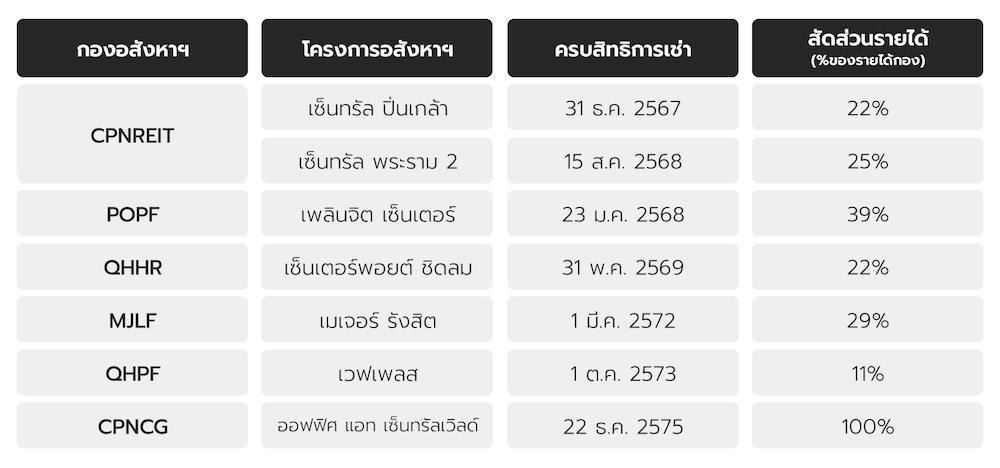
Source: SET
Additionally, some funds in the market can offer high yields partly because they have properties nearing the end of their leasehold rights, causing market prices to decline in line with the anticipated decrease in future income from the funds.