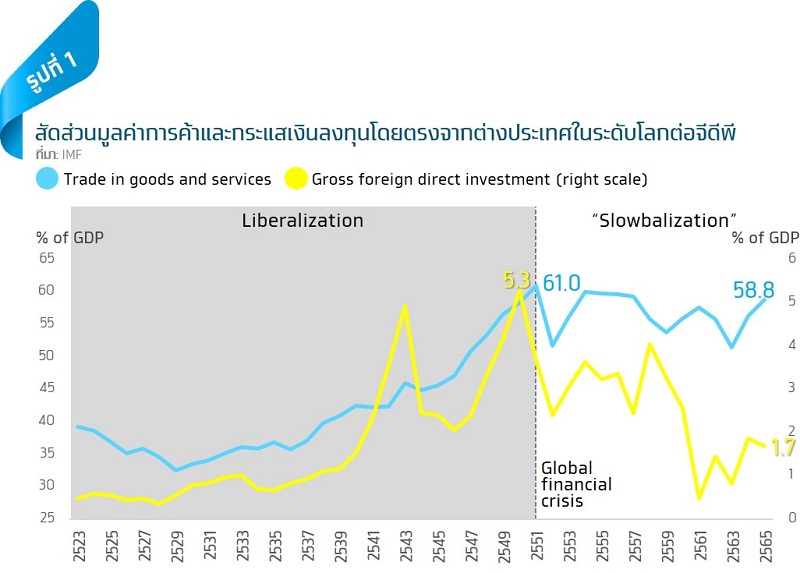
Krungthai COMPASS reveals one of the global Mega trends that many are closely watching is the direction of "De-globalization" or, as some institutions like the IMF refer to it, "Slowbalization." This trend has become increasingly evident, especially following the global financial crisis, as reflected in the slowdown of global trade value relative to GDP, which dropped from a peak of 61% in 2008 to 58.8% in 2022. Meanwhile, the proportion of foreign direct investment (FDI) to global GDP has decreased to just 1.7% from 5.3% in 2008 (Figure 1).

In the past 1-3 years, the trend of De-globalization has been increasingly discussed due to several significant accelerating factors: 1) The COVID-19 crisis highlighted the vulnerabilities of dependence on foreign sectors, such as supply chain disruptions, semiconductor shortages, the negative impacts of China's Zero COVID policy, and the decline in foreign tourists. 2) The intensifying geopolitical risks, particularly the tensions between Russia and Ukraine, which affect global trade and production costs. Most importantly, 3) The ongoing conflict between the two global economic superpowers, the United States and China, which is becoming more intense and widespread, especially in the realm of "technology wars," leading to global economic polarization (Decoupling) or what the IMF calls "Geoeconomic fragmentation," indicating a clearer separation in the global economic geography.

The trend of global economic polarization is a dimension of De-globalization that warrants attention, as it is not just about the United States and China. It will have global repercussions, particularly through changes in trading partners and global supply chains. For instance, we may see increased production base relocations in the form of "Reshoring" back to original countries, "Nearshoring" to countries geographically closer to the original, or "Friend-shoring" to allied countries without conflicts. Additionally, the "China+1" model aims to diversify production chains to countries outside of China. Furthermore, this polarization may impact global economic growth in the future, as the IMF estimates it could reduce global GDP by up to 7% in the event of complete decoupling across various sectors and potentially decrease GDP by 8%-12% in some countries if technological decoupling occurs.

These events will inevitably affect Thailand, as it is a small open economy closely linked to both the United States and China. In terms of trade, in 2022, China was Thailand's largest trading partner (including exports and imports) with a value of 3.69 trillion baht (18% of Thailand's total international trade value), while the United States ranked second with a trade value of 2.28 trillion baht (11% of Thailand's total international trade value). Therefore, this article presents an analysis of the ongoing global economic polarization and its implications for Thailand, both in terms of opportunities and potential challenges.

The Ongoing Conflict Between Two Superpowers
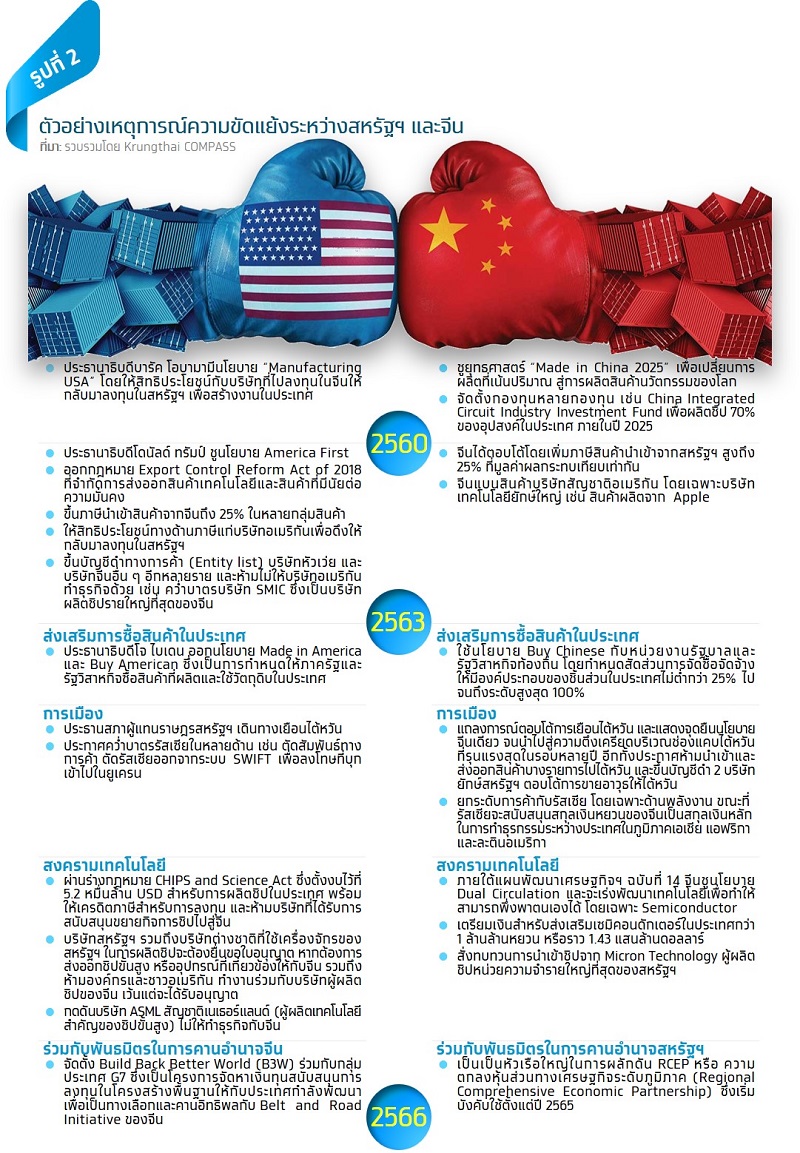
The conflict between the United States and China continues across trade, investment, and political dimensions, especially since 2018 when President Donald Trump implemented a 25% tariff on imports from China and introduced measures to encourage companies to invest back in the U.S. Simultaneously, he enacted laws restricting the export of technology-related goods and placed several Chinese companies, particularly in technology, on a trade blacklist (Entity list). China retaliated by imposing equivalent tariffs on U.S. goods and banning certain products from American companies. This tension has persisted into the Biden administration, where, although the COVID-19 situation seemed to necessitate a "temporary ceasefire," conflicts between the two nations have resurfaced periodically (Figure 2). For instance, in 2022, the U.S. Speaker of the House visited Taiwan, a significant trigger for heightened tensions in the Taiwan Strait, the most severe in years, alongside the conflict between Russia and Ukraine, where the U.S. and China have taken opposing stances, such as the U.S. imposing sanctions on Russia while China has strengthened trade relations with Russia, particularly in energy.

The conflict in trade and technology investment is clearly intensifying, especially after the U.S. declared a full-scale "semiconductor war" against China in 2022, implementing various measures to block China from accessing advanced semiconductor technology, which is crucial for AI technology. For example, the U.S. requires American and foreign companies using U.S. machinery to produce and export advanced semiconductors and related equipment to China to apply for licenses and prohibits American organizations and individuals from collaborating with Chinese semiconductor manufacturers unless authorized. Additionally, the U.S. passed the CHIPS and Science Act, allocating $52 billion for domestic semiconductor production, alongside the Inflation Reduction Act to support investments in the U.S. and the "Chip 4 Alliance," a collaboration between the U.S., Japan, South Korea, and Taiwan to develop the semiconductor supply chain. In response, China is advancing its own semiconductor production capabilities, announcing late last year that it would allocate over 1 trillion yuan (approximately $143 billion) to promote its domestic semiconductor industry. Recently, in March 2023, China ordered a review of chip imports from Micron Technology, the largest U.S. memory chip manufacturer. The EU is also taking action on this issue by supporting its semiconductor industry and reducing dependence on foreign sources, having passed the "European Chips Act" to increase EU semiconductor production to 20% of global capacity by 2030, up from about 10%, with an investment of over 43 billion euros.

From Conflict to Global Economic Polarization (Decoupling)

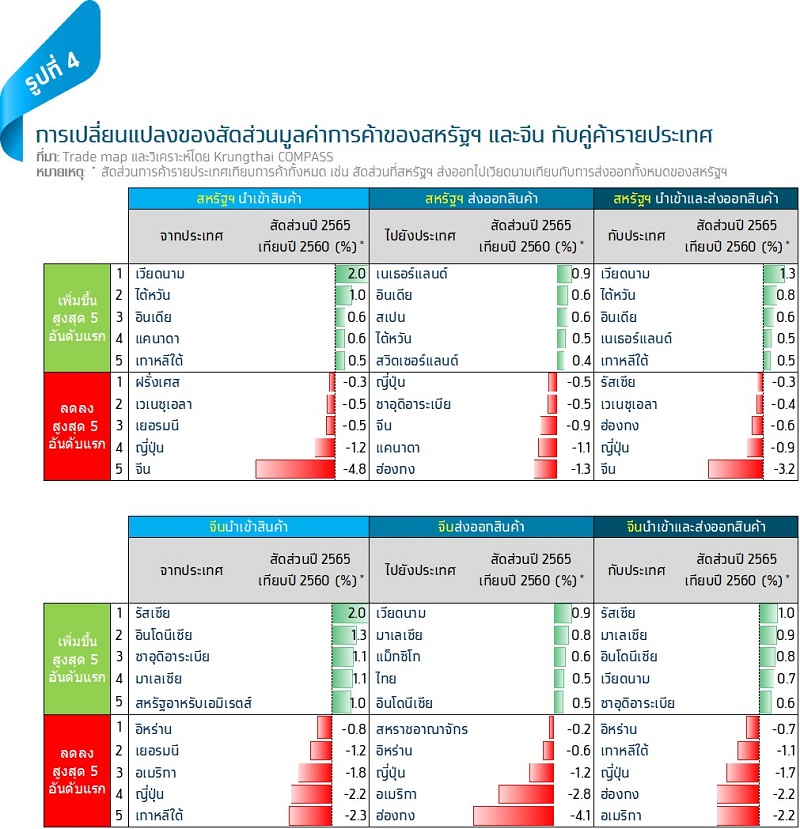
It is expected that trade decoupling will continue as signs of intensification emerge, reflected in the decreasing trade proportion between the U.S. and China. Although in 2022, the U.S. saw a 5.5% increase in trade value (total exports and imports) with China, reaching $730 billion, which is higher than during the intense trade war in 2018 and pre-COVID-19 levels, the proportion of trade value between the U.S. and China relative to total U.S. foreign trade has clearly declined from 16.6% in 2017 to just 13.4% in 2022. The same trend is observed from China's perspective regarding its trade value with the U.S. (Figure 3). Furthermore, when examining key trading partners, it is noted that both the U.S. and China have increased trade relations with ASEAN countries, with Vietnam, Taiwan, and India being the top three countries where the U.S. has seen the highest trade growth over the past six years, while for China, it is Russia, Malaysia, and Indonesia (Figure 4).

In addition to trade decoupling, investment decoupling is also expected to occur concurrently, as multinational companies are likely to adjust their supply chains by relocating production bases. This is reflected in the IMF's index measuring interest in relocating production, which tracks the frequency of mentions of reshoring, friend-shoring, or near-shoring in large multinational companies' earnings call reports. Since the trade war between the U.S. and China began in 2018, and lessons learned from the COVID-19 crisis leading to supply chain disruptions and the ongoing conflict between Russia and Ukraine, multinational companies have indicated a significant interest in increasing production relocations (Figure 5). This aligns with a survey of American CEOs conducted in early 2023 by Xometry, Forbes, and Zogby, which found that 55% plan to reshore production back to the U.S. amidst investments in digital systems, robotics, and automation that will help alleviate labor constraints. Data from the Reshoring Initiative indicates that employment rates from reshoring and FDI in the U.S. increased by as much as 53% (yoy) in 2022.

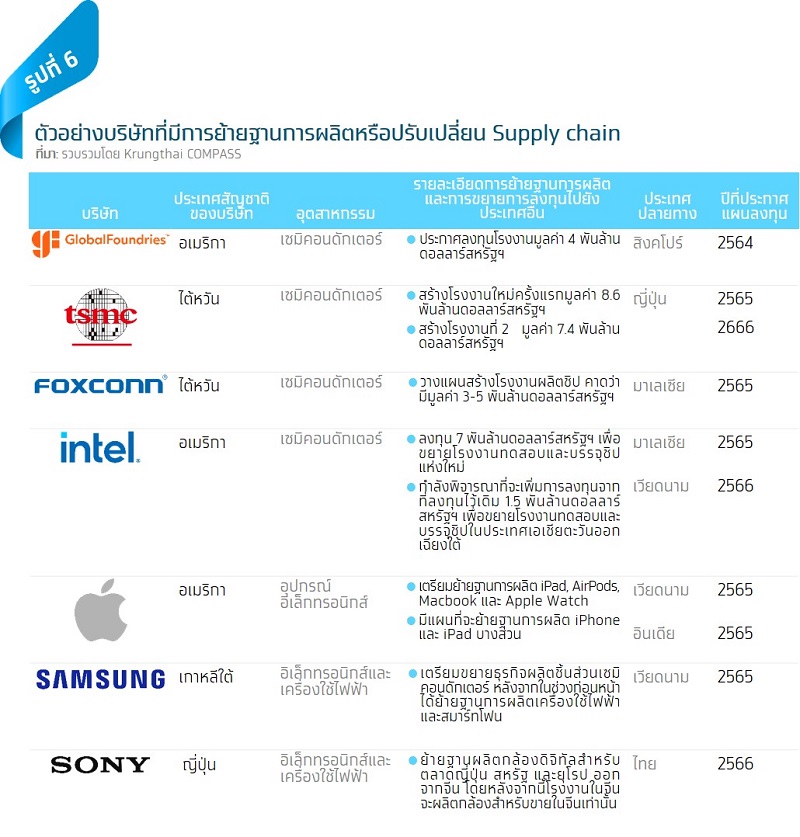
In addition to returning to the original country, Southeast Asia is expected to be a key destination for production relocations, continuing from 2021-2022, where many companies have increasingly moved their production bases to this region, such as GlobalFoundries, TSMC, and Apple (Figure 6). This has led to a significant inflow of foreign direct investment (FDI) into six countries: Indonesia, Malaysia, the Philippines, Singapore, Thailand, and Vietnam in 2021-2022, with an annual value exceeding 1.6 times the average during 2012-2020 (Figure 7). A key supporting factor is that most countries in this region maintain a neutral stance regarding the U.S.-China conflict, and many have implemented measures to promote investment or provide various incentives while rapidly developing infrastructure conducive to business operations to attract foreign investment.

Implications for Thailand's Opportunities and Challenges
Amidst the ongoing conflict between the superpowers of the U.S. and China, which will continue, leading to a clearer trend of economic decoupling, although in the short term, we may not see a complete decoupling due to the current complexity and interconnectedness of trade, investment, and global value chains (GVC). However, in the long term, the trend of decoupling is likely to intensify. Krungthai COMPASS views that this decoupling will create both opportunities and challenges for Thailand as follows:

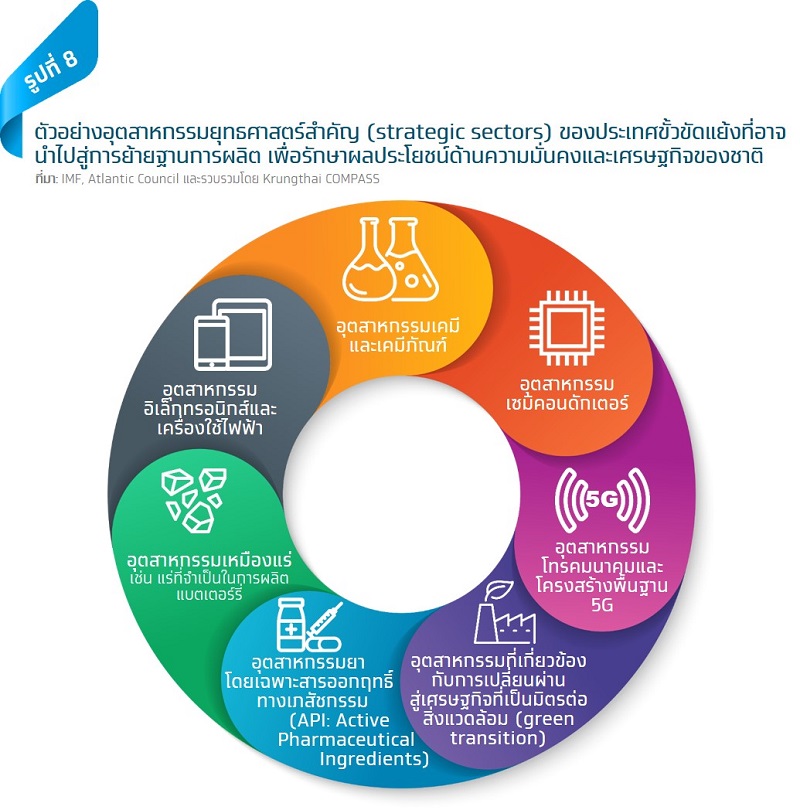
Thailand has the opportunity to attract multinational companies to relocate their production bases or invest more in Thailand, especially in the electronics and technology sectors, which are strategic industries for conflicting powers (Figure 8). For instance, earlier in 2023, SONY announced plans to relocate its digital camera production for the Japanese, U.S., and European markets from China to Thailand. This relocation will create ongoing opportunities for various businesses in Thailand, such as construction and building materials, transportation and logistics, warehousing, and industrial estate businesses.

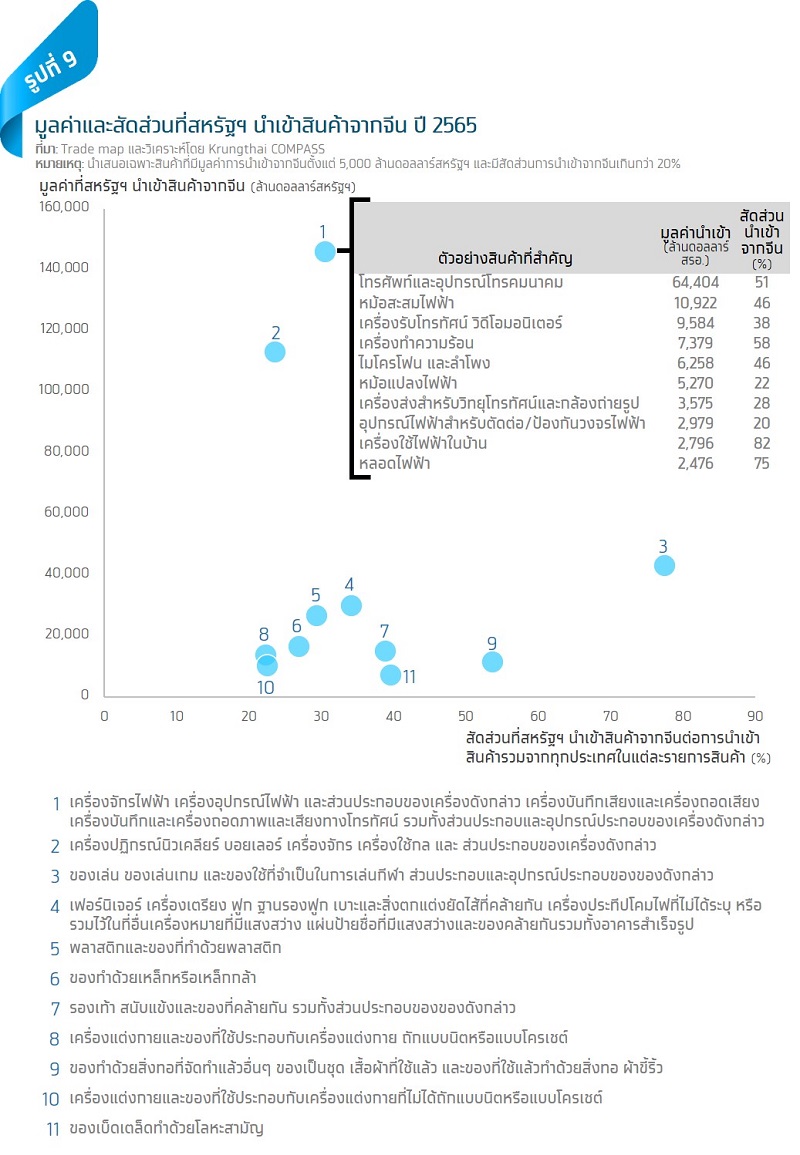
Thailand has the opportunity to export goods to replace those from conflicting countries, particularly exports to the U.S. to substitute products that the U.S. imports from China, such as electronics and electrical appliances, which the U.S. imports in significant proportions and volumes. For example, in 2022, the U.S. imported over $2.796 billion worth of household appliances from China, accounting for 82% of total household appliance imports in the U.S. (Figure 9), while these are products that Thailand is already capable of exporting globally.

However, Thailand may face challenges in the future, such as: 1) The challenge of maintaining a balance in relations between China and the U.S., especially if the situation escalates to the point where Thailand must choose sides. 2) The challenge of raw material shortages and supply chain disruptions, as seen in the past with the global chip shortage, partly due to the conflict between the U.S. and China, including the Taiwan situation. 3) The challenge of exporting goods that are used as raw materials for products to be exported to countries with conflicting issues, such as exporting raw materials like plastic pellets to China, which may be affected if the U.S. increases trade barriers against China. In 2022, Thailand exported plastic pellets to China worth approximately 109 billion baht, accounting for 9% of total exports to China and 29% of Thailand's total plastic pellet exports.

Conclusion & Recommendation: