Decoding the Seminar on 'Driving the Elderly Workforce with Research and Innovation'
Associate Professor Dr. Chalermpol Jamjan, Institute for Population and Social Research, Mahidol University stated that data on the situation and trends of elderly employment in Thailand reveal that a significant number of elderly individuals work in the informal sector. From 1961 to 2004, Thailand transitioned into an aging society, continuing to the latest data in 2022, which shows that elderly employment has been ongoing but is trending downward according to the most recent information from 2022.
Among Thai individuals aged 60 and over, over 36.1% are still working. Data from 2022 indicates that the Thai population begins to reduce their working hours starting at age 50, with a noticeable decline at age 60, where over 22.5% have stopped working. The main reasons include aging, retirement, or the desire to rest. This reflects a societal mindset that associates turning 60 with retirement, which is a flawed perspective that views 60 as old.
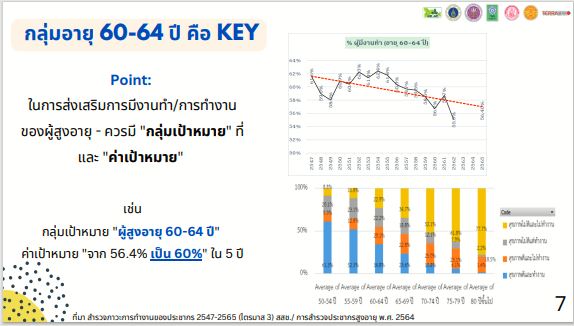
Based on this data, it is suggested that policy efforts to promote employment among the elderly should target specific groups, particularly those aged 60-64, as they should be a key focus. Health-related factors may not be the primary reason for their cessation of work. Currently, 56.4% of this age group is still employed, equating to 2.33 million people. If efforts are made to increase this to 60%, it could add 149,000 more workers, as they still possess valuable skills for national development.
Moreover, attention must be given to the 2.33 million elderly workers currently employed, as they are a group we cannot overlook. We must be mindful of their working conditions, noting that over 80% of elderly workers are engaged in informal work supporting household businesses, while 13% are private sector employees and 3% are employers. Survey data also indicates that earnings from informal work are generally lower compared to those in private employment, especially among civil servants and employers.
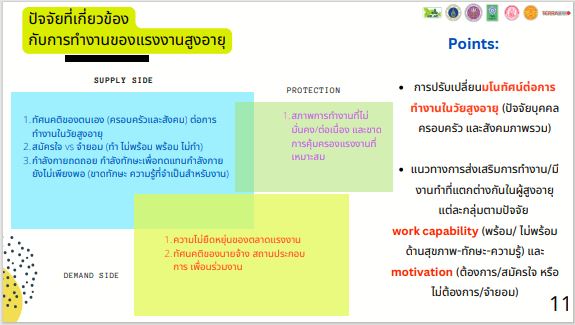
This illustrates that being employed does not mean we should overlook their needs. At the same time, we must create opportunities and increase support for elderly workers to ensure they have sufficient income for living, particularly in private sector employment or workplaces, where opportunities remain limited for older workers.
In summary, factors related to elderly employment that should be considered include motivation to work, especially for those in stable jobs with adequate income and pensions, who may feel the desire to rest and perceive themselves as elderly. We should encourage a shift in perspective, emphasizing that work does not solely equate to income but can also involve contributions to society.
Additionally, protections for informal workers must be strengthened, as opportunities remain limited for promoting employment or hiring. Efforts to promote elderly employment should not only focus on encouraging them to work but also consider economic stability and income security.
Ms. Sumitra Wongphakdee, Terra Media and Consulting Co., Ltd. stated that research on the desires and ideal jobs for the elderly, based on discussions with four groups aged 55-60, revealed differing work preferences. Regarding their attitudes towards work, elderly individuals feel that continuing to work is a source of pride, providing them with a sense of self-worth and independence, rather than being a burden on their families. They also find it beneficial to others. It is noted that as they enter old age, their spending decreases, allowing them to share their income with grandchildren or contribute to society by helping those less fortunate. Furthermore, working helps keep their minds active and their bodies in good condition, preventing cognitive decline.
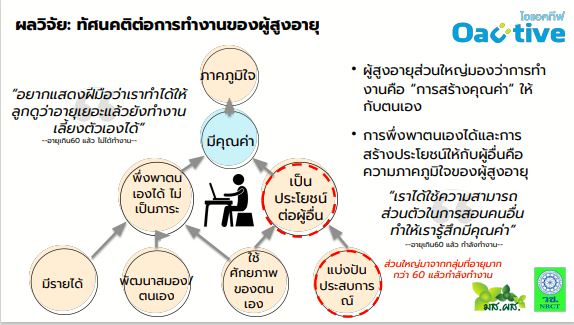
The ideal jobs for the elderly should not involve heavy labor, as their physical capabilities differ from younger individuals. Therefore, they seek part-time work that suits their abilities and does not adversely affect their health. If it involves investment, it should carry low risk and not require significant capital, or involve crafting jobs that do not emphasize quantity. They do not expect to earn as much as before and are satisfied with income ranging from 300 to 1,000 baht, without needing to work every day.
Additionally, the elderly wish to engage in work that allows them to meet diverse people and utilize their personal skills, such as technical or craft work that can be done on a freelance basis, ensuring a steady income without depleting their retirement savings.
Regarding income sources and opportunities for elderly individuals still working, many remain in their previous fields as consultants or part-time workers, often finding jobs through acquaintances or elderly clubs that facilitate job referrals. However, elderly individuals may not seek to upskill or reskill to compete with younger workers but instead contribute their experience and insights to younger generations.

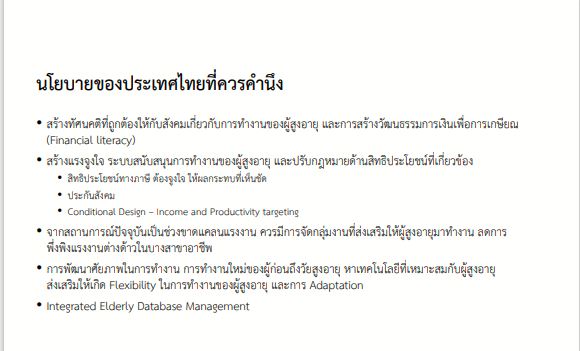
Ms. Apakarn Rattanapithak, Department of Elderly Affairs mentioned that Thailand initiated its first elderly plan in 1982, a long-term strategy involving collaboration among the Ministry of Labor, private sectors, and various organizations to promote elderly employment. A Cabinet resolution in 2017 encouraged the hiring of elderly individuals by allowing employers to deduct wages paid to the elderly from their expenses, capped at 15,000 baht. Since then, there have been public-private partnership initiatives to promote elderly employment, with private businesses participating through CSR models or hiring elderly individuals within their companies. However, data from this seminar suggests a need to reassess the working conditions and hours for the elderly to align with their physical capabilities.
Moreover, there is a push to develop various vocational skills for the elderly, including those approaching retirement, to prepare them adequately. The government has allocated budgets for integrated plans addressing elderly social issues, involving the Ministry of Labor and various public relations departments to prepare different groups for a quality transition into old age.
The research data from this seminar will be beneficial in structuring services or jobs suitable for the elderly, particularly regarding technology that may pose challenges, which they need to learn anew.

Assistant Professor Dr. Suphachai Srisuchat, Thammasat University noted that most elderly individuals face challenges with employers willing to hire them due to limitations. Therefore, in terms of policy, Thailand should reconsider its approach to elderly labor. Although some job models, like barista positions, may seem appealing with daily earnings of 400-500 baht, family members may need to explain to society why they do not support their parents. This attitude in Thailand may need significant adjustment. Additionally, the incentive systems, particularly regarding social security benefits for elderly workers, may require legal adjustments. There is a need to create connections as examples, and government actions must consider productivity, such as ensuring that training programs lead to systems that promote elderly workers in roles that may be in demand and utilize their knowledge, such as in services, food, and hotel care, which can reduce reliance on foreign labor. Importantly, developing the potential of the workforce creates a labor market, especially enhancing elderly access to technology, enabling them to manage other aspects of their lives and generate income.