
Thailand's Opportunities in the EV Car Market from the Perspective of Chinese Investors
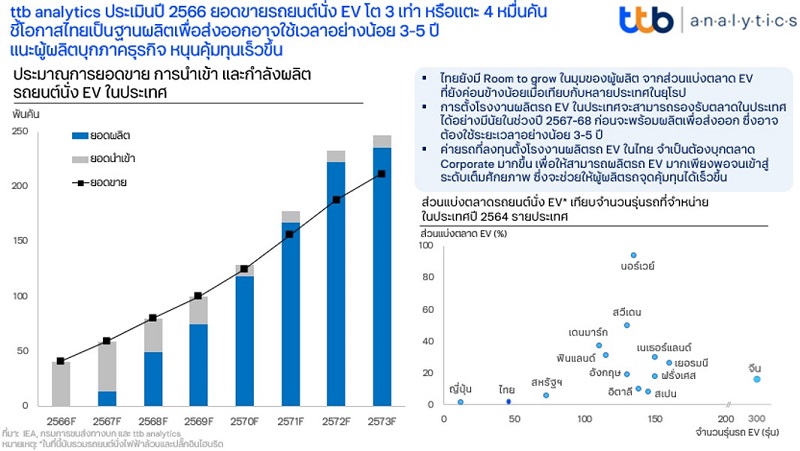
According to data from ttb analytics, it is estimated that in 2023, sales of electric passenger vehicles (EVs) will triple, reaching 40,000 units. This indicates that Thailand's opportunity to become a production base for exports may take at least 3-5 years. It is recommended that manufacturers target the car rental, transportation, and logistics sectors to accelerate cost recovery.

The TTB Economic Analysis Center, or ttb analytics, reveals that the current global EV market is experiencing intensified competition due to an average price reduction of 2-10%. This price stimulation has led consumers to adopt EVs more rapidly. In 2022, sales of fully electric vehicles (EVs) reached a record of 7.23 million units, growing by 57%. Positive factors include global automotive manufacturers accelerating their business plans towards EVs by launching over 100 new EV models.
For Thailand, the government aims for the country to produce 30% of EVs by 2030. In the past three years, Thailand has seen a 17-fold increase in EV registrations, with this year expected to reach 40,812 registered electric passenger vehicles, a growth of 321.7% compared to the same period last year. The import of popular EV brands from China primarily benefits from trade incentives from the Free Trade Area (FTA), and some manufacturers also receive additional discounts after participating in government investment support measures, which require them to invest in domestic EV production within a specified timeframe.
Game Changer in the Global Car Market: Brands that Adapt Slowly May Not Survive
Price competition in the EV market will be a Game Changer impacting the global automotive market, particularly for traditional brands that may gradually disappear if they fail to adapt. EVs are akin to "electric appliances on wheels," similar to "technology products" that become outdated over time. Additionally, the decreasing prices of EVs affect both the new and used car markets, especially in the luxury segment, and even among Japanese and Chinese brands in the C and D segments, which have similar price points, leading to a rapid increase in the supply of used passenger vehicles.
China's Rapid Push into the EV Market: Thailand May Not Benefit Much from Initial Investments
Geopolitical issues between the U.S. and China have prompted China to consider establishing EV production bases in Thailand to mitigate risks and avoid fierce competition in the Chinese EV market. Meanwhile, Thailand has a relatively low EV market share and significant growth potential, which can enhance the Thai automotive parts production chain. It would be advantageous for China to set up EV manufacturing plants in Thailand, as they could reach the breakeven point faster compared to establishing production bases in other countries, especially with support from Thailand's investment promotion measures for EV production, which are more attractive than China's consumer subsidy measures that are set to expire by the end of 2023.
The government's support for EV production under the "30@30" policy aims for Thailand to produce 30% of EVs by 2030. From 2023 to 2025, the target is to produce a combined total of 225,000 electric passenger vehicles and pickups, which is close to the investment promotion requests from the Board of Investment (BOI), estimated at a production capacity of 260,000 units (as of August 2022).
Based on this data, ttb analytics analyzes that establishing EV passenger vehicle manufacturing plants at this stage will primarily serve the domestic market to reduce reliance on imports from China as much as possible before seriously producing for export, which may take at least 3 years, around 2026 onwards.
In line with establishing Thailand as a production base for EV pickups for export, this may take more than 5 years, as Thailand currently ranks second in the world as a production base for one-ton pickups, averaging one million units per year, with only a few market leaders, and over half of production is for export. The export market for pickups is still small and specific, with key markets including the U.S., the Middle East, Australia, and ASEAN. Additionally, the relatively low selling price of pickups means that the breakeven point for establishing production facilities may take longer than for passenger vehicles, as evidenced by the research and development plans for producing EV pickups lagging behind those for passenger vehicles.
However, in the initial phase of the EV market in Thailand, it may be necessary to penetrate the business sector first, such as the EV rental business (Fleet) and logistics, to ensure that the volume of EVs produced and sold domestically is sufficient to reach full capacity, which will help domestic EV manufacturers achieve breakeven faster.