Lumpini Wisdom Advises Real Estate Developers to Use Eco-Friendly Construction Materials to Combat Global Warming
Lumpini Wisdom advises real estate developers to choose eco-friendly construction materials to help reduce carbon dioxide (CO2) emissions in Thailand, in line with the COP26 commitment to reduce CO2 emissions by 20-25% by 2030.
Mr. Prabhan Sak Raksaiwan, Managing Director of Lumpini Wisdom and Solutions Co., Ltd., a research and development company under L.P.N. Development Public Company Limited, discussed the approach to developing environmentally friendly real estate under the BCG Economy framework—Bio-Circular-Green Economy—which is a model for sustainable economic growth using science, technology, and innovation as tools for economic development. He noted that real estate development is one of the industries that requires significant labor and materials, while the construction process also generates pollution in the form of dust and noise.
According to research by Architecture 2030, a non-profit organization dedicated to reducing greenhouse gas emissions in the construction industry and addressing climate change since 2002, the construction industry produced over 40% of greenhouse gas emissions or CO2 in 2022. This includes 27% from building operations, 6% from the building construction industry, and 7% from other construction processes, a decrease from 47% in 2021.
.jpg)
Mr. Prabhan stated that since the construction and real estate industries are among the highest greenhouse gas emitters, accounting for nearly half of global emissions, especially from building operations, it is the responsibility of real estate developers to adjust their project development strategies to minimize environmental pollution, including reducing dust, noise, and waste from construction processes, as well as lowering CO2 emissions throughout project development and building management. This is essential for contributing to Thailand's CO2 reduction goals as outlined in the commitments made by the Thai government at the 26th Conference of the Parties (COP26) held in Glasgow, Scotland, from November 1-12, 2021, where Thailand pledged to reduce CO2 emissions by 20-25% by 2030. In 2018, Thailand was ranked 20th in the world for greenhouse gas emissions, accounting for approximately 0.8% of global emissions, and in 2020, Thailand emitted 224.3 million tons of CO2, an 11.34% decrease from 253 million tons in 2019.
“Designing and selecting appropriate materials is one way to develop environmentally friendly real estate and reduce CO2 emissions. Currently, construction material manufacturers have developed and integrated technology to create eco-friendly materials from the production process to their application in construction, contributing to sustainable CO2 reduction,” Mr. Prabhan said.
According to a study by Lumpini Wisdom, there are currently new alternative materials developed to help reduce CO2 emissions while also inspiring new design concepts and construction methods, resulting in new architectural forms and spatial designs. Examples include:
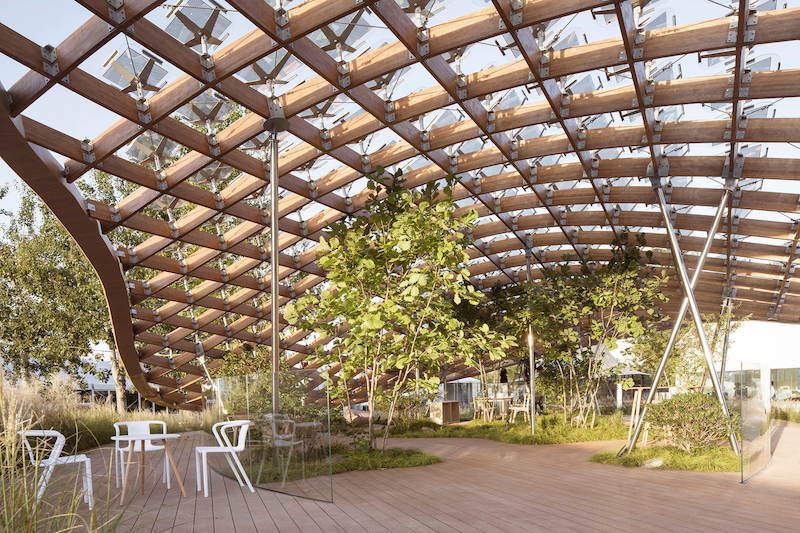
Wooden Bamboo
This innovation enhances the strength of bamboo by incorporating high-performance bamboo fibers, allowing it to withstand tensile forces up to three times greater than steel. With a lifespan of up to 50 years, bamboo emits 22 times less carbon than steel throughout its lifecycle.
I-Mesh Textile
I-Mesh was first introduced at Expo 2020 in Dubai as a sunshade for the central walkway. It is made from carbon, fiber, cheiron, aramid, and basalt, woven into a spider-web-like material using resin-coated threads, resulting in a high-performance textile suitable for both indoor and outdoor use, with a longer lifespan compared to conventional textile construction materials.
PETG Particles
PETG is a widely used material, such as in clear plastic water bottles (also known as PET bottles). The process involves recycling clear plastic back into plastic pellets, which are then used to create plastic filaments for 3D printing. The advantages of this material include its lightweight yet high strength, glossiness, UV resistance, and most importantly, its recyclability. Research shows that the more PETG is used and recycled, the more it reduces carbon emissions by over 50%.
All three materials mentioned above are examples of innovations developed under the principle of reducing CO2 emissions into the atmosphere by reusing old materials, recycling to minimize new material production that impacts the environment, and designing structures for easy disassembly, facilitating effective reuse and recycling.
“Although the real estate business inevitably generates pollution during construction processes, including dust, noise, and CO2 emissions, we can choose to be an industry that minimizes toxic emissions by selecting eco-friendly materials, which are increasingly available for both construction and interior decoration. We can also improve construction processes to reduce pollution as much as possible, contributing to the fight against global warming and supporting the sustainable BCG economy,” Mr. Prabhan concluded.