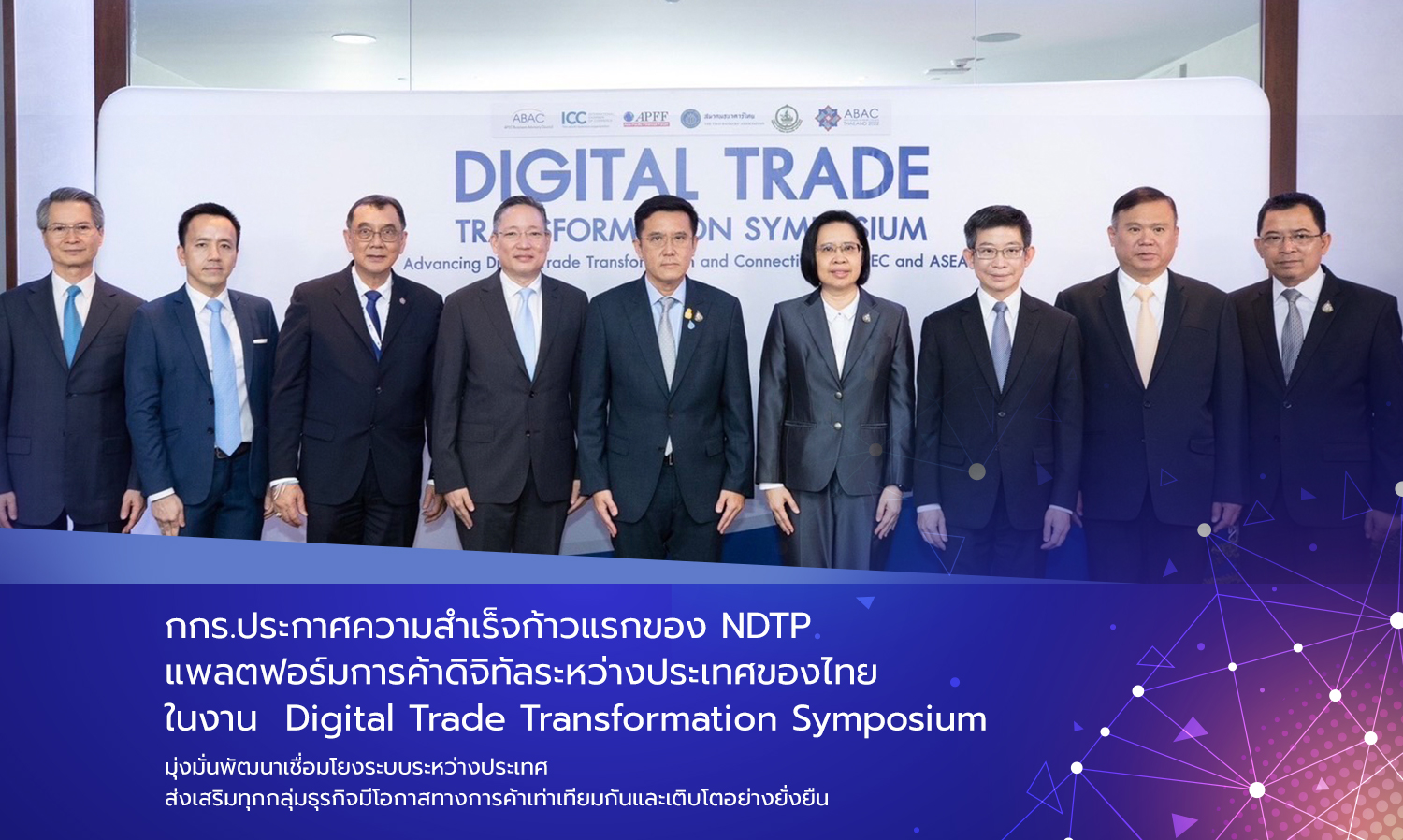
The Joint Private Sector Committee Announces the First Success of NDTP, Thailand's International Digital Trade Platform at the Digital Trade Transformation Symposium
NDTP (National Digital Trade Platform), Thailand's international digital trade platform, is a project driven by the Joint Private Sector Committee of three institutions (JPS) comprising the Thai Chamber of Commerce, the Federation of Thai Industries, and the Thai Bankers' Association. In its first phase, it was developed and operated by National ITMX Co., Ltd. (NITMX), with Baker & McKenzie Ltd. managing the related contract documents.
The NDTP platform is developed using blockchain technology and operated by NITMX, which is currently the developer and provider of Thailand's payment infrastructure, including PromptPay. It has expanded its services to trade infrastructure and lending through PromptBiz and the Trade Document Registry (TDR) for banks, supporting the transformation of financial services into new forms and enhancing the NDTP infrastructure to boost Thailand's competitiveness in the global trade arena.
The platform aims to improve the operational efficiency of exporters, importers, and other stakeholders, making import and export processes easier, more convenient, and faster. It helps prevent improper transactions or duplicate transactions and increases access to funding sources for small and medium-sized enterprises (SMEs) in the country.
The government supports this initiative by establishing a special subcommittee to study and define the development guidelines for Thailand's international digital trade platform, driving government agencies to support the development of NDTP under the Office of the Public Sector Development Commission.
NDTP has successfully developed the platform and completed the Proof-of-Concept (POC)/Pilot Live testing in Phase 1 in collaboration with Japan's TradeWaltz platform and Singapore's Networked Trade Platform (NTP) in October 2022. The scope includes the use of electronic trade documents according to UNCEFACT standards for electronic purchase orders, electronic invoices, and electronic packing lists, along with other documents that are still in image format.
Exporters and importers participating in the POC with partners in Japan include PTT Global Chemical Public Company Limited, Toyota Tsusho (Thailand) Co., Ltd., and Unicord Public Company Limited.
Exporters and importers participating in the Pilot Live with partners in Singapore include B Foods Products International Co., Ltd., part of Betagro Group, and Pacific Sugar Corporation Co., Ltd., part of Mitr Phol Group.
This Phase 1 POC also included verifying the accuracy of documents received by banks for loan disbursement, connecting NDTP and TDR (Trade Document Registry), which has been in use since early 2022 for banks providing loans for international trade to check for duplicate financing. Participating banks in the NDTP Phase 1 project and TDR include Bangkok Bank Public Company Limited, Krungsri Bank Public Company Limited, Kasikorn Bank Public Company Limited, Krung Thai Bank Public Company Limited, Siam Commercial Bank Public Company Limited, and TMBThanachart Bank Public Company Limited.
The next phase will involve establishing and recruiting organizations and agencies to further develop and operate NDTP, leading to practical implementation and achieving concrete objectives.
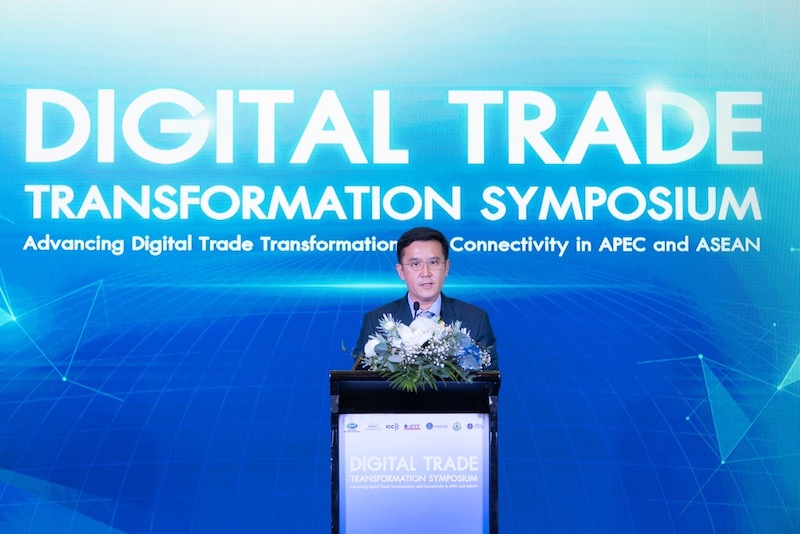
Mr. Chaiwut Thanakmanusorn, Minister of Digital Economy and Society (DES), stated that Thailand has launched a national digital trade platform that will centralize and streamline import and export processes, enhancing Thailand's competitiveness in trade, especially in digital commerce. This offers flexibility for businesses to excel in the new trading world, making business convenience a key factor in attracting foreign trade and investment.
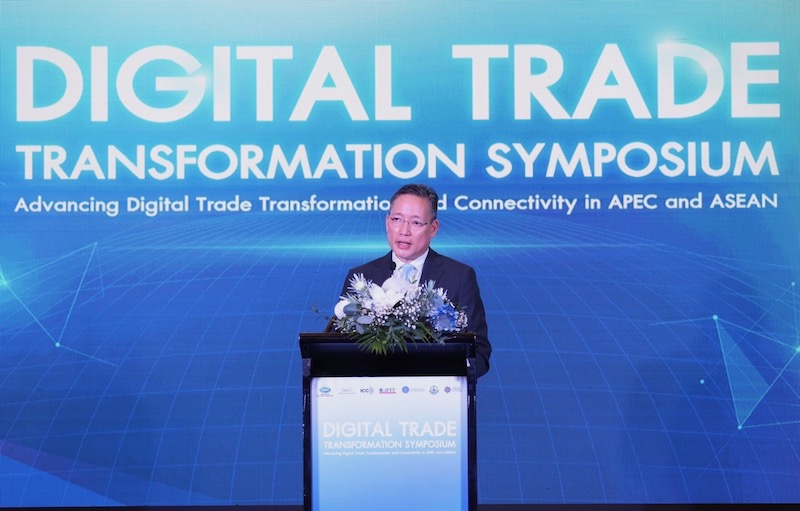
Mr. Phayong Srivanit, President of the Thai Bankers' Association and Joint Chairman of the Joint Private Sector Committee, remarked that the success of NDTP is a significant step for Thailand in elevating international trade to a digital system, making trade transactions, imports, and exports more convenient, faster, and efficient. It reduces the paperwork involved by utilizing electronic trade, enhances document verification efficiency, and strengthens the competitiveness of Thai businesses, especially SMEs, allowing easier access to loans at reasonable costs. Financial institutions can accurately assess loan requests based on each entrepreneur's potential, as banks are already verifying through the Trade Document Registry (TDR).
The success of NDTP Phase 1 is a result of collaboration among various sectors, both public and private, making Thailand one of the first countries to advance in international digital trade. It is hoped that this will expand cooperation in developing interconnected systems internationally and promote sustainable growth opportunities for all business groups.
Mr. Kriangkrai Theeranukul, President of the Business Advisory Council (ABAC), President of the Federation of Thai Industries, and Joint Chairman of the Joint Private Sector Committee, stated that the NDTP project will enhance the efficiency and competitiveness of the industrial sector, which is crucial for the country's imports and exports. Currently, the value of imports and exports reached 17 trillion baht in 2021, playing a vital role in driving the economy, especially during the recent COVID-19 pandemic, where the export sector was a key engine for Thailand's economic recovery.
Today, Thailand's import and export processes still involve numerous steps and extensive documentation, with 20-30 agencies involved in each import or export transaction, resulting in high time and costs compared to many countries. Therefore, the JPS's initiative to drive this project will facilitate business operations (Ease of Doing Business) and significantly enhance the country's competitiveness (Thailand Competitiveness), aligning with ABAC's proposals to APEC leaders advocating for international trade through digital systems (Cross Border Digital Trade).
Additionally, the NDTP project will help SMEs access financial loans more easily, as the system connects with banks through the Trade Document Registry (TDR) to verify credible import and export data and prevent duplicate financing using blockchain technology, reducing risks for financial institutions and increasing SMEs' access to funding sources.
Mr. Sanan Angubolkul, President of the Thai Chamber of Commerce and Joint Chairman of the Joint Private Sector Committee, expressed satisfaction that the Thai private sector has developed the NDTP Phase 1 platform and successfully tested the connectivity. This achievement is a result of strong collaboration among all relevant sectors, both public and private, to move towards a fully digital international trade system, which can reduce costs and time, enhance competitiveness, and improve data security and transparency in the import-export process.
The Thai Chamber of Commerce has continuously supported the development of the NDTP platform and is committed to further advancing it by expanding data connectivity with other countries through the NDTP platform. They invite businesses involved in international trade transactions to utilize the NDTP platform, believing it will enhance the competitiveness of Thailand's international trade in the near future.
Ms. Onfa Vejsachiva, Secretary-General of the Office of the Public Sector Development Commission, stated that the OPDC is the agency assigned by the Cabinet to develop the NDTP platform using a mechanism to appoint a special subcommittee to study and define the development guidelines for Thailand's international digital trade platform, comprising experts from relevant agencies, both public and private, to collaboratively develop a prototype to test the accuracy of data linkage when the system begins actual operation. This promotes data connectivity for imports and exports with the NSW system, involving over 36 public agencies, and revising laws that hinder digital trade, such as the Electronic Transactions Act B.E. 2565, which mandates that the government must primarily provide services through digital channels to facilitate and build confidence among entrepreneurs, enhance business expansion, and create competitive opportunities for Thai private sectors at all levels.
The OPDC is accelerating the development of the NDTP platform in a public-private partnership (PPP) model, which is a suitable approach to leverage the strengths of both public and private sectors to jointly operate the NDTP platform, aiming to launch services by 2024. Currently, it is in the feasibility study phase to ensure that NDTP meets the needs and expectations of businesses and the public.
Dr. Kob Sakk Phutrakul, Chairman of the NDTP Subcommittee of the OPDC, stated that the digital trade platform is a crucial component in driving Thailand's economy towards progress and a complete digital economy. The work and drive involved are complex and challenging due to the diverse stakeholders from both public and private sectors and the extensive documentation related to imports and exports. Additionally, there is a need to amend laws and regulations to facilitate documentation and digital transactions, requiring collaborative support from both public and private sectors to work together integratively. Therefore, the success of the development and testing of the NDTP Phase 1 system is a significant step towards Thailand's digital era. I would like to thank all working groups from both the private and public sectors, the Thai Bankers' Association, JPS, National ITMX Co., Ltd., Baker & McKenzie Ltd., the OPDC, and the Electronic Transactions Development Agency (ETDA) for their diligent efforts that led to this achievement, and I also thank other government agencies for their full support.