Opening the Country: Krungthai COMPASS Predicts Short-Term Foreign Tourist Support for the Tourism Market in 2023, Before Anticipating Full Recovery of Chinese Tourists in 2024
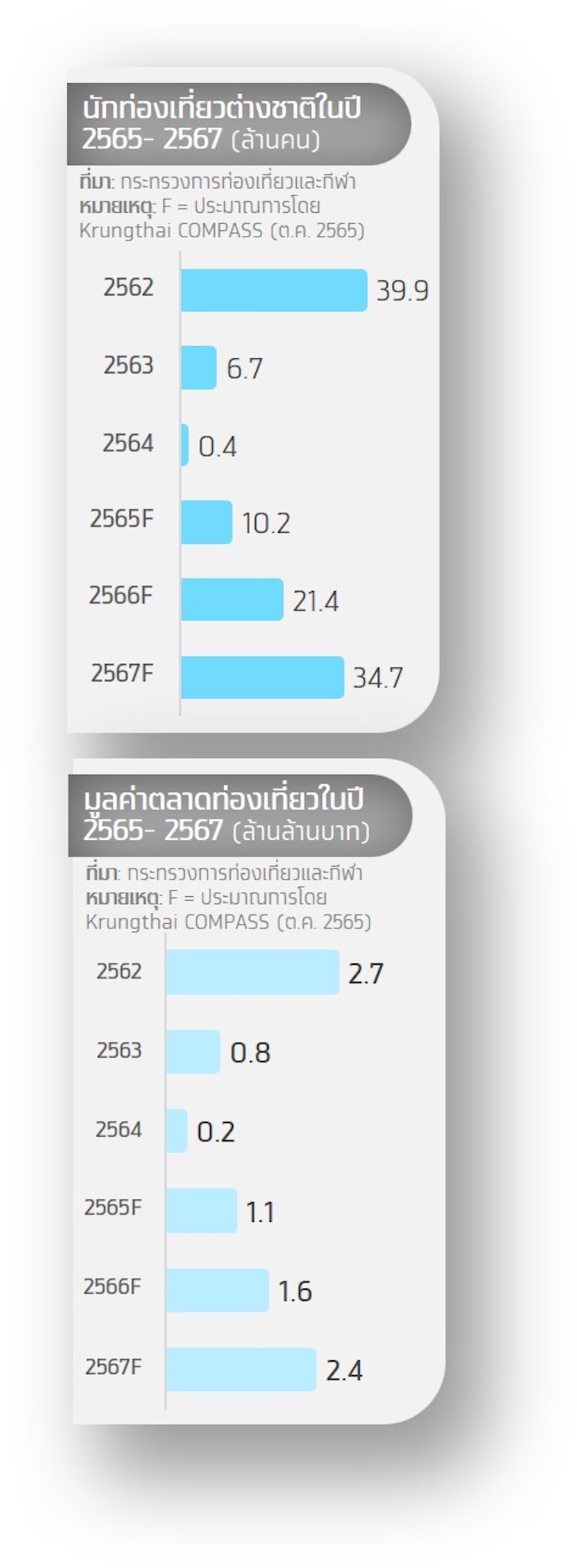
- Krungthai COMPASS estimates that Thai tourism will gradually recover in 2023 and show clear recovery in 2024, forecasting the number of foreign tourists to be 21.4 million and 34.7 million, respectively, with an overall tourism market value of 1.6 trillion and 2.4 trillion baht, which is 58-87% compared to 2019. This recovery is significantly supported by Thailand's full reopening and the pent-up travel demand from tourists worldwide accumulated over the past 2-3 years, especially from Chinese tourists expected to start traveling again in the second quarter of 2023.
- Short-term foreign tourists from countries like Malaysia, India, and Singapore remain key groups that will help stimulate Thailand's tourism sector in 2023, which continues to pressure per capita trip spending to be 17% lower than the average of the past three years (2017-2019).
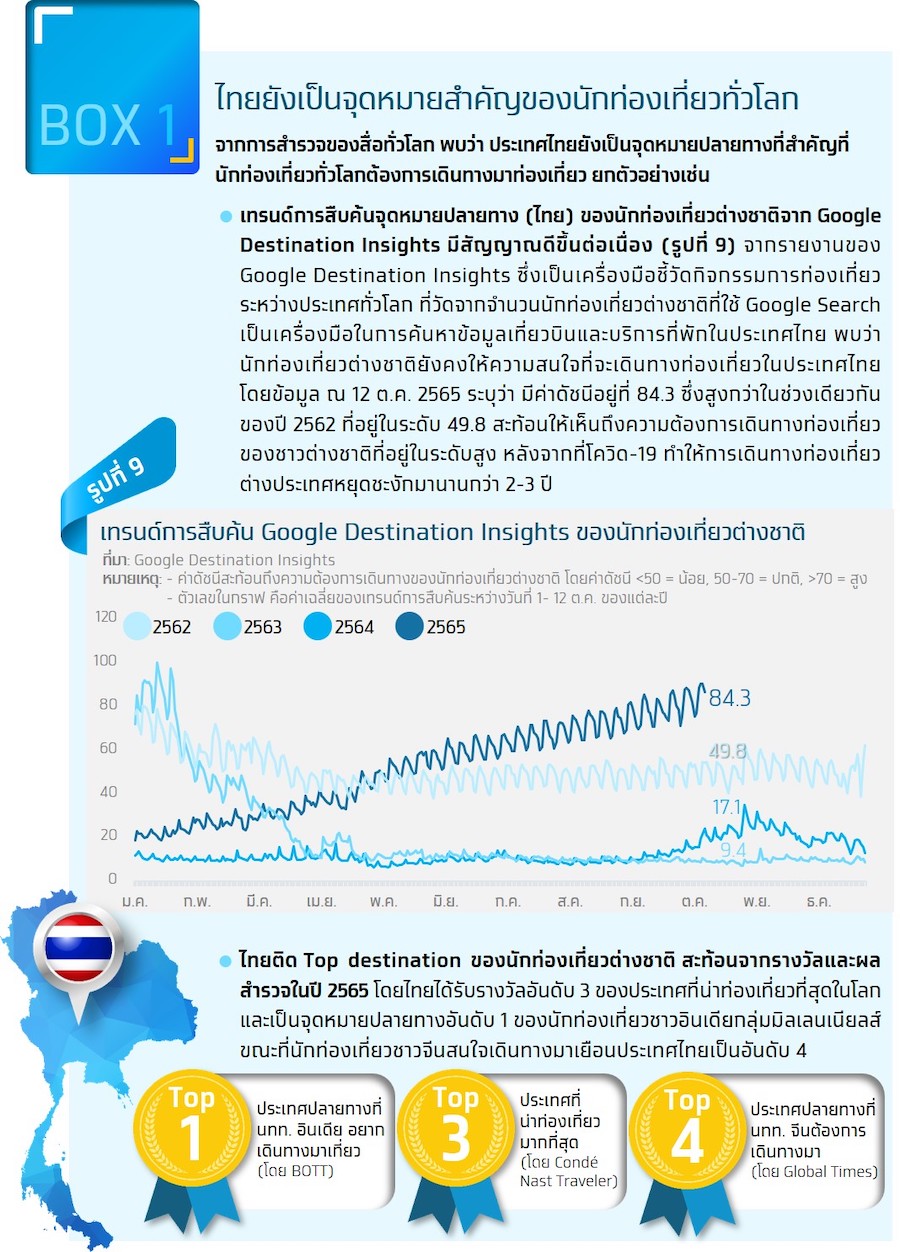
- Krungthai COMPASS predicts that Thailand's tourism sector will return to normal levels by the end of 2024, with Thailand still being a primary destination for global tourists, as reflected in a survey by Condé Nast Traveler, which ranks Thailand as the third most desirable country to visit in the world.
The Thai tourism sector in 2022 still felt the aftereffects of COVID-19
Krungthai COMPASS estimates that although the reopening of the country in the second half of the year allowed Thailand to welcome 10.2 million foreign tourists throughout 2022, this number is still considered very low compared to pre-COVID-19 levels in 2019 when Thailand welcomed nearly 40 million foreign tourists. The tourism market value in 2022 is expected to be 1.1 trillion baht, primarily from domestic tourist revenue, and is significantly lower than the 2.7 trillion baht market value in 2019.
The ongoing COVID-19 pandemic into 2021 severely impacted Thailand's tourism market value, with the number of foreign tourists dropping to just 400,000 from 39.9 million in 2019, and the market value plummeting to 240 billion baht, a decrease of over 90% compared to 2019, affecting many businesses related to tourism, such as hotels, restaurants, and other related sectors.
As the COVID-19 situation eased, the government relaxed entry measures throughout mid-2022, such as abolishing the Test & Go and Thailand Pass systems to fully reopen the country, leading to a better recovery in tourist numbers. In the first nine months of 2022, 5.7 million foreign tourists traveled to Thailand, an increase of 6,526% year-on-year. However, this number still only represents 19% of the foreign tourist count during the first nine months of 2019.
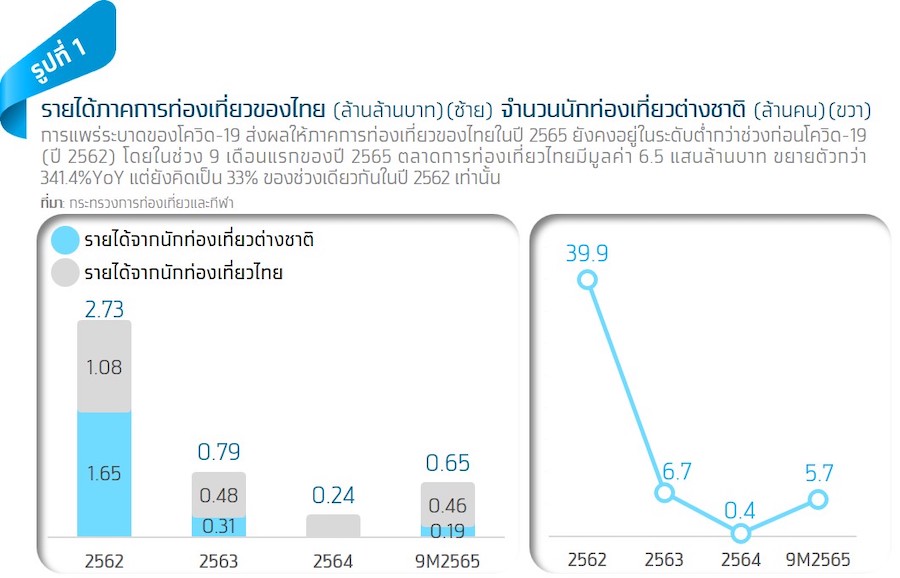
However, Krungthai COMPASS predicts that in 2023-2024, the Thai tourism sector will clearly recover due to four supporting factors.
Firstly, short-term foreign tourists flocking to Thailand after the reopening.
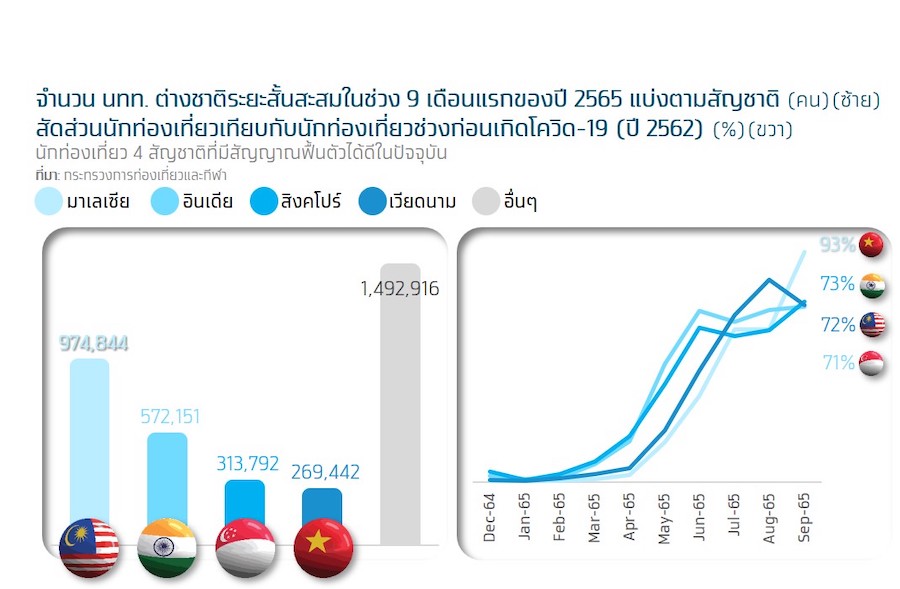
Currently, most of the recovering tourists are short-term foreign tourists from countries like Malaysia, India, Singapore, and Vietnam. In the first nine months of 2022, 3.6 million short-term foreign tourists traveled to Thailand, accounting for 63.7% of all foreign tourists, a result of the country's reopening in the second half of the year, especially the easing of cross-border travel restrictions after over two years of border closures. This has led to an increase in travel from neighboring countries, particularly Malaysia, as the cost of traveling in Thailand is lower compared to their home countries, and the attractions are more appealing (Source: Utusan Malaysia). Krungthai COMPASS believes that in 2023, short-term foreign tourists from Malaysia, India, and Singapore will continue to be significant groups stimulating Thailand's tourism sector before the main market of Chinese tourists returns to normal in 2024.
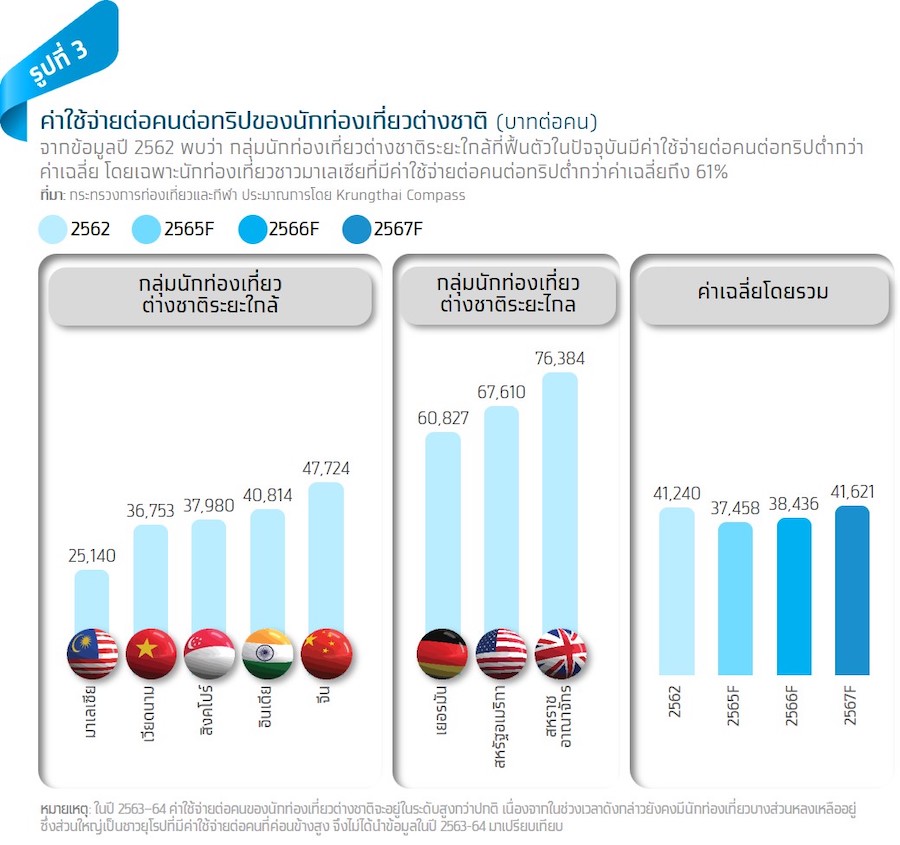
However, it is noted that short-term foreign tourists, especially from ASEAN countries like Malaysia, Singapore, and Vietnam, tend to have shorter stays in Thailand, averaging about 2-5 days, resulting in lower per capita trip spending. The latest data from 2019 indicates that short-term foreign tourists spent about 25,000-38,000 baht per trip, significantly lower than the overall average of 41,240 baht per person. In contrast, main tourist groups like Chinese and European tourists tend to stay longer, averaging 7-8 days and 17 days, respectively. Given that short-term foreign tourists accounted for over 63.7% of arrivals in the first nine months of 2022, Krungthai COMPASS estimates that the average per capita trip spending for foreign tourists in 2022 will trend down to 37,458 baht per person, a 9% decrease compared to pre-COVID-19 levels.
Secondly, other foreign tourists are also ready to travel after being pent up for over 3 years.
Krungthai COMPASS believes that other foreign tourists have accumulated travel desires since the COVID-19 outbreak and are ready to unleash them in 2023-2024. Although the current recovery of Thailand's tourism sector mainly comes from ASEAN tourists, it is expected that the number of Chinese tourists may not return to normal levels in 2023. However, we anticipate that other foreign tourists will continue to have a strong desire to travel after facing international travel restrictions for over 2-3 years.
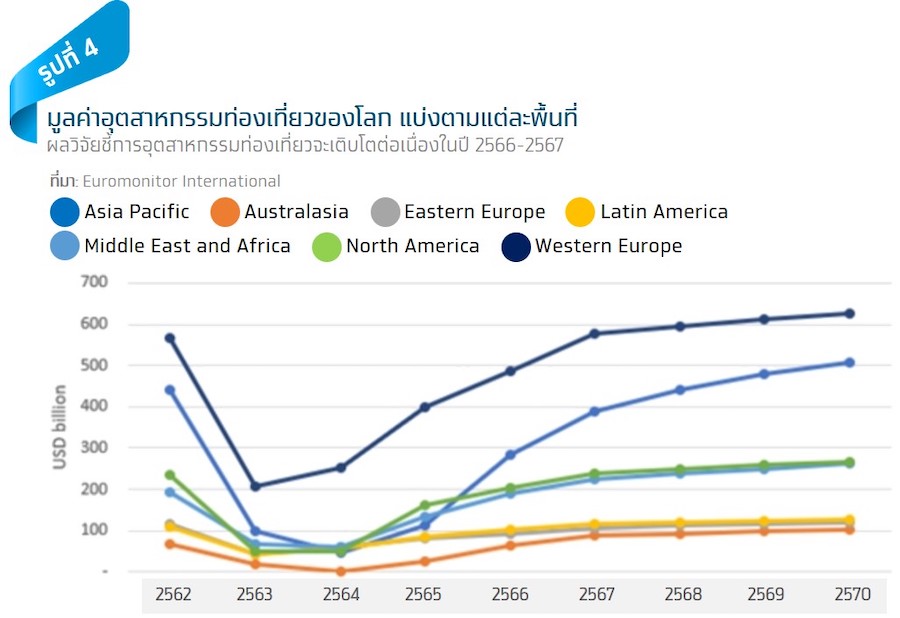
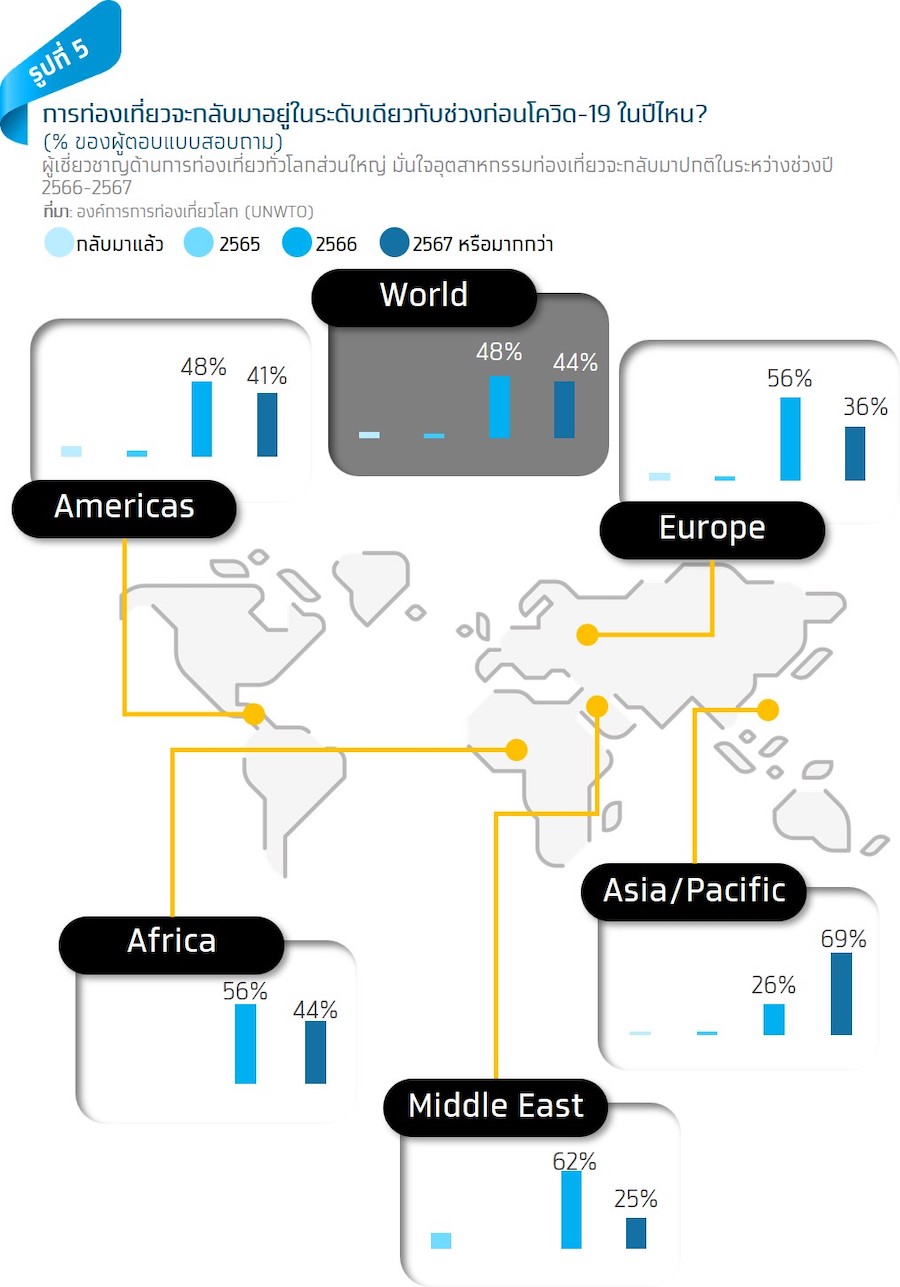
This aligns with research from Euromonitor International in October 2022, which indicates that the global tourism industry is expected to grow continuously in 2023-2024, supported by the easing of international travel restrictions worldwide and high global vaccination rates (Image 4). This information is also consistent with the views of global tourism experts who remain confident that the tourism market will bounce back after COVID-19 subsides, as highlighted by a survey from the UNWTO showing that most tourism experts expect the global tourism market to continue expanding and return to normal levels in 2023-2024. However, the survey indicates that tourists in the Asia-Pacific region will recover more slowly than in other regions due to some countries still not opening to foreign tourists, such as China and Hong Kong (Image 5).
Thirdly, most Chinese tourists are ready to return to Thailand whenever the Zero-COVID policy is lifted.
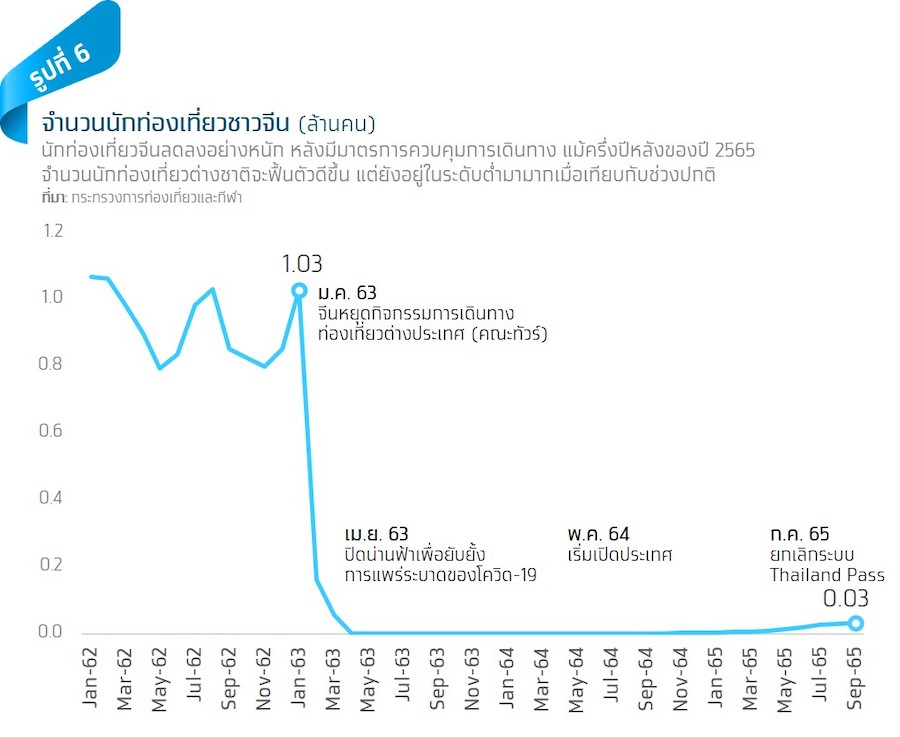
Currently, Chinese tourists are still unable to travel normally, and it is expected that the Zero-COVID measures will not be lifted in 2022. Since 2020, China has had strict control measures on international travel, leading to a significant drop in the number of Chinese tourists. In 2019, Chinese tourists were a major market contributing over 530 billion baht to Thailand's tourism sector. Although Thailand fully reopened in July 2022, the number of Chinese tourists has only recovered at a low level due to the Zero-COVID policy (currently, those traveling out of China must have purposes related to work, education, scientific research, or medical treatment). In the first half of 2022, the average number of Chinese tourists was 10,000 per month, increasing to 32,320 in September 2022 after Thailand's full reopening, which is still significantly lower than the average of about 930,000 per month in 2019 (Image 6).
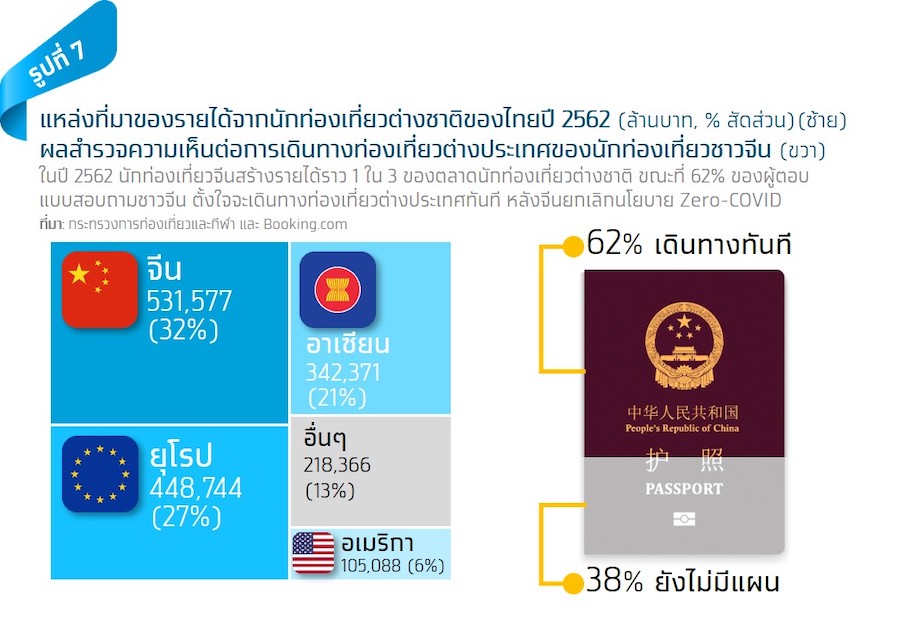
Currently, even though the Chinese government has announced an indefinite extension of the Zero-COVID measures, Krungthai COMPASS believes that when China begins to ease these measures in the second quarter of 2023, it is expected that more Chinese tourists will travel to Thailand. This is reflected in a survey by Booking.com, which indicates that 62% of respondents intend to travel abroad immediately after China lifts the Zero-COVID policy (Image 7), with Thailand being one of the top five desired destinations. Before COVID-19, in 2019, Thailand welcomed 11.1 million Chinese tourists. However, the recovery of Chinese tourists will still be gradual, as it is expected that the easing of the Zero-COVID policy will occur province by province rather than a nationwide announcement, with the number of Chinese tourists expected to return to normal levels by 2024.
Did you know?
Chinese tourists are crucial to the global tourism industry, with over 155 million traveling internationally in 2019, contributing a total value of over 8.6 trillion baht, accounting for 17% of the global tourism industry. However, after China implemented international travel restrictions to curb the spread of COVID-19, the tourism industry was severely impacted, with the number of Chinese tourists dropping from 155 million to just 20 million in 2020.
Fourthly, wellness tourism presents a new opportunity in the New Normal and will be a significant upside for Thailand's tourism sector.
The Global Wellness Institute (GWI) estimates that the global wellness tourism market is expected to grow at a rate higher than 20.9% per year, from a value of 4 trillion USD in 2020 to 11 trillion USD by 2025, driven primarily by the global demographic shift towards an aging society and the modern lifestyle filled with stress. This makes wellness tourism a significant opportunity for tourism operators worldwide, including Thailand. GWI defines wellness tourism as travel that promotes preventive health, focusing on activities that restore and enhance health, covering both physical and mental health, such as spa activities, yoga, and onsen. GWI ranks Thailand's wellness tourism 15th in the world and 4th in the Asia-Pacific region, as Thailand has strengths in offering lower costs compared to the quality received.
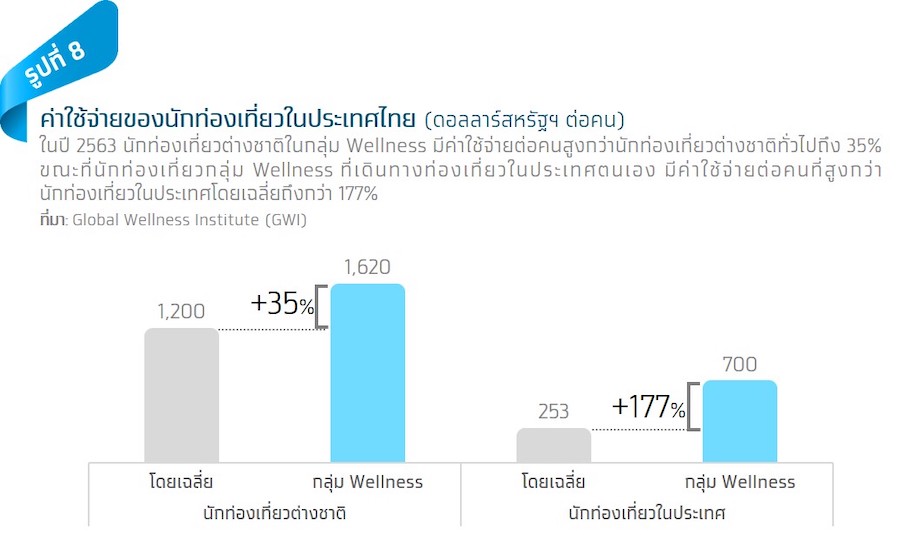
Krungthai COMPASS sees the wellness tourism market as a significant upside for Thai tourism, as it attracts quality tourists with a tendency for high spending per trip (Image 8). Therefore, in 2022-2023, while the number of foreign tourists has not yet returned to normal levels, businesses related to tourism, such as hotels, may adjust their business strategies by targeting wellness tourists instead of general foreign tourists, which will facilitate a quicker recovery.
Summary:
Krungthai COMPASS believes that the Thai tourism sector in the fourth quarter of 2022 will show signs of growth as it enters the high season. Additionally, the Thai baht's expected depreciation and the government's policy to extend the stay duration for foreign visitors from a maximum of 30 days to 45 days will make Thailand more attractive to foreign tourists. It is expected that the number of foreign tourists will accelerate to about 1.5 million per month, resulting in a total of 10.2 million foreign tourists for the entire year of 2022, which is only 25% of the 39.9 million in 2019, as the main group of Chinese tourists has not yet returned to normal travel.
Meanwhile, in 2023-2024, the Thai tourism sector is expected to grow significantly with the continuous increase in foreign tourists to 21.4 million and 34.7 million. The main positive factors include the pent-up travel demand accumulated over 2-3 years, along with the anticipated return of Chinese tourists in 2023. It is expected that the number of foreign tourists will return to normal levels by the end of 2024, as Thailand still has competitive potential in tourism compared to other countries that are gradually reopening.
However, it is noted that the number of foreign tourists in 2022-2023 will still be significantly lower than the 39.9 million in 2019, and most tourists will continue to be short-term foreign tourists who spend less per trip. This will continue to pressure per capita trip spending to remain below pre-COVID-19 averages, impacting related businesses such as hotels and restaurants, which will still face challenges in the future. Additionally, business costs are expected to rise due to minimum wage increases, electricity costs, and rising interest rates amid fierce competition.
Therefore, businesses may need to adapt by reducing reliance on any single tourist group to diversify risks or engage in marketing activities to attract high-spending tourists and new groups, such as wellness tourism with higher per capita trip spending or digital nomads who stay longer for work through digital means (video conferencing, email, etc.), while also striving to improve operational efficiency to reduce costs before the tourism sector returns to normal by late 2024.