SCG and Partners Launch 'Love the Sea' Project to Restore Marine Resources with Coral Homes Using CPAC 3D Printing Solution
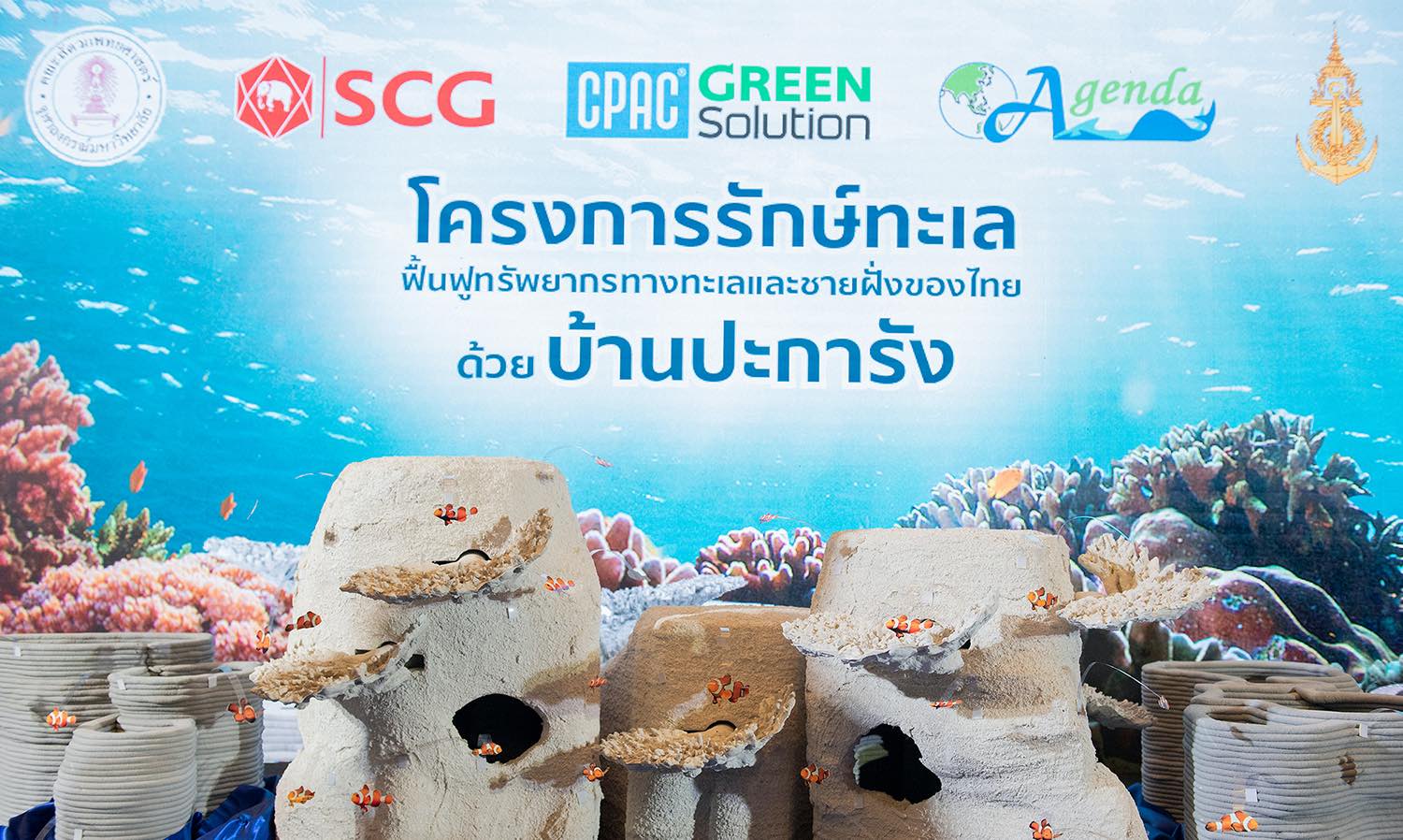
SCG emphasizes collaboration with the Department of Marine and Coastal Resources, Ministry of Natural Resources and Environment, Faculty of Veterinary Medicine, Chulalongkorn University, and supporting partners to launch the 'Love the Sea' project, uniting efforts to restore marine resources through coral homes, an innovation from CPAC 3D Printing Solution.
SCG, through SCG Building Materials Co., Ltd., in collaboration with the Department of Marine and Coastal Resources, Ministry of Natural Resources and Environment, Faculty of Veterinary Medicine, Chulalongkorn University, and Earth Agenda Foundation, along with supporting partners including the Navy and King Mongkut's University of Technology North Bangkok, has launched the 'Love the Sea' project. This initiative aims to restore marine resources using coral homes created with CPAC 3D Printing Solution, forming a base material for coral larvae to settle, creating a prototype for restoring the marine and coastal resources of the country that closely resembles natural structures. The project integrates knowledge and expertise from partners to enhance the biodiversity of coral reef ecosystems, with funding support through the Earth Agenda Foundation.
The 'Love the Sea' project is a collaborative effort aimed at restoring the richness of Thailand's seas, fostering participation from government, private sectors, society, and the new generation. It focuses on developing and designing base materials for coral larvae settlement or coral homes, under the collaboration and integration of marine biology knowledge from both the Department of Marine and Coastal Resources and the Faculty of Veterinary Medicine, Chulalongkorn University. This is achieved through the cement molding technology from CPAC 3D Printing Solution, which can create base materials for coral larvae settlement that closely mimic real-life conditions, emphasizing the design and development of structures made from strong, durable, and environmentally friendly materials. The designs can be customized to suit the species of marine life inhabiting the area.
By developing the specific properties of limestone in the cement to have a pH level close to that of seawater, the project helps shorten the time for coral larvae to settle, enhances growth efficiency for coral transplantation, and allows for quicker self-restoration. The structures can be easily transported and installed, with the added feature of modular components. The award-winning innovation of 2020, 'Coral Innovation', under the 'Love the Sea' project, has also involved data collection on hydrodynamics, sedimentation testing based on water current directions around the structures, and monitoring the settlement and growth efficiency of coral larvae. Pilot projects are planned for locations such as Koh Racha Yai in Phuket, Koh Tao in Surat Thani, Koh Si Chang in Chonburi, Khao Lak in Phang Nga, and Koh Samaesarn in Chonburi.
Ms. Pornsri Sutthanarak, Deputy Director-General of the Department of Marine and Coastal Resources, Ministry of Natural Resources and Environment, stated, "Marine ecosystems are the largest and most complex in the world. Various marine activities rely on resource utilization, economic development alongside conservation, and pollution reduction, which are national factors directly affecting marine and coastal resources. The Ministry has been driving natural resource and environmental management according to the 20-year national strategy and the national reform issues regarding natural resources and the environment, achieving tangible results such as waste management, a significant global issue, and raising public awareness about the impacts of marine debris and environmentally friendly tourism through national marine and coastal resource management policies and plans."
This year, the ministry continues to align its policies with last year's plans, aiming to restore coral areas to at least 40% health, increase protected marine and coastal resource areas by 1,000 square kilometers annually, and improve the Ocean Health Index to over 75% this year. It also promotes cooperation with NGOs, foundations, associations, and clubs to monitor, research, and develop knowledge for managing coastal marine resources. This is why the Department of Marine and Coastal Resources collaborates with all partners today, as studies and monitoring of the coral larvae settlement materials have shown successful results, with an average of over 40 colonies settling per base and over 70 species of marine animals and fish inhabiting the area, enhancing the marine ecosystem's richness and improving the scenery for the diving tourism industry.
Mr. Chana Poomi, Vice President – Cement and Green Solution Business at SCG, stated, "SCG operates its business alongside sustainable development, considering environmental impacts, social care, and corporate governance according to the ESG 4 Plus framework, which includes:
1. Aiming for Net Zero
2. Going Green
3. Leaning towards equity
4. Emphasizing collaboration and transparency in all operations.
Previously, SCG has implemented the 'Water Conservation' project from mountains to rivers, developing from upstream to downstream, such as building water retention dams, fish homes, planting forests, seagrass, and mangroves, etc. The 'Love the Sea' project is SCG's commitment to enhancing innovation for application, in addition to housing standards, extending the use of innovations from CPAC 3D Printing Solution for conserving and restoring the country's resources, demonstrating social and environmental responsibility in business operations, respecting nature and all marine life through coral homes, highlighting the collaboration in designing and developing world-class technology for 3D modeling.
Additionally, the project develops an environmentally friendly cement formula (Powder Extrusion) to enhance the settlement efficiency and growth of coral larvae. Through this collaboration in the 'Love the Sea' project, we aim to create participation from business partners, government networks, civil society, academia, and communities to support conservation as a driving force for future collaboration, enabling tangible expansion that will ensure sustainability for future generations.
Prof. Dr. Kawalee Chatrarong, Vice President for Strategy, Innovation, and International Missions at Chulalongkorn University, stated, "The Coral Innovation project has been a source of great pride, utilizing the distinctive structures and surface characteristics of real corals in nature to design coral innovations that are realistic, harmonious, and beautiful. This is achieved using 3D cement printing technology and coating the exterior with Nano Calcium Phosphate Particles, a key nutrient component for coral larvae, featuring slots for installing seedlings or natural coral branches to accelerate reproduction rates. The design also emphasizes easy transport and installation, being lightweight yet resistant to water currents. Testing the wave resistance capabilities using the Hydrodynamic Testing System at the Southeast Asian Fisheries Development Center (SEAFDEC) revealed small whirlpools forming around the decorative branches, facilitating natural nutrient circulation, promoting rapid growth of real corals, and increasing coral larvae settlement rates. The coral innovation can also be further developed into various forms, including prototype products for artificial corals in the future, artificial reefs for tourism to replace natural reefs, or underwater coral parks (Marine Parks) that can serve as Smart Stations for monitoring environmental changes and observing coral bleaching, as well as training areas for diving, titled 'Coral Innovation: Sculpture of Technology for Lives'.
Prof. Dr. Nantharika Chansue, Chair of the Earth Agenda Foundation, stated, "The foundation was established by the three aforementioned agencies with the intention of restoring and conserving, providing knowledge to the public to reduce degradation impacts, and creating participation from all sectors, including community networks, diving networks, and conservation-minded individuals, as well as developing new methods to save marine animals, such as projects for creating artificial turtle legs, seagrass projects, and the latest 'Love the Sea' project, where the foundation acts as a mediator to solicit funding support for producing and placing coral homes at www.lovethesea.net. This is undoubtedly an innovation that will change the world for the better, especially the underwater world, which is a vital ecosystem and a source of diverse life. We are committed to raising awareness to restore and conserve nature through collaborative efforts.
Join us in the 'Love the Sea' project to unite efforts in restoring marine resources with coral homes to make Thailand's seas beautiful again.