Is REIT Still an Investment Tool for Managing Portfolio Returns at This Time?
The first half of 2022 has been challenging, marked by the ongoing waves of the COVID-19 pandemic, followed by the trade war between the U.S. and China, and most recently, the war between Ukraine and Russia. These events have had widespread impacts, particularly with rising production costs due to sanctions on Russia. However, this situation seems to have allowed Russia to pivot its trade openly towards the Eastern world, especially with China. This has affected the countries imposing economic sanctions and has spread globally, primarily due to crude oil, which is Russia's main product. Russia is the third-largest crude oil producer in the world, with 10.7 million barrels per day (data from 2020, source: Bloomberg). This has led to increased oil prices, affecting the costs of various goods and contributing to rising inflation worldwide. The measures taken by the U.S. Federal Reserve to manage inflation include raising interest rates by 0.75% on June 15, 2022, bringing the current rate to 1.50-1.75%, marking the highest increase in 28 years.
The Thai stock market has been quite responsive to news and various situations, leading to investment volatility. It has been emphasized that managing investment risk is crucial. Choosing assets that align with the investor's risk tolerance and incorporating assets that provide consistent returns can enhance portfolio safety. In such circumstances, keeping cash or depositing money may not always be the best answer, as there are still certain asset types that offer good and stable returns, such as REITs. Investing in REITs involves tangible assets, with clear knowledge of where the investments are made, whether directly in factories, warehouses, office buildings, hotels, or indirectly through stock purchases, indicating which companies and what type of real estate assets are involved. This is essential knowledge for good investors to understand what they are investing in, the nature of the business, the sources of income, and future growth prospects, which REITs address effectively.
REITs come in various types for investors to study and invest in, such as Hospitality REITs, Retail REITs, Office REITs, Mixed-Use REITs, Exhibition Center REITs, and Industrial REITs. Historical performance shows that during the aforementioned situations, Industrial REITs have continued to provide good returns for investors, as their income primarily comes from rents paid by tenants, typically under lease agreements lasting three years, with some long-term leases extending from 6 to 12 years or even longer, sometimes up to 20 years. This results in consistent income, and the costs associated with managing these properties are relatively low, especially if managed well by experienced real estate managers or existing property owners.
Statistically, the dividend payout rates of different types of REITs vary based on the circumstances affecting them and the nature of the income received. Investors should thoroughly research the details of the assets they plan to invest in on the Stock Exchange website or the specific REIT's website before making investment decisions.

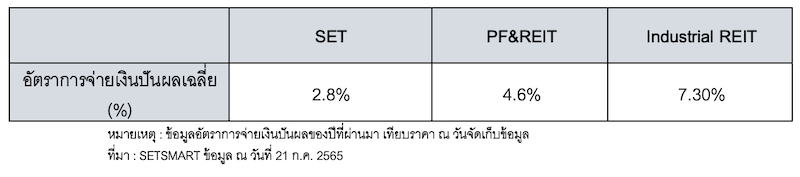
When comparing the dividend payout rates of all stocks in the stock market with those of real estate mutual funds and all types of REITs, including Industrial REITs, it is evident that REITs remain one of the assets providing good and consistent returns.
Ultimately, investors should assess their own risk tolerance before deciding how much risk they can accept for each asset they plan to invest in. Previous articles have discussed risk management strategies.
Having assets in an investment portfolio that provide consistent returns is essential for reducing the risks of a volatile market and managing one's mindset effectively, especially when receiving stable returns in unpredictable situations like the current one.