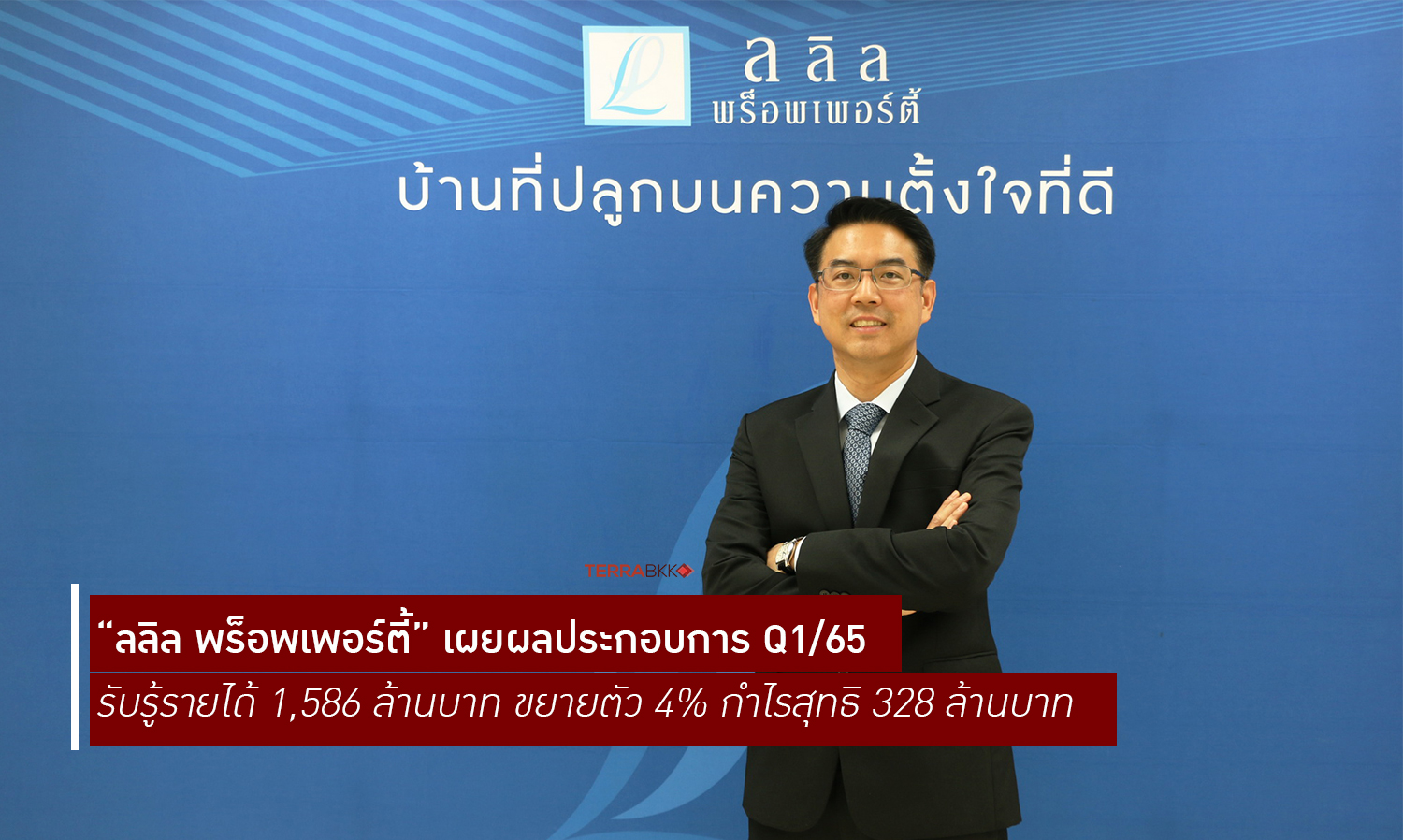
Lalin Property Reports Q1/2022 Results with Revenue of 1.586 Billion Baht, 4% Growth and Net Profit of 328 Million Baht
The company Lalin Property Public Company Limited announced its Q1/2022 financial results, showing continuous growth despite numerous negative factors in the first quarter of the year. The company recorded revenue of 1.586 billion baht, representing a 4% increase compared to the same period last year. It also maintained effective cost management amidst rising global inflation, achieving a net profit of 328 million baht, up 3%.
Mr. Churachart Chakrakul, Managing Director of Lalin Property Public Company Limited, stated that the first quarter results faced several negative factors impacting economic recovery, including the spread of the Omicron variant of COVID-19, the war between Russia and Ukraine, global supply chain crises, rising inflation, and various countries' policies to increase interest rates to curb inflation, along with the Federal Reserve's QE tapering. These factors have pressured the economy and the overall market conditions. However, the company's focus on real demand markets, which are less affected, along with continuous development of products and services to meet customer needs, has enabled the company to remain competitive, achieving continuous revenue growth and confidence in meeting its targets. Meanwhile, the company has effectively managed costs, maintaining a gross profit margin of 39.1% and a net profit margin of 20.7%, which are above the industry average.
For 2022, the company aims to launch a total of 10-12 projects valued at 7,000-8,000 million baht. Currently, there are 8 projects that have been launched or are in preparation, valued at approximately 6,000 million baht, in line with the planned schedule.
In terms of financial risk management, last month, before interest rates significantly increased, the company issued a 3-year debenture to lock in interest costs amounting to 500 million baht at a fixed interest rate of 3.2%. The company has been cautious in managing financial risks, utilizing diverse funding sources, and maintaining a substantial amount of unused credit lines. Additionally, its rapid business turnover has allowed the company to maintain a strong financial position, even with ongoing investments in new projects over the past few years. The debt-to-equity (D/E) ratio at the end of the first quarter was only 0.59 times, significantly lower than the industry average of around 1.4 times. Furthermore, the net debt-to-equity (Net D/E) ratio stands at just 0.21 times, reflecting strong financial health and readiness for business expansion without liquidity issues.