TTB Economic Analysis Center Predicts 'Songkran 65' as a Boost for Tourism Recovery, Anticipating Revenue to Reach 1 Trillion Baht, the Highest in 2 Years
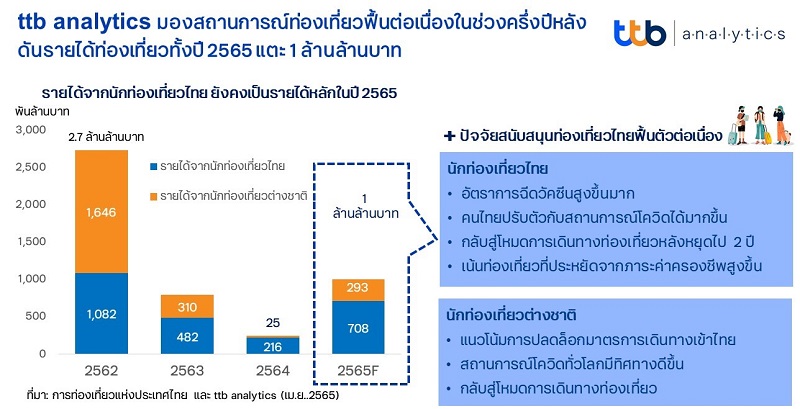
<\/span>TTB Economic Analysis Center <\/strong><\/span> or <\/strong><\/span> ttb analytics <\/strong><\/span> estimates that there are still positive factors supporting the continuous recovery of Thai tourism, pushing total tourist revenue for the year to reach 1 trillion baht, which accounts for 37% of the revenue in 2019.
Thai tourism has shown signs of improvement since late 2021, continuing into early 2022, despite still facing the COVID-19 situation. This is reflected in various tourism indicators over the first two months, which have consistently improved, including the number of tourists and occupancy rates, leading to an increase in revenue from both Thai and foreign tourists by over 150 billion baht. However, inflationary pressures have raised living costs, and the return of foreign tourists has not yet reached pre-COVID-19 levels, particularly from China and Russia, even though travel restrictions have been gradually lifted.
Travel patterns have become clearer since the beginning of the year.
Comparing current travel with the COVID-19 crisis in 2020-2021 using Real-Time data from Facebook Mobility, it shows that mobility trends are increasing across all regions, especially in the Northeast and North, aligning with the BOT Regional Activity Tracker, which indicates increased travel. Additionally, tourism statistics reveal that the occupancy rate in the first two months of 2022 was 35.6%, compared to 13.5% in the same period of 2021, with increases across all regions. The North had the highest occupancy rate at 55.9%, with Chiang Rai (75.8%) and Nan (72.2%) leading. Revenue from Thai and foreign tourists totaled 112.694 billion baht, a 105% increase, with 85% coming from Thai tourists.
 <\/p>
<\/p>
Continuous recovery trends during Songkran are expected to push annual tourist revenue to 1 trillion baht.
For travel during the second quarter of 2022, coinciding with the Songkran festival, there is an anticipated continuous increase based on the recovery patterns observed during the Songkran festival in 2021. Data from Facebook Mobility shows that mobility among Facebook users in all regions is increasing compared to the COVID-19 crisis in 2020-2021.
Particularly, there is increased mobility in the South and Northeast, which aligns with the travel index indicating increased travel across all regions, especially in the Northeast. Additionally, several factors are conducive to travel:
1) A significantly higher vaccination rate, with booster shots administered to 34% of the Thai population.
2) Thai people have adapted better to the COVID-19 situation.
3) The lack of travel back to hometowns or tourism during the first and second waves of the pandemic has made the upcoming Songkran festival a clear starting point for the travel mode of Thai people, along with attracting foreign tourists through the cancellation of RT-PCR testing within 72 hours before entering Thailand for all three groups: Test & Go, Sandbox, and quarantine.
However, rising inflation is likely to dampen tourist spending and limit overall revenue growth. It is expected that total revenue from Thai and foreign tourists for the entire year of 2022 will reach 1 trillion baht, marking the highest revenue in over two years, but still primarily from Thai tourists, accounting for 70%, which is 3.2 times higher than in 2021.
Foreign tourist revenue is expected to increase significantly in the second half of the year after all travel restrictions to Thailand are lifted. Additionally, it is anticipated that tourism spending will be distributed across all regions, with the South being the highest, as recent booking data for Koh Samui and Phuket shows occupancy rates above 60%.
Various factors support continuous recovery; operators are advised to create interesting packages and ideas to adapt to changing tourism.
The global tourism atmosphere is continuously improving, with several ASEAN countries, including Vietnam, Cambodia, Malaysia, Indonesia (Bali), and Singapore, having lifted restrictions to welcome tourists without quarantine. Thailand is also expected to relax its entry measures around mid-year, leading to an increase in foreign tourists, although not yet to pre-COVID levels.
ttb analytics predicts that foreign tourists this year will number 4.5 million, making the Thai tourist market the main source of revenue for the tourism sector this year. With various supporting factors, such as a higher number of people receiving booster vaccinations, Thai people adapting better to the COVID-19 situation, and average monthly household spending in Thailand, which includes transportation and entertainment expenses accounting for 17%.
Therefore, despite facing higher travel costs due to rising fuel prices and purchasing power not yet returning to normal levels, it is believed that Thai people will continue to travel in their daily lives, including tourism, by adjusting to the current situation where tourists are likely to spend less, considering travel to nearby provinces or visiting secondary cities with lower costs, or opting for land travel more.
Given these changing travel behaviors, tourism operators should consider and market to attract tourism in line with the travel patterns of both Thai and foreign tourists, who are also expected to return more. If tourists from key markets, such as China and Russia, can travel abroad this year, it will accelerate Thailand's tourism recovery to pre-COVID-19 levels more quickly.