KKP Research Indicates Omicron's Short-Term Impact, Predicts Economic Recovery in the Second Half of the Year with 3.9% Growth - Advises Monitoring Inflation that May Affect Purchasing Power and Business Sector
Kiattinakorn Securities Public Company Limited analyzes the overall Thai economy for 2022, revealing a tendency for better recovery, but it is essential to monitor the outbreak of the Omicron variant in the first quarter, which may delay economic recovery and the return of tourists. The annual economic forecast remains at a growth rate of 3.9% based on the assumption of 5.8 million foreign tourists.
.jpg)
Dr. Pipat Leuangnaruemitchai, Chief Economist of KKP Research, Kiattinakorn Securities Public Company Limited assesses the Thai economy for 2022, indicating a tendency for better recovery, with the economy expected to return to a more normal state. However, significant uncertainties remain, particularly concerns about the Omicron outbreak in the first quarter, which is likely to have a short-term impact, delaying economic recovery and the return of tourists. Recovery is expected to resume as the domestic economic situation and tourism return to normal, maintaining the annual growth forecast at 3.9% based on the assumption of 5.8 million foreign tourists.
In 2022, there are several aspects to watch closely including the gradual transition of COVID into an endemic disease, where accelerated vaccination will help reduce the severity of the disease and the impact of outbreaks, allowing the economy to gradually return to normal. Additionally, global liquidity is expected to decrease, and global interest rates are likely to rise due to higher-than-expected global inflation pressures, prompting major central banks, particularly the U.S. Federal Reserve, to begin tapering economic stimulus and adjusting policy interest rates. This will impact investment, financial costs, capital mobility, and exchange rates globally, including in Thailand. Furthermore, the Thai economy is likely to recover more slowly than the global economy, with expectations of acceleration in the second half of the year as domestic demand and the return of foreign tourists improve, although recovery remains uncertain and uneven.
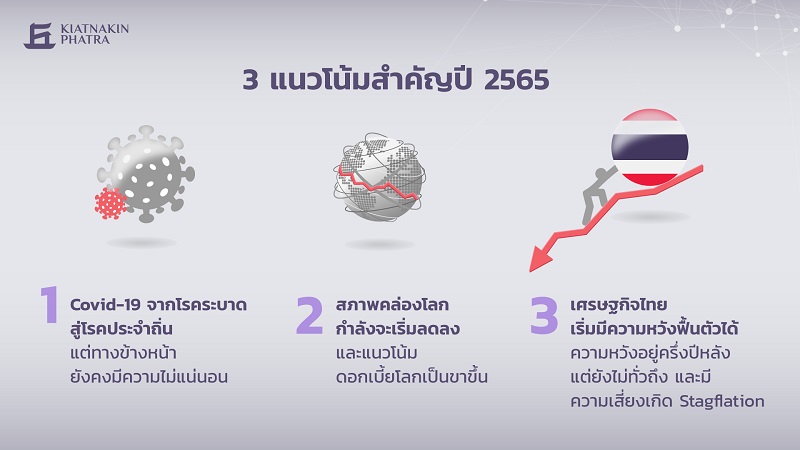
Inflation in Thailand may rise to 3.5% in the first quarter due to rising energy and food prices, which will impact the cost of living, especially for low-income individuals.
On the monetary policy side, the Bank of Thailand is likely to prioritize economic recovery over inflation and maintain the policy interest rate throughout most of the year. The interest rate differential between domestic and external markets will cause fluctuations in the Thai baht, particularly in a situation where there is still a current account deficit.
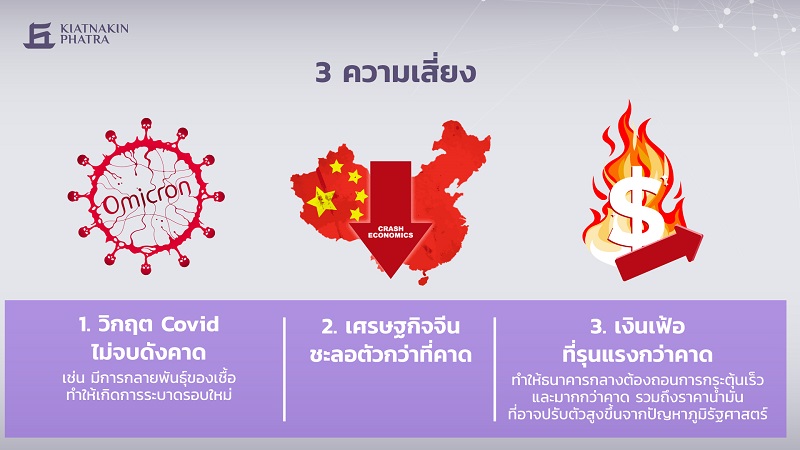
Additionally, there are three significant risk factors to consider: the outbreak and mutation of the virus may prolong the pandemic, affecting economic recovery and tourism.
This includes the slowdown of the Chinese economy due to real estate sector issues and COVID crisis management, which may impact global economic recovery and the Thai economy, particularly exports that may slow down. Furthermore, if global inflation does not decrease as expected, central banks worldwide may need to raise interest rates and withdraw stimulus more aggressively than the market anticipates, which will affect economic recovery. Additionally, geopolitical issues may further drive up oil prices and pressure global inflation.