Rising Pork Prices, Increasing Egg Costs, Inflation: Will REIT Prices Rise?
At the beginning of 2022, there was a significant increase in pork prices. According to TTB Analytics, the price of pork in January 2022 was 190 baht per kilogram, up approximately 33.8% compared to the average price of 142 baht per kilogram in 2021. Additionally, prices for other items such as chicken eggs, chicken meat, and palm oil have also risen, leading to increased raw material costs for restaurants, along with higher utility bills, transportation costs, and fuel prices. This has led to predictions that inflation in Thailand is likely to rise.
Table 1: Increase in Prices of Goods and Raw Material Costs
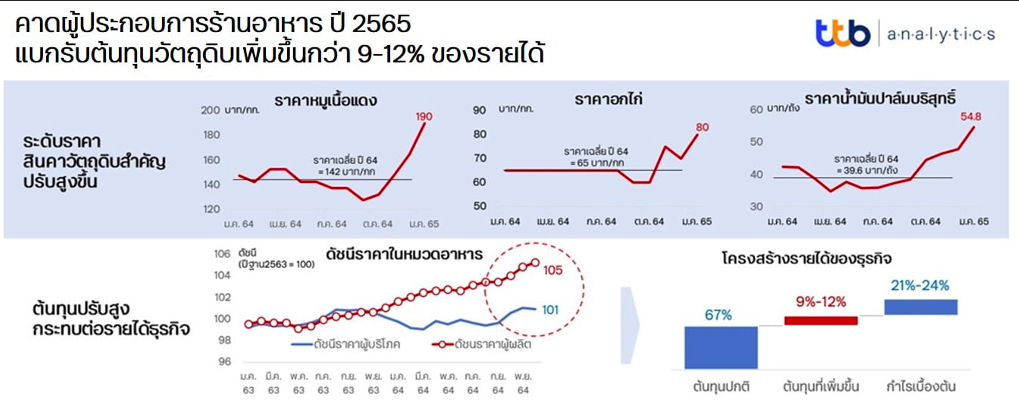
Source: NESDB, OSMEP, DIT, and TTB Analytics (January 2022 forecast data)
For REITs, which invest in real estate and generate regular rental income, one of their key features is that they can act as a hedge against inflation. In normal circumstances, REITs can increase rental prices in line with inflation changes. For example, office buildings typically raise rents by 7-10% upon lease renewal every three years. Furthermore, rental prices and commodity prices are components used to calculate inflation. Given the trend of rising inflation in Thailand, there is a question of whether this will drive up rental prices for real estate, resulting in increased profits and dividends for REITs, which could support higher REIT prices.
However, considering the rising commodity prices and inflation, it appears that this inflation is not driven by increased demand, which may not directly impact rental prices.
- Pork price increases are a result of supply push inflation due to rising feed costs and the outbreak of African swine fever, as reported by the Department of Livestock Development in Nakhon Pathom, leading to higher care costs and infection rates among pigs.
- The rise in chicken egg and chicken meat prices is due to increased demand for substitute products that provide similar protein content.
- The increase in oil prices at the end of 2021 was driven by rising demand and economic activities as developed countries, like the United States, began to recover.
Moreover, regarding Thailand's economy, the Bank of Thailand has projected the Thai economy to grow by 3.4% in 2022, impacted by the COVID-19 Omicron variant and the tourism sector, which will take time to recover as the number of foreign visitors remains lower than pre-COVID levels. This means that Thailand's economy will not recover to pre-COVID levels this year, following a contraction of 6.1% in 2020. However, growth is expected to be around 0.9% in 2021 and 3.4% in 2022, respectively.
Table 2: Economic Forecast for Thailand 2021 – 2022

Source: Bank of Thailand (December 2021 forecast data)
In summary, while prices for some goods are rising and may lead to increased inflation, this inflation is driven by rising production costs, increased demand for substitute goods, and higher global market prices due to foreign demand linked to stronger economic growth. Coupled with the still low growth of the Thai economy, the demand for rental properties is not increasing significantly, which will limit the upward adjustment of rents and the increase in rental rates for real estate. Consequently, the profits and dividends of REITs may not grow significantly. Therefore, the price of REIT units may not rise as quickly as pork prices.