Krung Thai Bank Highlights the Need for Thai Industry to Accelerate Efficiency with Industrial Internet of Things (IIoT)
Krung Thai Bank Research Center emphasizes that the Thai industrial sector should rapidly integrate Industrial Internet of Things (IIoT) technology to elevate itself to smart factories, enhance production efficiency, and reduce costs, particularly the maintenance costs of machinery, which amount to 206 billion baht annually. It suggests that eight groups of exporters, which collectively operate over 17,290 factories and incur machinery maintenance costs of 112 billion baht per year, should be the first to adapt. Meanwhile, the government should consider allocating funds to revive and stimulate the economy post-COVID-19, particularly to support SMEs in adopting IIoT more extensively.
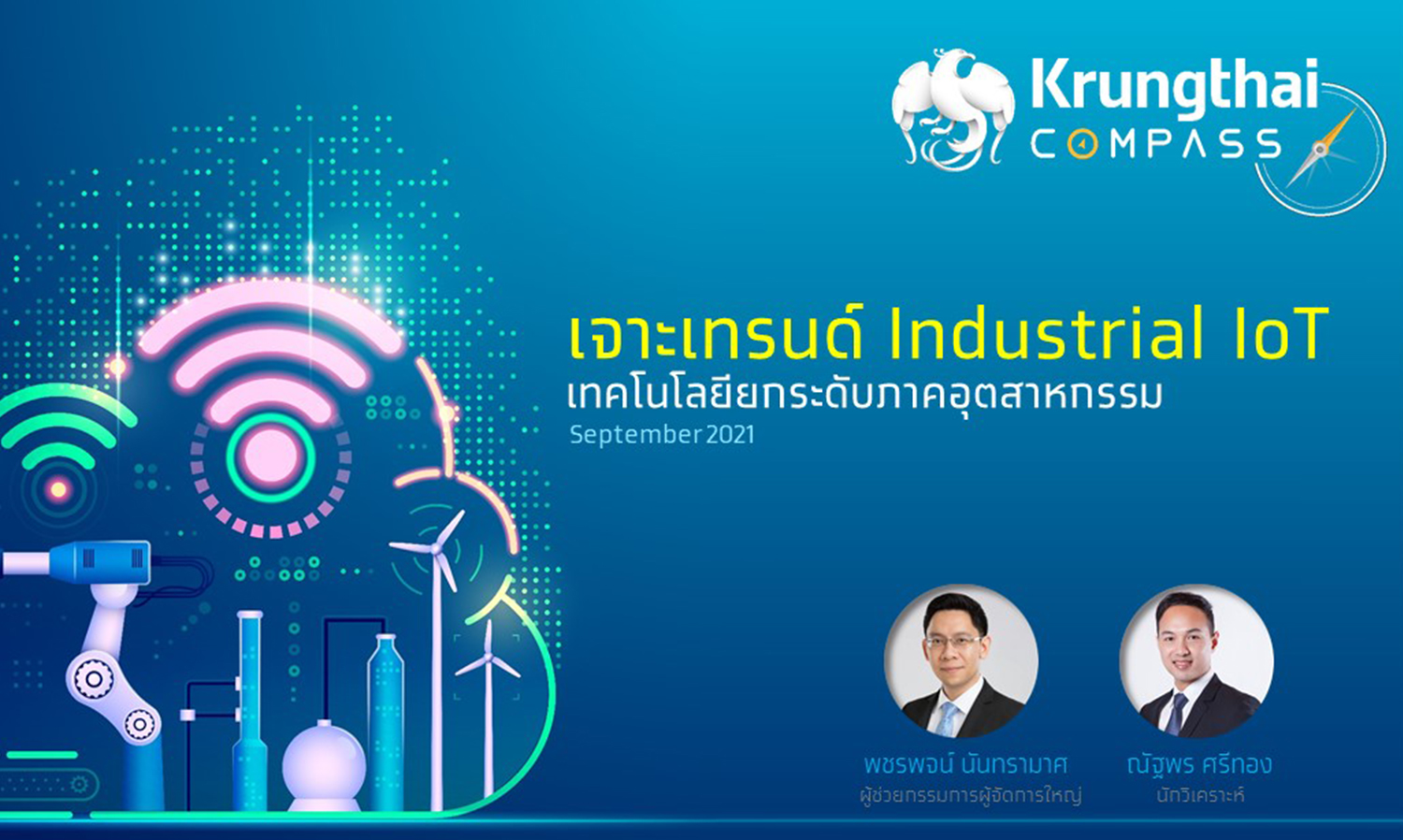
Dr. Patcharaporn Nantharamas, Assistant Managing Director of Krungthai COMPASS Research Center at Krung Thai Bank, stated that Industrial Internet of Things (IIoT) technology is one of the global megatrends gaining momentum as it aligns with the concept of Digital Lean Manufacturing, which focuses on minimizing waste in every production step. Additionally, the COVID-19 crisis has necessitated increased operational flexibility in the industrial sector to cope with Supply Chain Disruption. The growth trend of this megatrend aligns with McKinsey's assessment that global investment in IIoT will increase by an average of 12% annually from 2020 to 2025, leading the global industrial sector into a fully-fledged Industry 4.0 era with enhanced efficiency through real-time monitoring of machinery and predictive maintenance analysis, which could reduce installation, repair, and maintenance costs, currently valued at 206 billion baht annually in Thailand.
“We are beginning to see more examples of use cases for IIoT implementation abroad, proving that IIoT can reduce production costs by as much as 30%. Therefore, the Thai industrial sector should accelerate the integration of IIoT in manufacturing plants to keep pace with global trends and enhance the country's competitive capabilities, as currently about 60% of Thai operators are still at Industry 2.0. Several factors facilitate the use of IIoT, such as decreasing sensor and data storage costs, the development of 5G technology for fast and accurate data transmission, and government measures promoting Industry 4.0,”
Mr. Natthaporn Sritong, an analyst, added that the eight export-oriented industries that are recovering in line with the economic conditions of trading partners and are ready to apply IIoT include processed fruits and vegetables, processed chicken, automotive, machinery, rubber products, electronics and electrical appliances, plastic pellets and products, and chemicals. Currently, these industries have over 17,290 factories, accounting for about 25% of all factories in Thailand, with machinery maintenance costs reaching 112 billion baht annually. Operators should start by studying the technology and considering suitable IIoT solutions, which can be consulted through government agencies, as well as participating in various projects such as the Industrial IoT and Data Analytics Platform (IDA) in collaboration with the National Electronics and Computer Technology Center (NETEC) and partners, or directly contacting system integrator service providers.
“The government should consider allocating funds to revive and stimulate the economy post-COVID-19 towards supporting the business sector, especially SMEs, to adopt IIoT more extensively. The main challenge SMEs face is funding, in addition to knowledge and personnel limitations. Support could take the form of a 'co-financing project' aimed at covering a wide range of SMEs and utilizing a digital platform as a key mechanism for project implementation, without requiring SMEs to pay upfront, thus providing genuine financial assistance,”