Analysis of Words - Business Trends from MD&A Reports of SET50 Companies
Analysis of Words - Business Trends from MD&A Reports of SET50 Companies: How do companies explain their performance? What do they feel during COVID-19? And what trends are they interested in?
• The EIC employs computational language processing to analyze the "Management Discussion and Analysis" (MD&A) reports of large listed companies in Thailand, which serve as the primary communication tool for businesses to engage with shareholders and stakeholders on a quarterly basis.
From the analysis of the MD&A reports of SET50 companies from Q1 2015 to Q1 2021, six interesting findings were identified:
1. The length of MD&A reports has consistently increased, with an average length increase of 35%.
2. Sentiment analysis of the MD&A content reveals that positive-negative sentiment correlates with company profits.
3. The sentiment of SET50 companies during COVID-19 hit a six-year low, with all industries experiencing negative sentiment simultaneously for the first time.
4. Companies tend to maintain an optimistic outlook for the future, but this perspective does not accurately predict future performance.
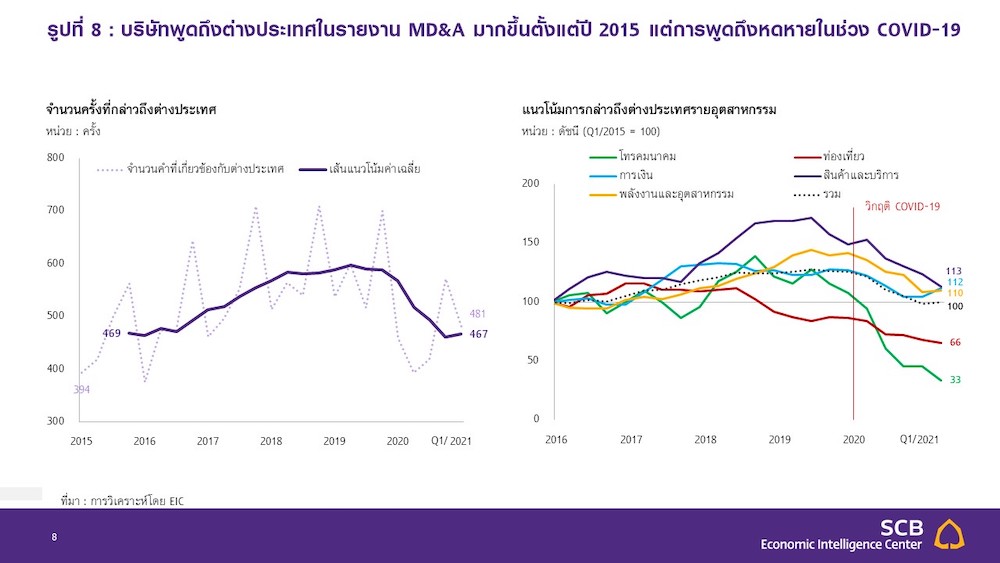
5. Prior to COVID-19, SET50 companies increasingly discussed developments and business opportunities abroad, but this trend shifted following the COVID-19 crisis.
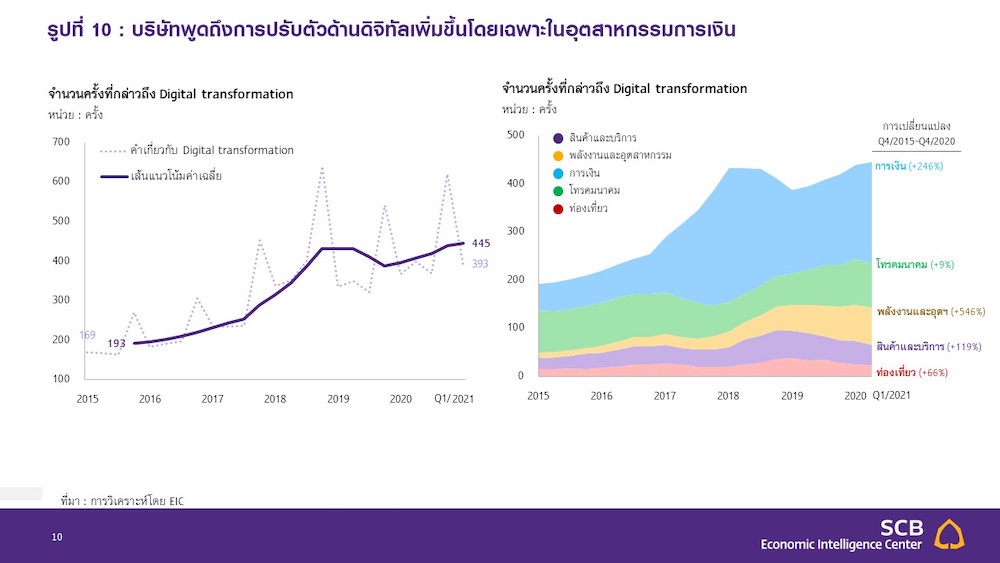
6. The trend of Digital Transformation prominently emerged in SET50 companies, with mentions in MD&A reports doubling.
• Overall, the analysis of data and sentiment from the MD&A reports of SET50 companies effectively reflects the companies' perspectives, aligning with performance results and business confidence indices. It also showcases qualitative data such as sentiments, interests, and future outlooks. During the COVID-19 crisis, this data highlighted the lowest sentiment points across various industries and the differing recoveries, along with the ongoing growth of the Digital Transformation trend.
Company performance, derived from financial statements such as revenue or profit, is a key indicator for tracking business conditions and trends. However, it is also interesting to monitor alongside the Management Discussion and Analysis (MD&A) reports, which companies use to explain their operational results and business trends each quarter. The MD&A report not only provides performance data but also explains the reasons behind that performance, economic conditions, business strategies, and future outlooks. Therefore, analyzing MD&A reports can yield valuable qualitative insights for stakeholders.
However, tracking information from MD&A reports can be challenging due to their narrative format, which lacks a clear structure (unstructured data), unlike numerical data in financial statements that follow standardized reporting formats and are easier to compare across companies. This presents limitations in monitoring this information, especially when tracking a large number of reports continuously, posing a barrier to systematically accessing useful data. Currently, there are methods for analyzing text data using computer programs, making it easier to track information from MD&A reports through Natural Language Processing (NLP) techniques that assist in analyzing words and sentence structures.
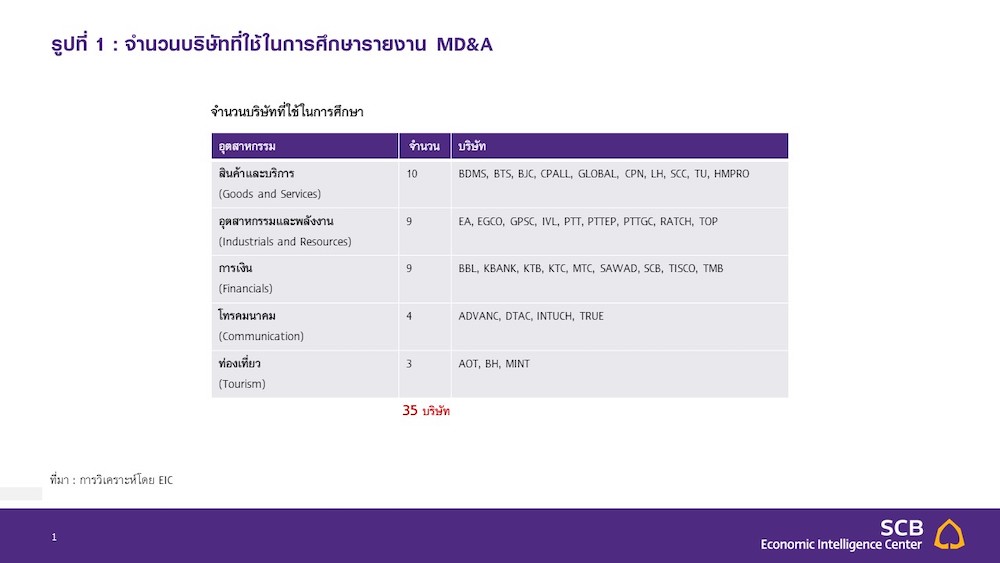
The EIC has applied various NLP tools to the MD&A reports of large Thai listed companies to analyze qualitative data and sentiment from the report content. The analyzed MD&A reports are in English, with developed analytical methods ready for application. The reports from companies in the SET50 group, which have complete MD&A reports from Q1 2015 to Q1 2021, total 35 companies (Figure 1). The market capitalization of the analyzed companies accounts for approximately 53% of the current stock market value, categorized into five industries: goods and services, energy and industry, finance, telecommunications, and tourism.
Figure 1: Listed Companies Used in the MD&A Study
Source: Analysis by EIC
From the analysis of the MD&A reports, six interesting findings emerged:
1. The length of MD&A reports has consistently increased over the past five years.
The word count in MD&A reports has shown a continuous upward trend over the past five years. MD&A reports do not have a fixed format; companies define their own formats and content details, resulting in varying word counts across companies, ranging from 200 to 8,500 words. However, the long-term trend indicates that the total word count used in the MD&A reports of the sample companies has consistently increased (Figure 2, left), from a total of 79,629 words in Q4 2015 to 107,412 words in Q4 2020, representing a 35% increase. Approximately three-quarters of the sample companies have increased their word counts, with the average word count of MD&A reports rising from 2,152 words in 2015 to 2,903 words in 2020.
This trend may result from several factors, including: 1) Business expansion, including international ventures, acquisitions, or diversification, where report length often correlates with company size (Figure 2, right); 2) Increased explanations of external factors affecting business conditions or company performance during specific periods, such as the COVID-19 crisis; and 3) Changes in regulations, such as evolving financial reporting standards.
Figure 2: The Word Count in MD&A Reports Has Continuously Increased and Correlates with Company Market Value
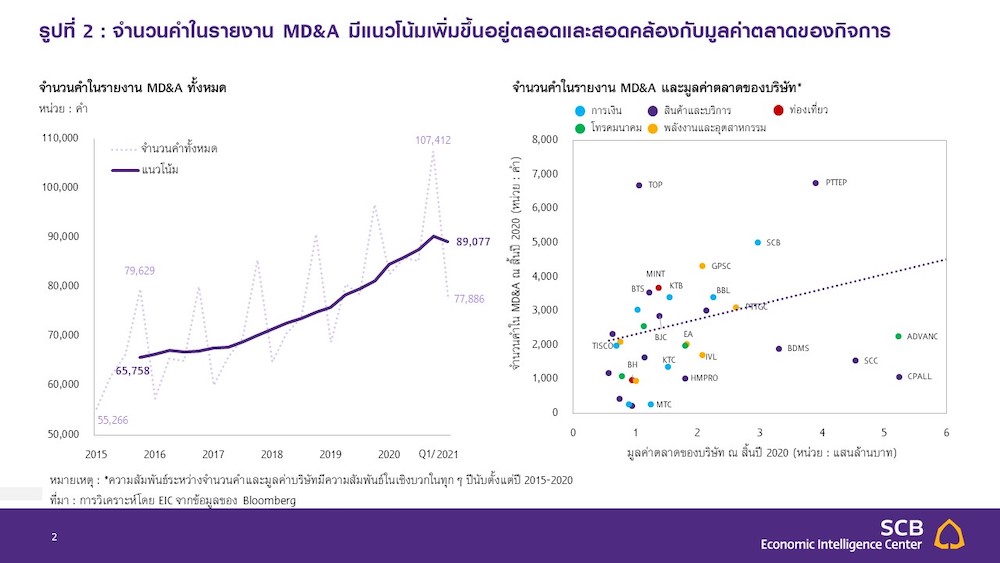
Note: *The relationship between word count and company value has shown a positive correlation every year from 2015-2020.
Source: Analysis by EIC from Bloomberg data
BOX: Which Words Are Most Frequently Used in MD&A Reports?
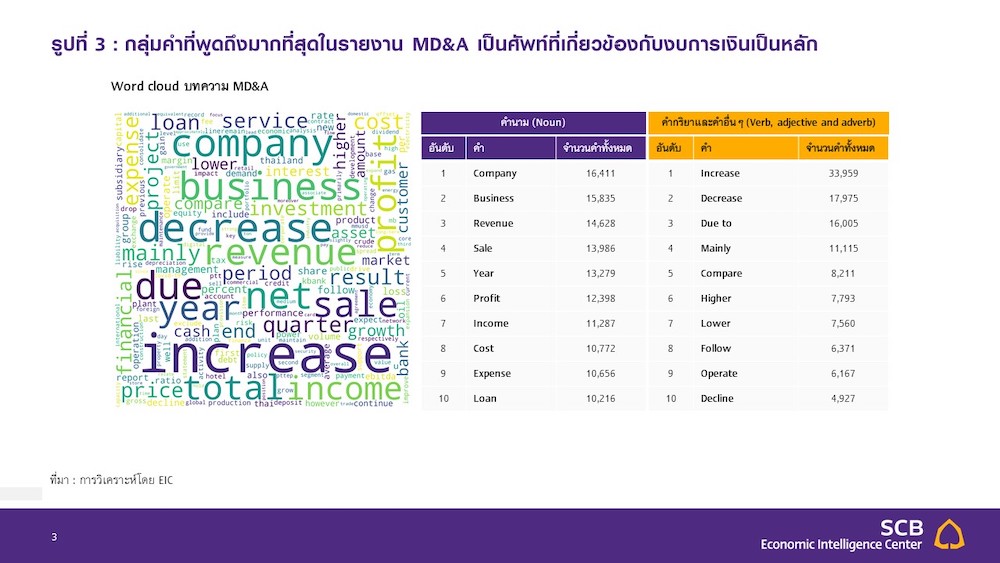
The words in MD&A reports primarily discuss the company's financial statements. When all words in the MD&A reports are lemmatized (e.g., converting "increased" and "increasing" to "increase"), and the frequency of these words is counted and displayed as a word cloud (showing the size of words based on usage frequency), it is evident that the terms related to financial explanations dominate (Figure 3), including financial terms like "revenue," "profit," or terms indicating change direction like "increase" (the most frequently used term during the analysis period) or "decrease."
Figure 3: The Most Frequently Discussed Words in MD&A Reports Are Primarily Financial Terms
Source: Analysis by EIC
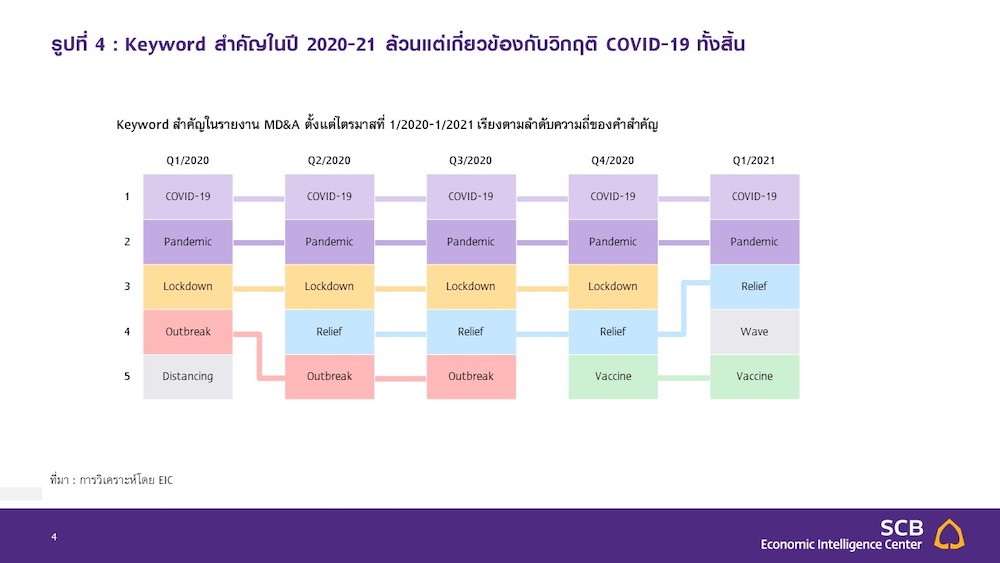
In addition to commonly used words in performance explanations, the documents often contain important keywords that indicate significant factors or events frequently mentioned during specific periods. The EIC employed the Term Frequency - Inverse Document Frequency (TF-IDF) technique to identify key terms in the documents compared to all existing documents. It was found that the key terms shared by all companies from 2020 to Q1 2021 were entirely related to the COVID-19 crisis (Figure 4), including terms like "COVID-19," "pandemic," and "lockdown," followed by related terms such as "relief" (referring to government assistance measures) or "vaccine" (which became a key term starting from Q3 2020). In contrast, applying the same method to the MD&A reports before COVID-19 (2015-2019) revealed prominent terms reflecting significant factors that varied each year, such as terms related to the US-China trade war during 2018-2019. However, the frequency of key terms before COVID-19 was significantly lower than during the COVID-19 crisis, indicating that the COVID-19 factor impacted nearly all companies, unlike earlier significant factors that may have affected fewer companies.
Figure 4: Key Terms in 2020-2021 Were Entirely Related to the COVID-19 Crisis
Source: Analysis by EIC
2. Sentiment Analysis from MD&A Reports Reveals That Positive-Negative Sentiment Correlates with Company Profits
The EIC utilized NLP tools to analyze sentence structures and convert descriptions in MD&A reports into a sentiment index. Previous studies by Siriyoth Chutanon (2019) examined MD&A reports of companies in the Thai stock market from 2012-2018 to explore the relationship between sentiment in MD&A and future profitability (Return on Asset), considering sentiment measurement in terms of words in the reports.
Since the previous studies did not account for sentence structure, the EIC further developed this approach by measuring sentiment in terms of sentences, allowing for the differentiation between sentences discussing past performance and future outlooks, as well as a more current timeframe to reflect the ongoing COVID-19 crisis. The analysis process involved:
1. Extracting articles into sentences, excluding headings or phrases not in sentence form (a sentence must contain a subject and a verb).
2. Identifying verbs and adjectives categorized as positive, negative, forward-looking, and uncertain, referencing the Loughran and McDonald dictionary, which is a Bag of Words created for sentiment measurement in analyses and financial reports of US companies.
3. Counting the frequency of words in the positive and negative sentiment categories in sentences and calculating the net sum of both groups. If a sentence contains more positive keywords than negative, it reflects a positive outlook; conversely, if negative keywords outnumber positive, it reflects a negative outlook. The net sum is then divided by the total number of sentences to create an index, resulting in the company's sentiment index.
4. Converting the company's sentiment index into an overall business sentiment index or MD&A sentiment index by calculating the weighted average based on market capitalization for that quarter.
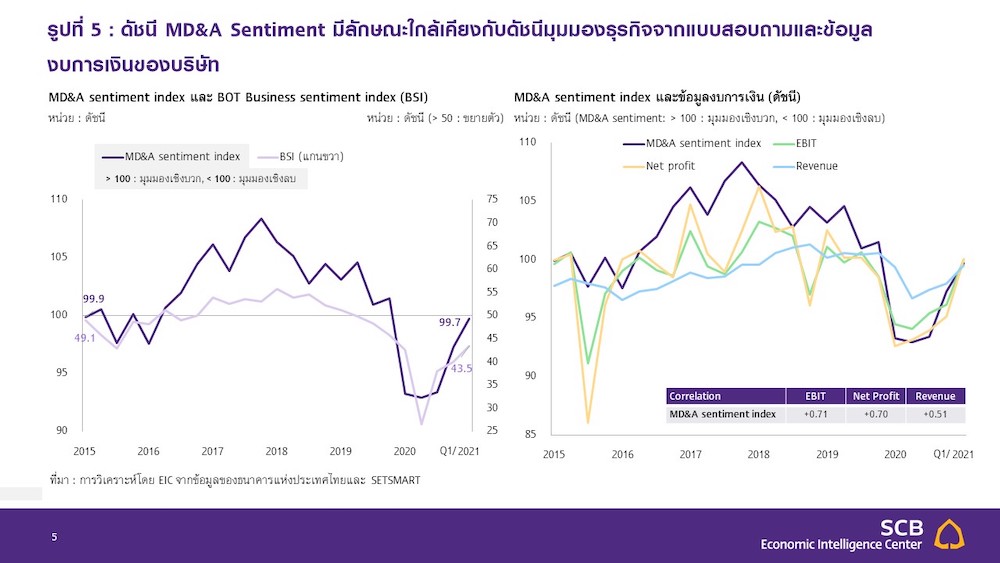
The MD&A sentiment index reflects management's perspective through the content of the MD&A reports. An index value above 100 indicates a positive overall outlook in the MD&A report, while a value below 100 indicates a negative overall outlook. Analysis of the MD&A sentiment index of 35 companies in the stock market using a weighted average based on market capitalization revealed a trend consistent with the Business Sentiment Index (BSI) of the Bank of Thailand, which measures business outlook similarly, although the BSI relies on surveys of entrepreneurs.
Moreover, the trend of the MD&A sentiment index aligns with key performance data of companies, as most descriptions in MD&A reports explain what has occurred in financial statements. It was found that the MD&A sentiment index correlates most strongly with earnings before interest and tax (EBIT), followed by net profit and revenue figures.
Figure 5: The MD&A Sentiment Index Closely Resembles the Business Sentiment Index from Surveys and Company Financial Data
Source: Analysis by EIC from data of the Bank of Thailand and SETSMART
3. The Sentiment of SET50 Companies During COVID-19 Hit a Six-Year Low, and All Industries Experienced Negative Sentiment Simultaneously for the First Time
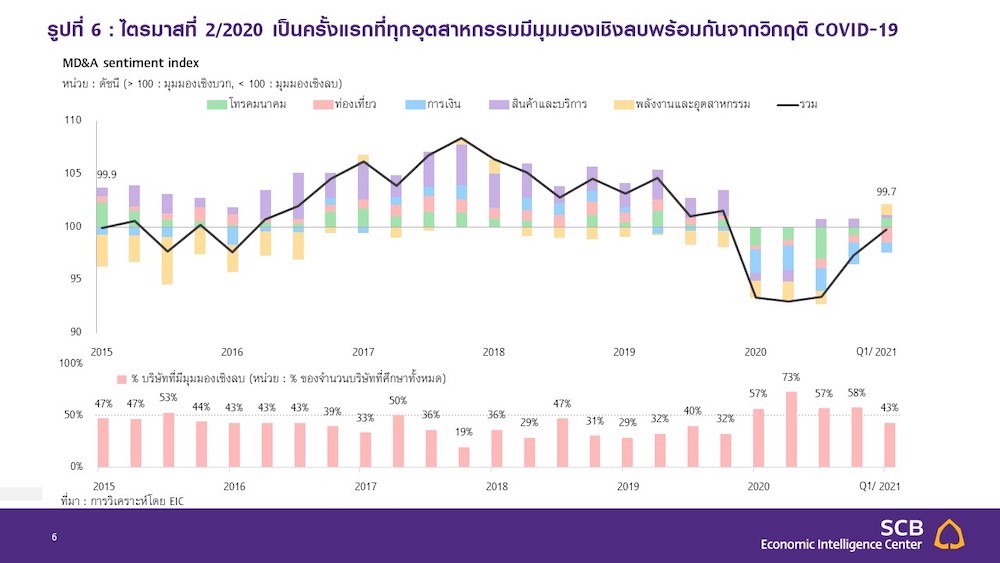
Analysis of the MD&A sentiment index data revealed that in Q2 2020, the index dropped to its lowest level in six years. Since Q2 2016, the MD&A sentiment index had shown a consistently positive trend for 15 consecutive quarters. However, the index rapidly declined in Q1 2020 to 93.3 from 101.5 in the previous quarter, as the COVID-19 outbreak expanded and began to significantly impact the performance of many companies. The index continued to decrease in the following quarter to 92.9, marking the lowest point in six years, and slightly improved in Q3 to 93.4, gradually recovering thereafter. Most recently, in Q1 2021, the MD&A sentiment index rose to 99.7, benefiting from companies that gained from the recovery in exports and commodity prices. Nevertheless, the index value remaining below 100 reflects an overall negative outlook.
The first half of 2020 marked the first time that all industries shared a negative outlook simultaneously. The overall decline in the index due to COVID-19 in Q1 2020 stemmed from negative sentiments across all industries (Figure 6, top), with 57% of companies expressing a negative outlook, the first time exceeding half since Q1 2015 (Figure 6, bottom). The situation worsened significantly in the following quarter, where, despite a slight overall decline in the index, the number of companies with a negative outlook rose sharply to 73%, the highest proportion during the study period, before gradually improving in subsequent quarters. Notably, since the onset of the COVID-19 crisis, the tourism and finance industries have consistently maintained a negative outlook, while the goods and services, telecommunications, and energy industries have shown some signs of easing negative sentiments, with some companies beginning to shift to a positive outlook in Q1 2021.
Figure 6: Q2/2020 Marked the First Time All Industries Shared a Negative Outlook Due to the COVID-19 Crisis
Source: Analysis by EIC
4. Companies Tend to Maintain an Optimistic Outlook for the Future, but This Perspective Does Not Accurately Indicate Future Performance
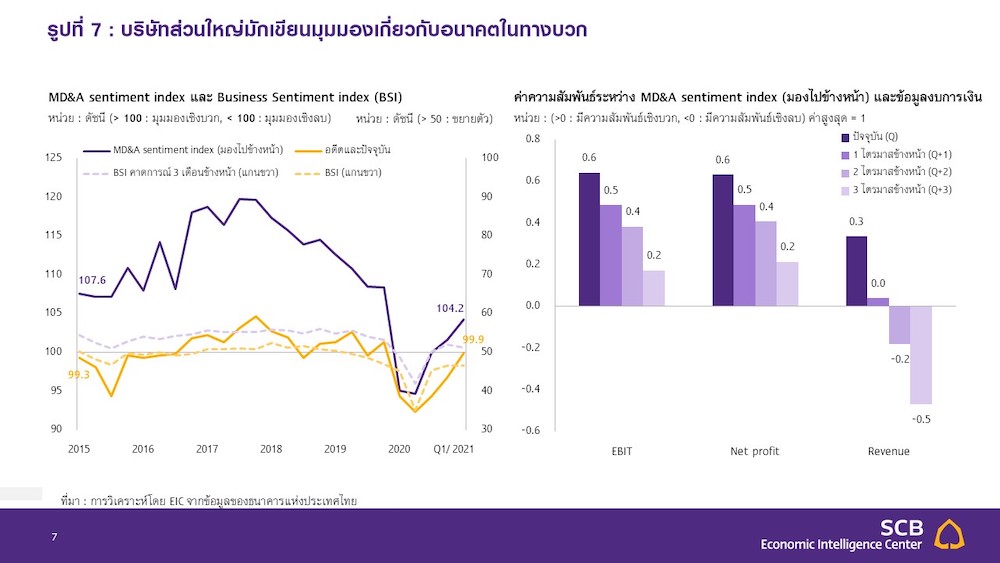
Most companies tend to express a significantly more positive outlook for the future than negative. When examining the MD&A sentiment index, separating sentences with forward-looking words (e.g., "expect," "plan," "look-forward") from those without (which reflect past or current events), it is evident that companies generally write about future perspectives more positively than negatively, even during economic downturns like COVID-19, where they still express fewer negative views about the future compared to the current situation. However, the gap between current and future perspectives has noticeably narrowed, reflecting the high uncertainty that remains in the near term.
The MD&A sentiment index regarding forward-looking perspectives does not predict future performance well.
The correlation between the forward-looking MD&A sentiment index and EBIT for the current quarter and the next quarter stands at 0.64 and 0.48 (with a maximum value of 1), respectively. This is because the timing of report writing occurs from the end of the current quarter to the beginning of the next, allowing the content to still reflect performance during that period. However, when considering the correlation with subsequent quarters, it is evident that the correlation decreases significantly (Figure 7, right), indicating that this index cannot reliably predict future performance.
Figure 7: Most Companies Tend to Write About Future Perspectives Positively
Source: Analysis by EIC from data of the Bank of Thailand
5. Before COVID-19, Companies Across All Industries Discussed International Matters More, but This Trend Shifted After the COVID-19 Crisis
Considering the importance of international factors for companies in the stock market, as reflected in the mentions of terms related to countries and regions in the MD&A reports, the EIC found that from 2015 to 2019, or before the COVID-19 crisis, the number of words discussing international matters, including country or region names (e.g., "China," "Europe") and nationalities or languages (e.g., "Chinese," "Malaysian"), consistently increased, often in the context of revenue sources, investment targets, resource origins, or policy factors. This upward trend indicates that international factors have become increasingly significant for large Thai companies, with mentions of international matters increasing by approximately 26% from 2015 to 2020, with the goods and services industry seeing the highest increase at 57%.
However, from Q1 2020 to Q1 2021, mentions of international matters in MD&A reports dropped to a five-year low due to the COVID-19 crisis, which hindered many companies from relying on international revenue, particularly in the service sector reliant on foreign tourists. During periods of revenue from this sector, some companies detailed tourists by country, and the complete absence of foreign tourists due to international travel restrictions during COVID-19 led to a notable decrease in discussions about international matters in MD&A reports.
Figure 8: Companies Discussed International Matters More in MD&A Reports Since 2015, but Mentions Declined During COVID-19
Source: Analysis by EIC
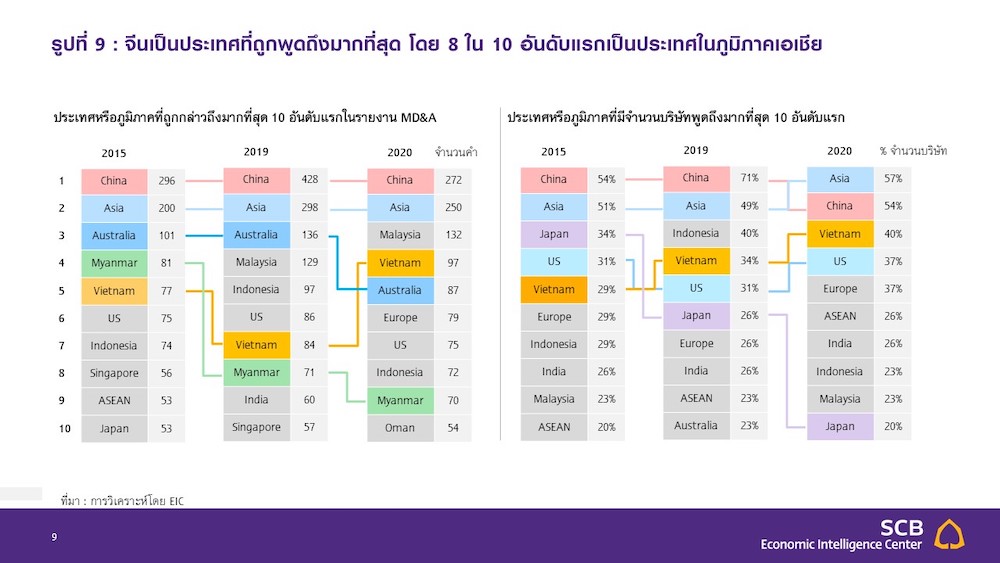
If we consider the top 10 countries or regions mentioned most in MD&A reports, China emerges as the most frequently discussed country, with 8 out of the top 10 being in the Asian region, reflecting the economic dependence of SET50 companies on these countries. Among Western countries, only the US and Europe are frequently mentioned. Other interesting trends include: (1) Japan, a major economy, is mentioned less frequently, both in terms of the number of mentions and the number of companies discussing it; (2) Vietnam is increasingly mentioned, standing out compared to other CLMV countries like Cambodia, Laos, and Myanmar; (3) Australia is mentioned frequently in total word count but appears in only a few companies, primarily concentrated in the energy sector.
Figure 9: China is the Most Discussed Country, with 8 out of 10 Being in the Asian Region
Source: Analysis by EIC
6. The Trend of "Digital Transformation" Has Emerged Prominently in MD&A Reports, with Related Mentions Doubling Over 5 Years
Using NLP analysis methods to capture the digital transformation trend of companies in the stock market through MD&A reports, considering terms related to digital adaptation such as "digital," "transformation," "platform," "technology," and "e-commerce," it was found that mentions of digital adaptation in MD&A reports have significantly increased, with a 1.3 times increase over the past five years (Figure 10, left). When analyzed by industry, the financial sector had the highest mentions of digital adaptation, followed by telecommunications and energy (Figure 10, right). These three industries have increasingly discussed this issue during COVID-19, reflecting the importance of technology in adapting during crises and preparing for various New Normal trends, while the goods and services and tourism sectors, which were severely impacted by the crisis, saw a decrease in discussions about digital adaptation during COVID-19 compared to before.
Figure 10: Companies Discussed Digital Adaptation More, Especially in the Financial Sector
Source: Analysis by EIC
The analysis results indicate that data from MD&A reports can effectively reflect the current perspectives of companies, aligning with performance results and business confidence indices. Systematic tracking and analysis of MD&A reports using Natural Language Processing (NLP) methods, as illustrated above, will help analysts access interesting qualitative data beyond merely tracking performance figures in financial statements, enabling the identification of significant trends occurring among large companies, which should be beneficial for monitoring.
Analysis from SCB EIC >>> https://www.scbeic.com/th/detail/product/7733
Authors of the Analysis:
Kasem Rangsipol, Director of Data Analytics
Chinachoti Therapanjaporn, Data Scientist, Economic Intelligence Center (EIC)
Siam Commercial Bank Public Company Limited
EIC Online: www.scbeic.com
Line: @scbeic