Cloud Kitchen: A Lifeline for Thai Restaurants in Crisis
By Nirathisai Tumwongsa and Jaruwan Laosamrit, Krungthai Compass Research Center
- Krungthai COMPASS assesses the impact of stricter lockdown measures that may extend into the second half of 2021 on the restaurant and food ingredient sectors, estimating total damages to be around 130 billion to 259.6 billion baht.
- The damage assessment is divided into three scenarios: 1) If the lockdown ends on August 31 and 29 provinces remain under control, the estimated damage will be about 130 billion baht; 2) If the lockdown ends on September 30 with the same provincial controls, the damage is expected to be around 198.3 billion baht; and 3) If the lockdown extends to October 31, potentially nationwide, the damage could reach approximately 259.6 billion baht.
- The restaurant business will continue to struggle for the remainder of this year. However, adapting to Cloud Kitchens is one potential solution to sustain operations, while the food ingredient sector may mitigate losses through food processing or online sales. The government should provide additional support to both sectors, as current measures may not sufficiently address the estimated damages.
1. How is the restaurant business faring amid the new wave of COVID-19?
On August 3, 2021, the government announced the reopening of restaurants in shopping malls, albeit with strict measures to minimize contact with consumers. This was a relaxation from previous measures that had closed these establishments from July 20 to August 2. Furthermore, the government intensified restrictions by expanding the maximum control area to 29 provinces from the previous 13.
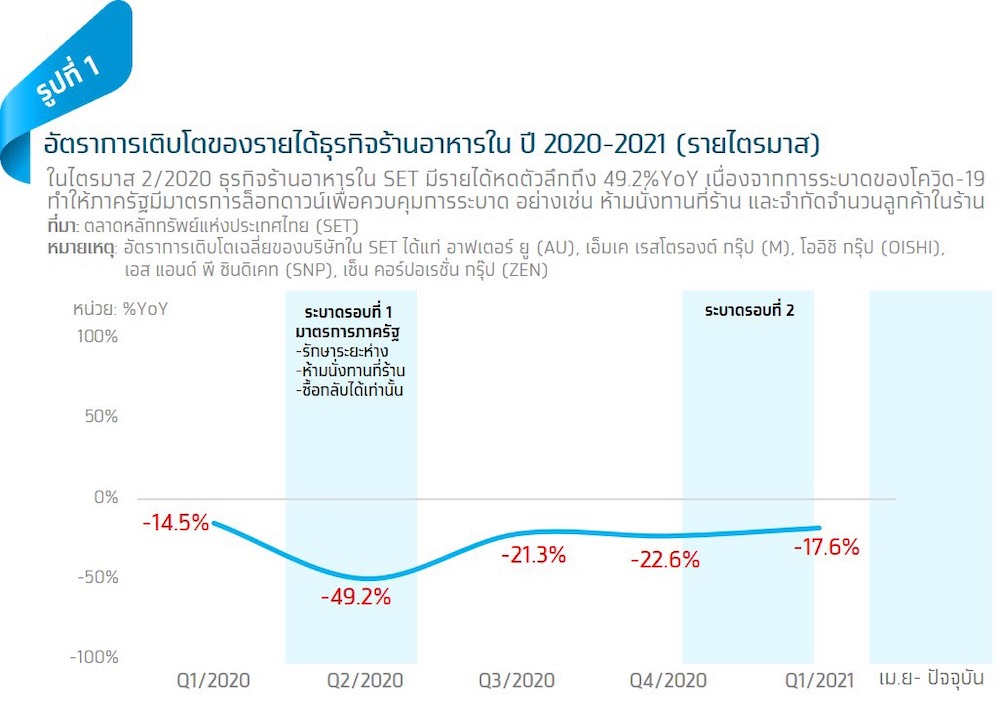
The lockdown period was extended to August 31 from the original date of August 2, further exacerbating the challenges faced by restaurants following the semi-lockdown measures implemented from June 28 to July 19. All these measures represent a new storm that threatens the survival of restaurants that have struggled to stay afloat over the past year since the COVID-19 crisis began. A review of the financial performance of listed restaurant companies on the Stock Exchange of Thailand (SET) in Q2 2020 revealed a staggering year-on-year contraction of 49.2% (Figure 1). Such poor performance may recur in Q3 2021 or extend through the end of 2021 if Thailand fails to control the COVID-19 outbreak.
In addition to lost revenue and financial liquidity, many restaurants face the risk of closure. The Thai Restaurant Association reported that there are approximately 550,000 restaurants in Thailand, with an estimated 50,000 having already closed before the semi-lockdown measures began on June 28, and another 50,000 expected to temporarily or permanently close if they do not receive government support by July 2021.
2. What will be the estimated damage to the restaurant business if the lockdown extends?
With daily new infections reaching a new high of around 20,000 for over a week, the resurgence of COVID-19 is evident, compounded by delays in vaccine distribution and administration. This suggests that the government may implement stricter measures beyond the current ones set to end on August 31, 2021, including extending the lockdown and expanding controlled areas.
Krungthai COMPASS anticipates that the government may extend the lockdown by another month, ending on September 30, 2021. In the worst-case scenario, the semi-lockdown measures could be extended for another month until October 31, 2021, potentially encompassing all provinces across the country.
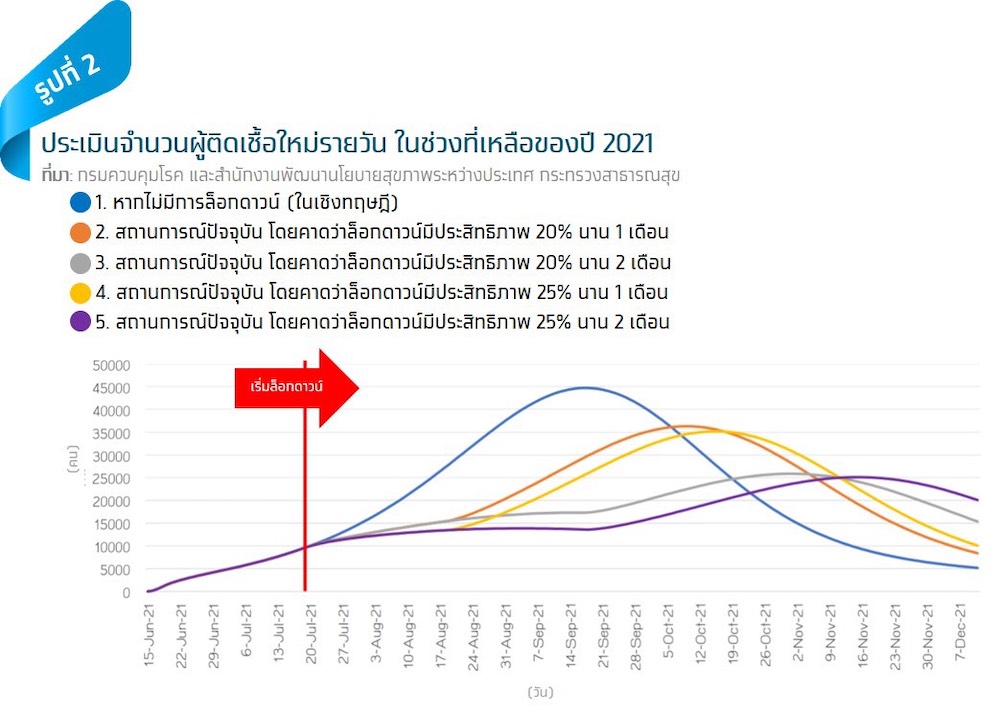
This perspective aligns with forecasts from the Epidemiology Bureau of the Ministry of Public Health, which estimates that a one-month lockdown (starting July 19, 2021) could delay the peak of daily new infections until October, and a two-month lockdown could push it to November. A two-month lockdown may also result in a lower peak of daily new infections compared to a one-month lockdown (Figure 2).
3. What will be the estimated damage to the restaurant business if the lockdown extends?
Given the trend towards stricter measures, Krungthai COMPASS has assessed the potential damages to the restaurant business in the second half of 2021, which includes the impact of 1) lost revenue from restaurants that can still operate under lockdown measures, and 2) revenue losses from restaurants that may close temporarily or permanently in the second half of 2021 (excluding the impact from restaurants that closed before the semi-lockdown measures on June 28, 2021).
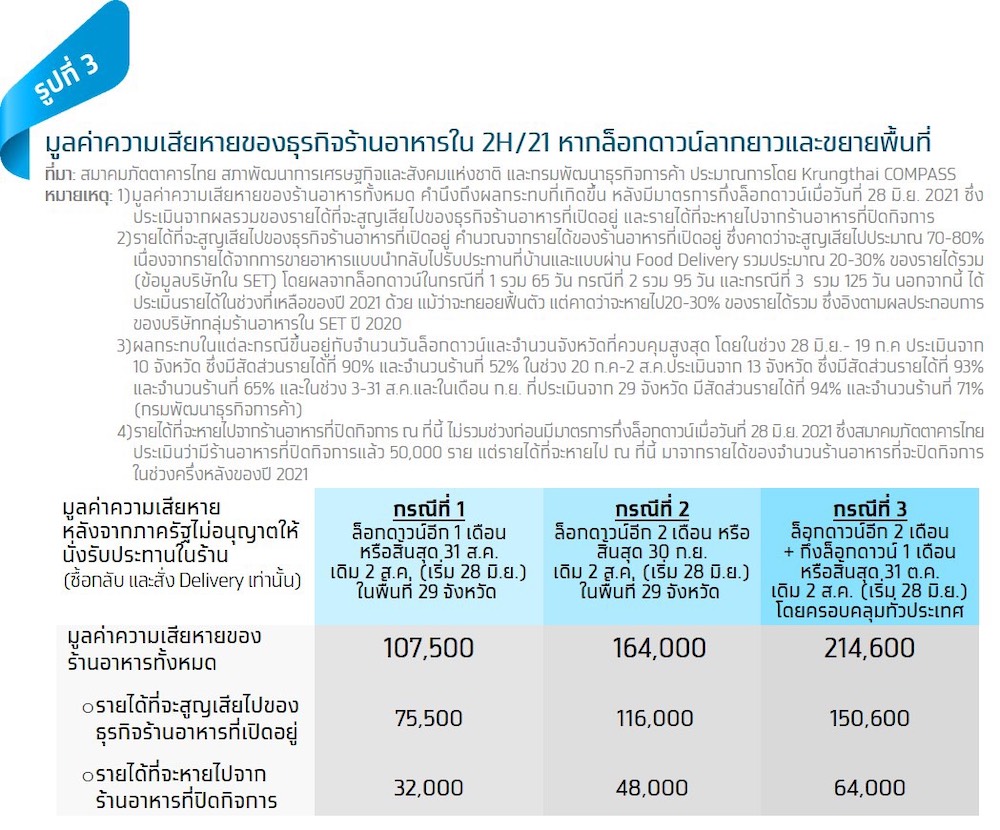
It is estimated that the total damage to the restaurant business in the second half of 2021 will be around 107.5 billion to 214.6 billion baht, representing a loss of 22-44% of total restaurant revenue in 2019, divided into three scenarios (Figure 3):
Scenario 1: If the lockdown ends on August 31 and 29 provinces remain under maximum control, the estimated total damage will be around 107.5 billion baht, including lost revenue from approximately 50,000 restaurants preparing to close.
Scenario 2: If the lockdown ends on September 30 and 29 provinces remain under maximum control, the estimated total damage will be around 164 billion baht, including lost revenue from approximately 75,000 restaurants preparing to close.
Scenario 3: If the lockdown ends on September 30 and semi-lockdown measures are extended until October 31, with nationwide lockdown measures, the estimated total damage will be around 214.6 billion baht, including lost revenue from approximately 100,000 restaurants preparing to close.
Food sales through Food Delivery applications are one option that can help address the challenges faced by restaurants after the lockdown measures prohibited dine-in services. However, overall, this may only generate enough revenue to keep businesses afloat, as this strategy may not be suitable for certain types of restaurants, such as buffet and fine dining establishments. Additionally, the current severe COVID-19 situation may lead consumers to avoid ordering food from restaurants and instead cook at home more often.
Considering the revenue from food sales through Food Delivery in 2020, which was also affected by lockdown measures, it was found that the proportion increased to 20% from 10% of total restaurant revenue in 2019. However, this remains a small proportion. Furthermore, restaurant operators often incur additional costs from paying GP or Gross Profit, which is the operational fee charged by Food Delivery applications, amounting to approximately 20-30% of sales, putting pressure on restaurant businesses to achieve profitability during this period.
When will the restaurant business recover?
The prolonged impact of COVID-19 containment measures has forced the restaurant business to adapt significantly to survive this crisis. Even if the virus outbreak situation improves, Krungthai COMPASS believes that the restaurant business in Thailand will require at least two years to recover.
This is primarily due to three factors:
1) International tourism is expected to return to 2019 levels by 2023, which aligns with the International Air Transport Association (IATA) predicting a return to pre-COVID-19 air travel levels in 2023 as well.
2) Consumer purchasing power in Thailand will remain fragile and may take another 1-2 years to recover due to the overall worsening business environment, leading to layoffs or reduced wages for some workers, which will gradually affect consumer purchasing power.
3) The current increase in debt burdens for restaurant businesses may hinder their recovery in the future. As of the end of Q1 2021, the total loans for the restaurant sector from all commercial banks stood at 34.698 billion baht, compared to 27.544 billion baht in 2019, representing a 26% increase.
4. What will be the estimated damage to businesses related to restaurants if they remain closed for an extended period?
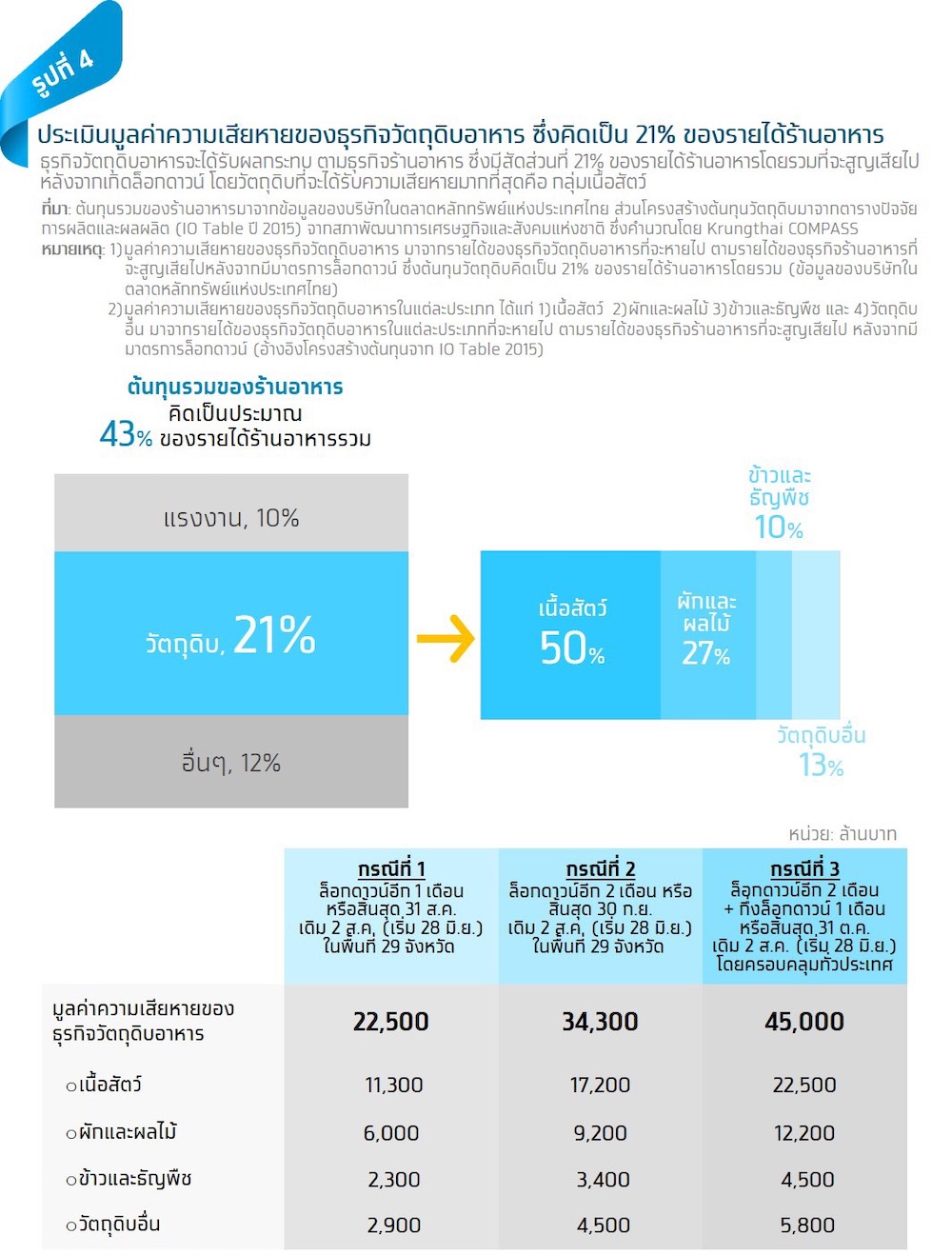
It is undeniable that lockdown measures not only harm the restaurant business but also have a ripple effect on related businesses, particularly the food ingredient sector, which accounts for 21% of total restaurant revenue. Krungthai COMPASS estimates that the loss of revenue in the restaurant sector will likely lead to a corresponding loss in the food ingredient sector of approximately 22.5 billion to 45 billion baht in the second half of 2021.
The types of ingredients most affected will be meat, which constitutes 50% of total ingredient costs, potentially resulting in damages of around 11.3 billion to 22.5 billion baht. Following that are vegetables and fruits, which are difficult to preserve, with estimated damages of around 6 billion to 12.2 billion baht. Next are rice and grains, with estimated damages of around 2.3 billion to 4.5 billion baht (Figure 4).
In summary, the estimated damage to both the restaurant and food ingredient sectors will be around 130 billion to 259.6 billion baht in the second half of 2021. The impact of stricter lockdown measures in each scenario includes:
Scenario 1: If the lockdown ends on August 31 and 29 provinces remain under maximum control, the estimated damage to the restaurant and food ingredient sectors will be around 130 billion baht.
Scenario 2: If the lockdown ends on September 30 and 29 provinces remain under maximum control, the estimated damage will be around 198.3 billion baht.
Scenario 3: If the lockdown ends on September 30 and semi-lockdown measures are extended until October 31, with nationwide measures, the estimated damage will be around 259.6 billion baht.
Implication:
For restaurant operators, it will be difficult to avoid the impacts during the lockdown, and it is likely that the total damage to the restaurant sector in the second half of 2021 could reach around 107.5 billion to 214.6 billion baht. Nevertheless, restaurant operators may adapt to Cloud Kitchens, which could help the restaurant business recover, aligning with the Food Delivery sector in Southeast Asia, including Thailand, which is projected to grow at an average rate of 31% per year from 2020 to 2025.
Cloud Kitchen is a business model for restaurants without physical storefronts, characterized by a central kitchen that allows multiple restaurants to rent space. Currently, it includes both Food Delivery and Take Away sales, enabling Cloud Kitchens to meet consumer needs in an era challenged by COVID-19 containment measures.
This is due to:
1) Low investment costs, especially in city centers.
2) Reduced operational costs, such as service staff and utilities.
3) Often conveniently located for transportation, such as “Ruan Mit Cloud Kitchen,” which combines several well-known restaurants, typically choosing locations that are convenient and close to community areas like Town in Town and Thonglor.
However, the current locations of Cloud Kitchens are often in city centers, which, while targeting urban consumers, may not reach a significant number of consumers living in suburban areas. In the future, Cloud Kitchens should be established closer to residential areas in the suburbs to align with the Work from Home trend.
- For food ingredient business operators, adjustments should be made to mitigate losses, such as 1) processing fresh or frozen food to preserve and extend shelf life, 2) delivering products directly to consumers through online sales channels, and 3) seeking new markets, such as supplying to factories that export food to countries that can still operate.
- However, adapting solely within the restaurant and food ingredient sectors may be challenging for survival. The government should provide support and relief to both sectors. In the short term during the lockdown, the government could implement programs to purchase food from restaurants or food ingredients to supply to central kitchens for distribution to virus patients who may be undergoing Home Isolation or Community Isolation, thereby generating income for operators.
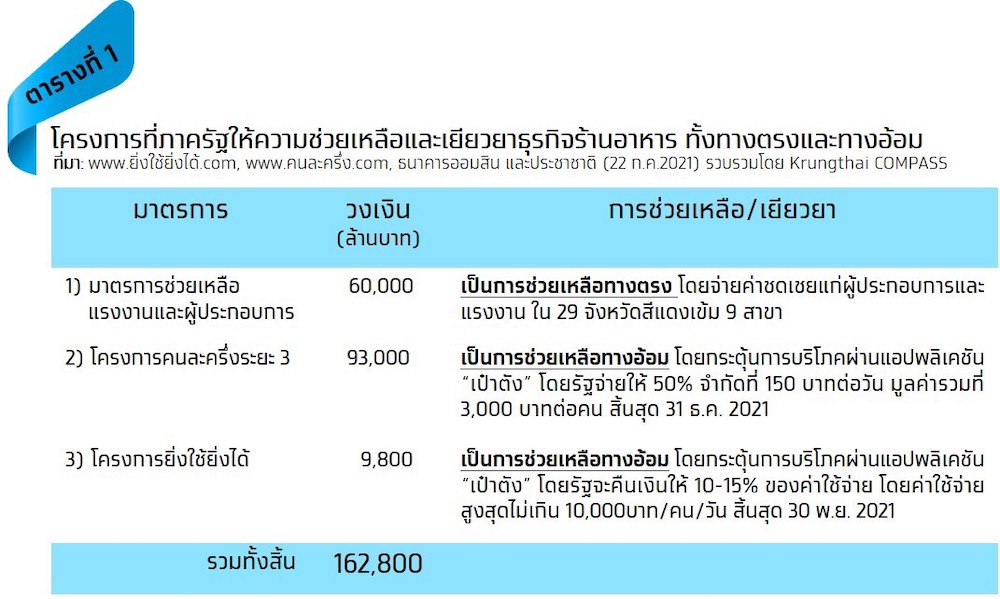
Considering the various measures to support the restaurant and food ingredient sectors from the government, both directly and indirectly, it is evident that they are still insufficient to address the damages, as the estimated damages for both sectors are around 130 billion to 259.6 billion baht in the second half of 2021, while the total government assistance currently stands at 162.8 billion baht (Table 1), which also includes support for other businesses. Therefore, the government may need to consider more extensive relief measures to sustain both businesses.