"Lumpini Wisdom" Predicts Real Estate Market Recovery in Q4
"Lumpini Wisdom" Predicts Real Estate Market Recovery in Q4
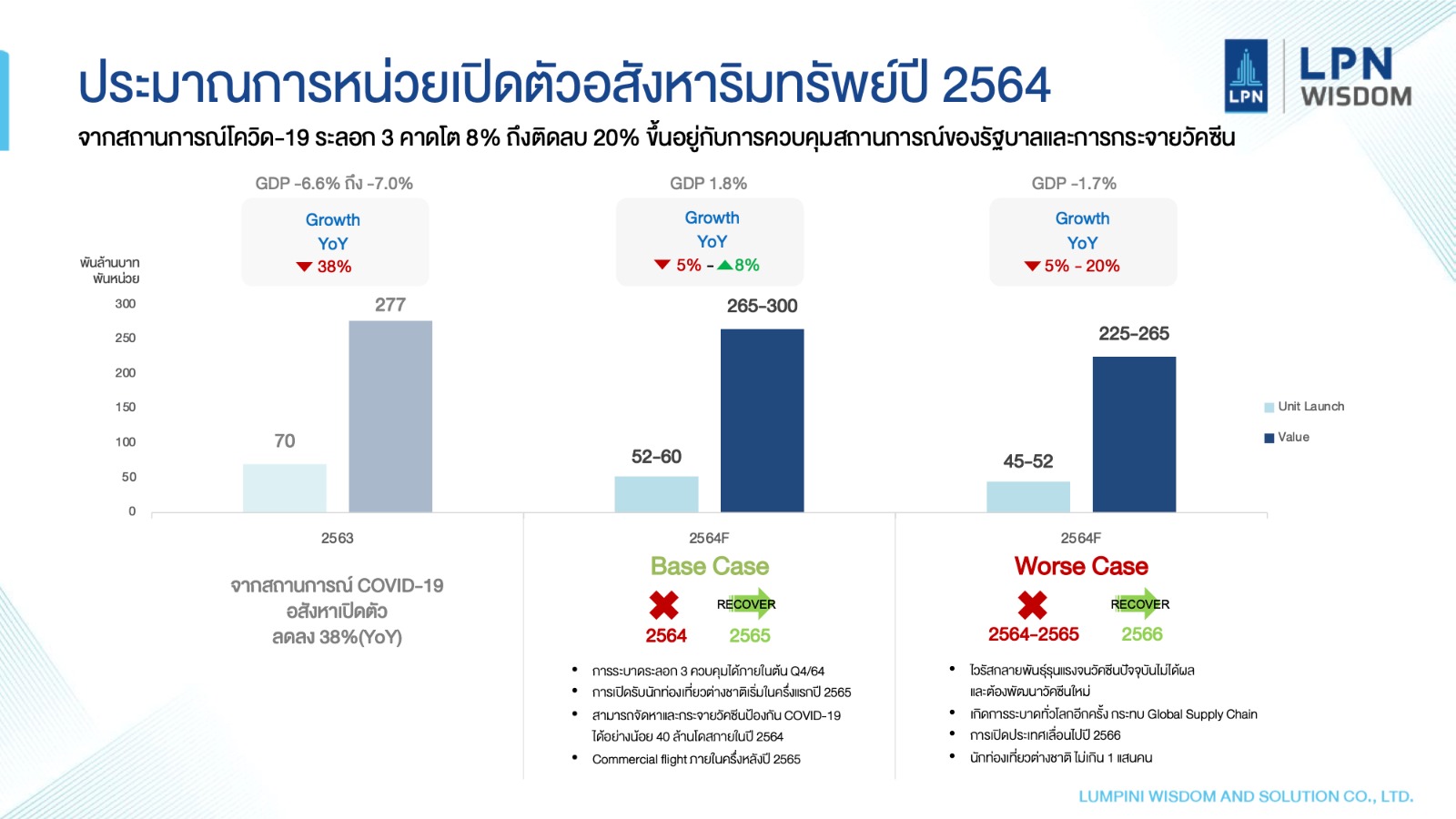
According to Lumpini Wisdom, the real estate market is expected to recover in Q4 of 2021. It is anticipated that the total number of new project launches in Bangkok and its vicinity will grow by 8% to a decline of 20% compared to 2020, depending on the ability to control the COVID-19 outbreak and the economic recovery in the second half of the year.
Mr. Prabhan Sak Raksaiwan, Managing Director of Lumpini Wisdom and Solutions Co., Ltd., a research and development company under L.P.N. Development Public Company Limited (LPN), stated that the real estate market is expected to improve in the second half of 2021 compared to the first half of the year. This is due to real estate operators planning to launch new projects in the latter half of 2021 after postponing several launches in the first half due to the severe COVID-19 outbreak that began in April and continues to this day.
According to a survey by Lumpini Wisdom, if the government can control the COVID-19 outbreak by Q3 of 2021, it will allow real estate operators to gradually launch new projects towards the end of Q3 and Q4. It is estimated that in 2021, there will be approximately 52,000-60,000 new units launched in Bangkok and its vicinity, valued at 265,000-300,000 million baht, representing a contraction of about 5% to an expansion of 8% compared to 2020.
However, if the government fails to control the COVID-19 outbreak within 2021, it is expected that the residential market in Bangkok and its vicinity will see new launches of approximately 45,000-52,000 units, valued at 225,000-265,000 million baht, representing a contraction of 5% to 20%, marking the second consecutive year of decline since 2020.
In the first half of 2021, the real estate market contracted by 18%
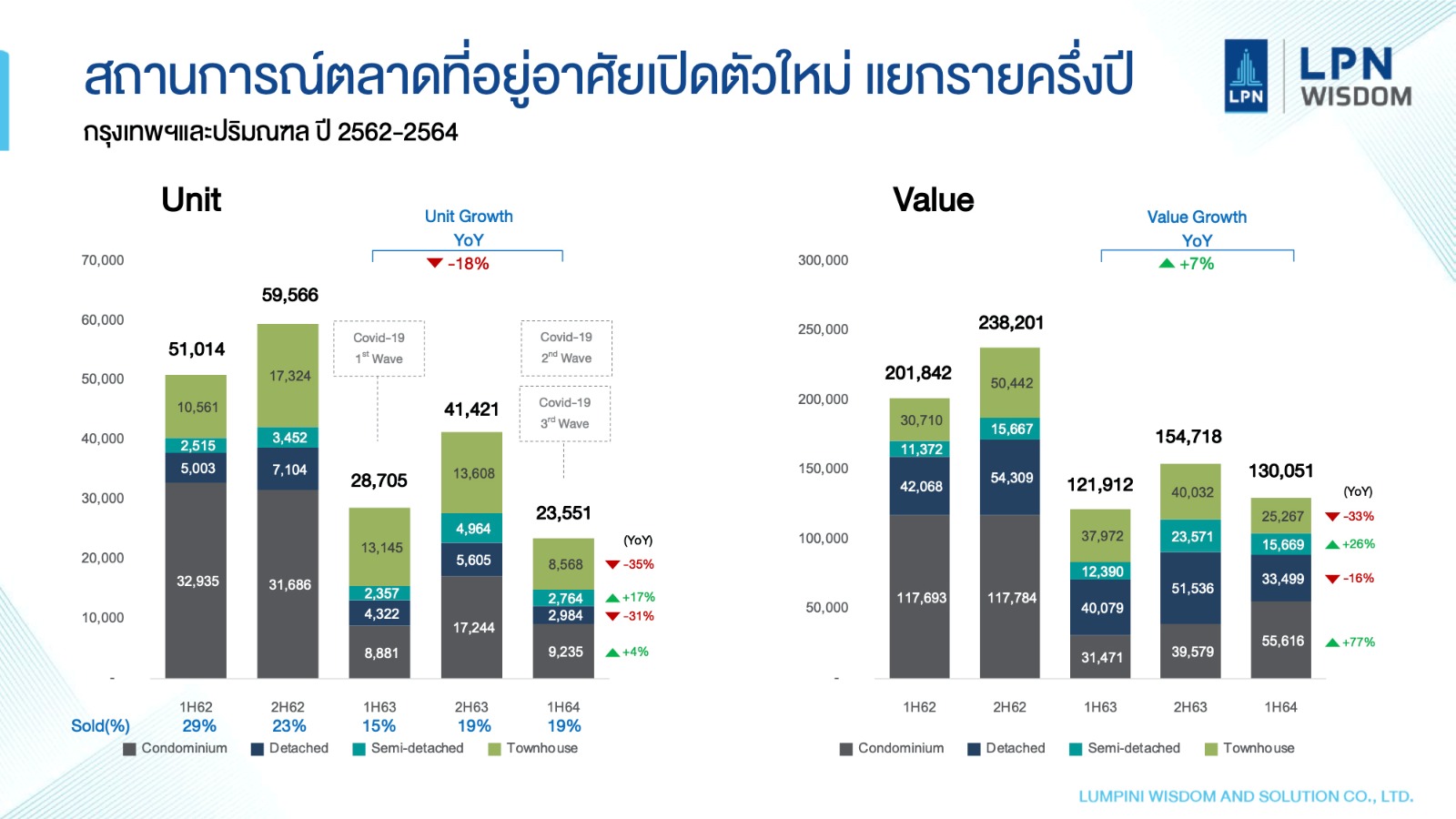
In the first half of 2021, there were a total of 23,551 new residential units launched in Bangkok and its vicinity, a decrease of 18% compared to the same period in 2020, valued at 130,051 million baht, which is a 7% increase compared to the same period in 2020. Although the number of units launched decreased, the value increased due to the launch of the project "The Forestias," valued at 45,000 million baht, by Magnolia Quality Development Corporation Limited in Q2 of 2021, resulting in a higher overall project launch value in the first half of 2021 despite the reduced number of units.
Out of the total 23,551 units launched, 9,235 were condominium projects, an increase of 4%, valued at 55,616 million baht, which is a 77% increase compared to the same period in 2020, with an average sales rate of 29%, higher than the previous year. This is due to the implementation of the Loan to Value (LTV) measures for the first time in 2020, which pressured purchasing decisions, combined with stricter lending policies from financial institutions.
Meanwhile, the launch of residential housing projects in the first half of 2021 showed a declining trend compared to the same period in 2020, but still had a higher number of units and value than condominiums, accounting for 61% of total launches. There were 14,316 residential units launched, valued at 74,435 million baht, representing a contraction of 28% and 18% respectively compared to the same period in 2020. Despite the decline in launches, residential housing still had an average sales rate of 13%, similar to the sales rate in 2020.
Residential projects can be categorized into three types. The first type is townhouses, which continue to attract interest due to the COVID-19 outbreak, leading to a demand for more usable space and increased social distancing considerations. Townhouses, priced affordably, are an attractive option at this time, with 8,568 new units launched, valued at 25,267 million baht, a contraction of 35% and 33% respectively compared to the same period in 2020, with an average sales rate of 14%.
The second type is single-detached houses, with 2,984 new units launched in the first half of 2021, valued at 33,499 million baht, a contraction of 31% and 16% respectively compared to the same period last year, with an average sales rate of 11%, which is higher than the same period in 2020 due to the higher price point of these products, which may not be as affected by the economic situation.
Lastly, there are semi-detached houses, which have gained more interest, with an average sales rate of 12%. This type of house has been developed to resemble single-detached houses, with an average selling price of 5-8 million baht, making it an increasingly attractive option. In the first half of the year, 2,764 new units were launched, valued at 15,669 million baht, an increase of 17% and 26% compared to the same period last year.
Studies show that in the first half of 2021, condominiums priced below 3 million baht (Affordable Price) accounted for a market share of 70% of all sold condominium units. This price range has prompted many operators to launch new brands or develop projects at this price level. Meanwhile, the market for residential housing such as townhouses and semi-detached houses is expected to stabilize in terms of selling prices due to the current market conditions and economic slowdown. However, the prices of single-detached houses are expected to rise due to the development of high-value projects on small to medium-sized plots, with a limited number of units, targeting real demand customers who are less affected by the economic situation.
In the peripheral areas around Bangkok, such as Rangsit in Pathum Thani and Bangna in Samut Prakan, many residential projects are being developed due to their convenient access to major roads, expressways, and outer ring roads, making it easy to travel to the city center or business districts, as well as nearby provinces. Additionally, the availability of amenities in these areas and land prices that allow for projects priced below 5 million baht are still feasible. However, the recent explosion at an industrial plant in the Khing Kaew area in Q2 may complicate the decision to purchase residential properties near industrial zones like Bangna.
Unsold Units Remain Stable, Average Selling Time of 51 Months
As a result of the decline in new project launches and the average sales rate in the first half of 2021, Lumpini Wisdom predicts that the number of unsold units in the housing market during the first half of 2021 is expected to remain stable from the end of 2020, with a total of approximately 222,000 units. It may take about 51 months to sell all unsold units, which includes approximately 85,300 unsold condominium units, a decrease of about 6% from the end of last year due to the postponement of new project launches since early 2020. Meanwhile, the number of unsold residential housing units is expected to increase from the end of 2020 by about 4%, totaling approximately 136,700 units, as real estate operators focus more on developing residential housing rather than condominiums to meet the demand for housing with more space and privacy, driven by the COVID-19 outbreak and the increasing trend of working from home.
Mr. Prabhan Sak stated that the decline in new project launches in Bangkok and its vicinity during the first half of 2021 was a result of the COVID-19 outbreak in Q2 of 2021, causing real estate operators to postpone their plans. Additionally, the government has begun implementing strict measures to control the COVID-19 situation in Bangkok and its vicinity. Although there is a positive outlook for the second half of 2021, there are still factors that may impact the real estate market, aside from the ability to control the COVID-19 situation, which may extend from Q3 to Q4, such as the construction camp closure measures in July that affect construction and prevent operators from delivering housing as planned. Furthermore, rising construction material prices, particularly steel, have increased business costs. The number of unsold units in the housing market is expected to remain stable due to the reduced average absorption rate, combined with the current economic situation, which has a high unemployment rate of over 2 million people, household debt reaching 90%, declining consumer confidence, and financial institutions being cautious in granting housing loans, with a loan rejection rate of 40-50%. These factors directly impact purchasing power in the housing market and the decision to launch new projects by real estate operators in the second half of 2021.
"However, if the government can control the outbreak situation in Q3 of 2021 and accelerate the import and vaccination rollout as planned to achieve herd immunity in the country, while the export and manufacturing sectors continue to grow in line with the global economic recovery, and the government's economic stimulus measures can be implemented as planned, combined with low-interest rates, these factors may provide an opportunity for the housing market to recover in the second half of 2021," Mr. Prabhan Sak concluded.