Design of King Mongkut's Hospital: A Harmonious Blend of Technology, Public Health, Environment, and Art
When it comes to hospitals, the first image that many people recall is often that of the past, where hospitals were seen as uncomfortable places with unfriendly environments for patients. However, as times have changed, many aspects have been developed, resulting in the construction of hospitals today that feature beautiful designs both inside and out, creating a more welcoming atmosphere for patients. This article will delve into the origins of the design idea for one of Thailand's "hospitals of the future," expected to be completed in 2024, serving as a model for modern hospitals.
.jpg)
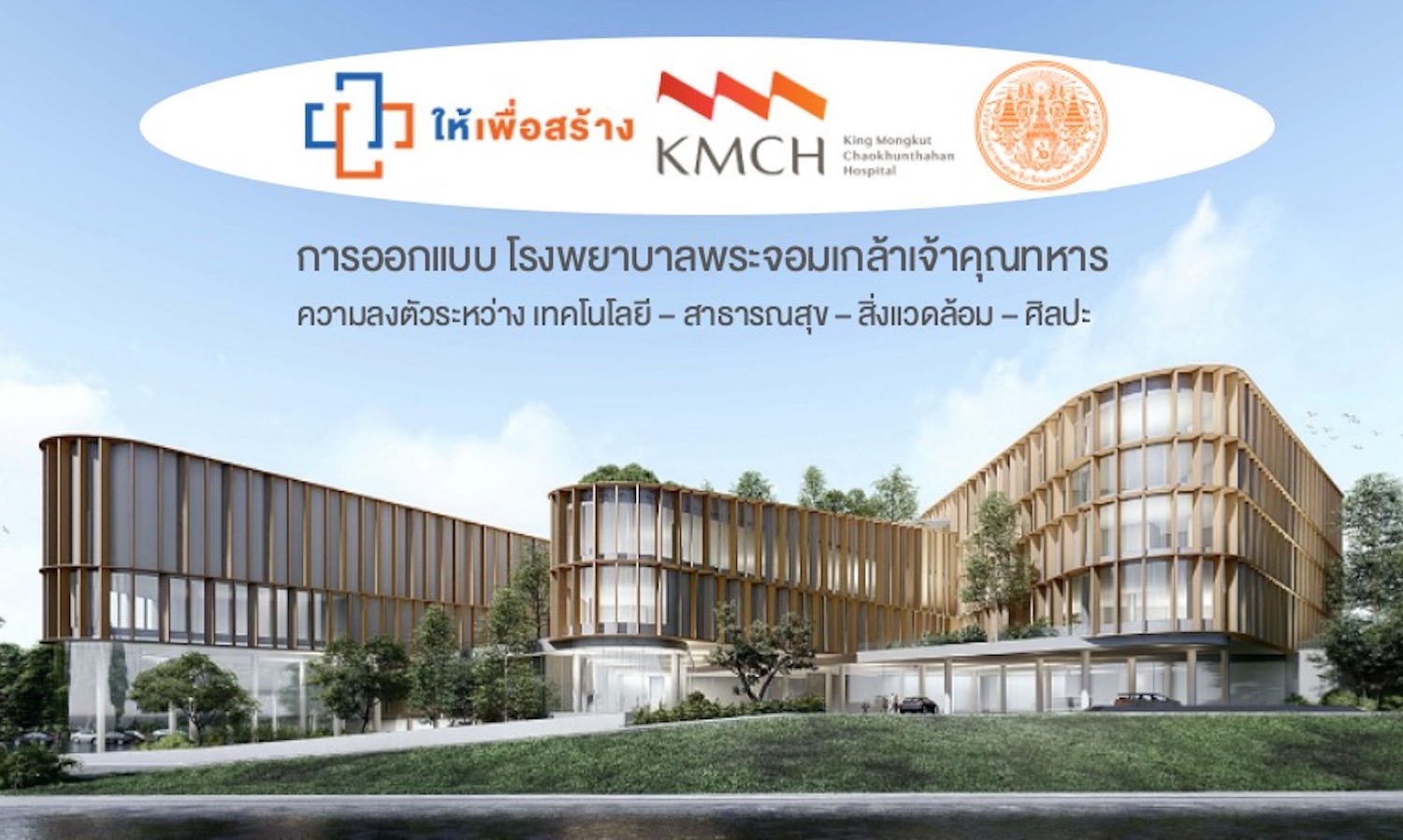
King Mongkut's Hospital - KMCH was established to commemorate the 60th anniversary of KMITL, under the concept of "Giving to Create." It is Thailand's first innovation research hospital, ready to care for patients and serve as a research center for medical equipment, aimed at developing medical devices for the Thai people. The uniqueness of this hospital's design lies in the collaboration of no fewer than five professional architectural teams, including 'Chatchai Thirawongphairoj,' Managing Director of Design+Develop Co., Ltd., and 'Pongthep Sukulku,' Director of August Design Consultant, an expert in interior architecture, among others. Typically, hospital designs involve only one lead architect, but this project has harnessed collective architectural ideas to create a hospital that integrates 'art' with 'science and technology,' ultimately leading to a perfect hospital building.
Healing Patients with "Healing Architecture" Inside and Out
Assoc. Prof. Kunthorn Lueanchai, Chairman of Keen Consulting Co., Ltd., former Dean of the Faculty of Architecture at KMITL, stated that KMITL aims not only to create an innovative research hospital but also to establish a model hospital that is perfect in every dimension. Beyond providing excellent utility as a hospital, it is also architecturally and engineering-wise perfect, making the building resemble a "floating sculpture" that aids patients in their recovery within a friendly environment, both inside and outside the building. This is achieved through a design technique known as "Healing Architecture," which encompasses all elements of form, taste, smell, and sound. The interior design is crafted to be as clean as a five-star hotel, using colors and artwork to help change the attitudes and emotions of patients during their stay.
Moreover, the design concept of "Borderless" integrates the outside nature with the modernity of the interior, allowing patients facing distress to feel relaxed and welcomed. Curved glass walls create a lush atmosphere inside the building while still considering patient privacy through wooden slats that act as the building's second skin, enhancing privacy for those inside and reducing heat absorption from the outside. Additionally, the top floor of the hospital is designed as a green space, featuring a "green plaza" equipped with solar panels to reduce external electricity consumption. The healing architecture technique also allows for the integration of aroma and soothing music to enhance relaxation.
.jpg)
.jpg)
Emphasizing Distinctive, Beautiful Design for Memorable Views on the Motorway
Mr. Jiravej Hongsakul, Managing Director of Idin Architects Co., Ltd., an architectural design expert, added that the hospital's location along the new Bangkok-Chonburi motorway, combined with the speed of traffic on this road, led the team to tackle the challenge of creating a modern research hospital that integrates knowledge from medicine, science, and technology into a distinctive architectural design resembling three overlapping triangles. This design opens up views for both incoming and outgoing traffic from Bangkok. The overlapping triangles create green spaces that can be integrated into the building, and from an aerial view, it resembles the number 4, commemorating the benevolence of "King Mongkut, Rama IV," represented by the royal emblem "Phra Mahapichai Mongkut" of the institution. Overall, the building creates a beautiful rhythm that is easy to remember for those traveling on both sides of the road. Not only is the exterior impressive, but the interior is designed to be as beautiful as leading hotels and resorts, creating a relaxing and friendly atmosphere for patients of all ages during their recovery.
Structurally Designed to Support "Thinking - Producing Innovations"
Mr. Chatchai Thirawongphairoj, Managing Director of Design+Develop Co., Ltd., a hospital design expert, stated that in addition to being designed with "Healing Architecture" techniques, this hospital is also designed to be modern and practical, ready to support future innovation research. The primary role of the designers is to prepare the building's basic structure to accommodate innovation production, including electrical systems, cloud connectivity, and AI systems, as well as planning the space size to support various systems for innovation research, ensuring that medical personnel have all the resources needed for patient care. Furthermore, there is an innovation research center specifically for medical innovation research. The building is also designed to be suitable for patients of all genders and ages, particularly the elderly, as the equipment and facilities cater to their needs. The hospital's rehabilitation center is specifically designed to assist elderly patients, aligning with Thailand's transition into an aging society.
.jpg)
1.jpg)
Envisioning a Hospital of the Future Ready to Care from Home
Assoc. Prof. Dr. Songkiat Tiyathirapat, Head of the Architectural Technology Research Unit at KMITL, project planner and design team manager for King Mongkut's Hospital, further stated that besides the uniqueness of the design work both inside and out, this hospital stands out from others by focusing on specialized treatment examinations, emphasizing medical research, and being a hospital that is always with patients, as if home is the hospital of the future. This is achieved through the development of 'Digital Health,' an innovation for treatment that allows communication or monitoring of care from home (Health Home), also known as 'Telehealth,' such as oxygen monitors and heart rate measuring devices. Additionally, there is a showroom for medical innovations from all faculties of KMITL on the third floor of the hospital building to promote and showcase researchers' work to interested outsiders.
.jpg)
Lastly, Prof. Dr. Suchatvee Suwansawat, Chairman of the King Mongkut's Hospital Foundation under the Royal Patronage and President of King Mongkut's Institute of Technology Ladkrabang (KMITL) concluded that King Mongkut's Hospital, or KMCH, is a hospital of the future that transcends the limitations of old hospitals, whether it be access limitations, medical costs, time constraints, and importantly, limitations in innovation. This allows King Mongkut's Hospital to become Thailand's first innovative research hospital established by Thais, for Thais. Interested individuals can join the #GiveToCreate campaign for "King Mongkut's Hospital" through various channels, including donating according to their faith to the foundation's account number 693-0-32393-4, donating 100 baht by dialing *948*1960*100# and calling, or purchasing a 'Give to Create' shirt for 299 baht.
.jpg)
.jpg)
Follow the updates of King Mongkut's Hospital (KMCH) at www.kmchf-pp.org
Facebook page: https://web.facebook.com/KMCHospitalbyKMITL
Line ID: @KMITLHospital
or call 092-454-8160 and 092-548-2640.