REIT Buy-Back Fundraising
In times when the economy and various business sectors show promising growth, operators can utilize Real Estate Investment Trusts (REITs) to raise funds and rapidly expand their businesses by leveraging properties such as retail spaces and hotels that have high occupancy rates and consistent rental income. However, due to the impact of the COVID-19 pandemic, these properties may not maintain high occupancy rates or be able to collect rents at previous levels, creating limitations on bringing assets into REITs. This is because the investment value of REIT assets is based on the income-generating capability of the properties, which is assessed by independent appraisers using the Income Approach.
The impact of COVID-19 may not only reduce the profitability of assets but could also lead property owners to incur losses and experience liquidity issues, especially in the hotel sector. Even when hotels are closed, they still incur expenses such as employee wages and maintenance costs. Therefore, using REITs to raise funds for properties that are still experiencing losses may not be appropriate. In response, the Securities and Exchange Commission (SEC) has introduced measures to assist by allowing property owners to raise funds through a new option: REIT Buy-Back.
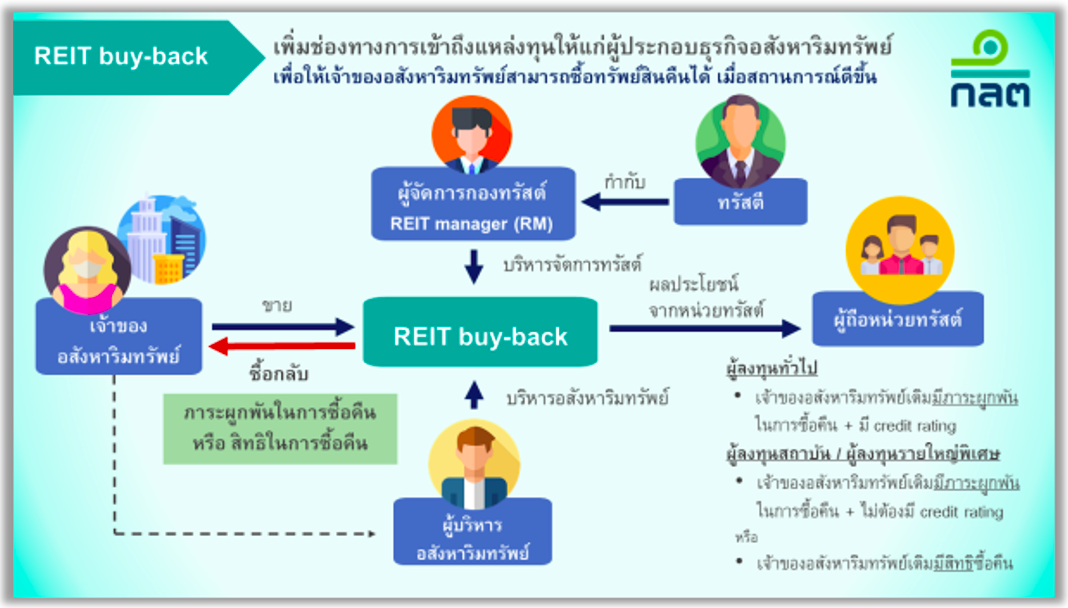
Structure of REIT Buy-Back
Source: Securities and Exchange Commission (SEC)
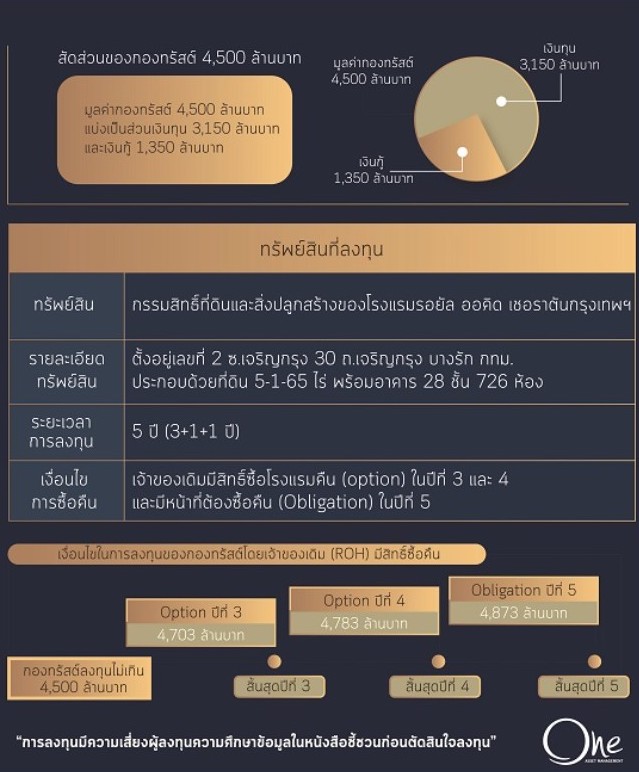
REIT Buy-Back is a fundraising model that allows original property owners the right to repurchase the assets used for fundraising in the future, with predetermined conditions and repurchase prices. The properties brought into REIT Buy-Back may be offered at prices lower than the market price to encourage property owners to repurchase in the future and to assure investors that the original owners will buy back the assets. If the owners are unable to repurchase, the assets can be sold at auction to obtain a fair value and avoid losses compared to the price at which REIT Buy-Back invested.
Properties brought into REIT Buy-Back can be either freehold or leasehold. The REIT Buy-Back may set conditions granting property owners the option to repurchase without mandating it. However, units must be sold only to institutional investors and ultra-high net worth individuals. If offered to the general public, REIT Buy-Back must have a repurchase obligation, requiring property owners to buy back the assets, and must disclose the credit rating of the property owners.
Currently, fundraising through REIT Buy-Back is still relatively new, with only one established trust: GROREIT. This means there is limited data on market returns for this type of investment. Nevertheless, factors that investors will consider to assess the risks associated with investing in REIT Buy-Back, which will reflect the desired return rates, include:
1. Potential of the asset
2. Type of real estate
3. Type of ownership as Freehold or Leasehold
4. Repurchase conditions as an option or obligation for the property owner
5. Credibility of the repurchaser, reflected in credit ratings and past financial status
6. Size and liquidity of trading in REIT Buy-Back