FDA Approves Self-Testing COVID Kits Available at Pharmacies
Regarding the progress of the registration request for Antigen test kits for the general public, Dr. Surachok Tangviwat, Deputy Secretary-General of the Food and Drug Administration (FDA), revealed that currently, 5 companies have submitted documents to register test kits for public use with the FDA. Out of these, 3 companies have already been registered, and 2 more will be registered tomorrow. Sales are expected to start this week, and it is anticipated that more companies will apply for registration next week.
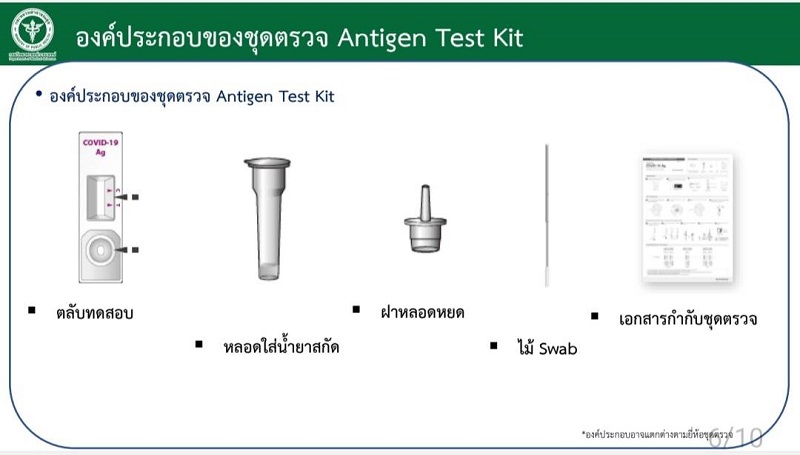
The Antigen test kits will be sold through healthcare facilities, clinics, and pharmacies with licensed pharmacists who can provide proper usage instructions to guide the public on how to use the kits, how to collect samples, how to interpret results, what to do after receiving results, and how to dispose of the kits properly. Consumers should look for labels on the test kits that state “for general public use” and the technology assessment number approved by the FDA, which will be displayed on the label or accompanying medical device documentation. The test kits will collect samples from the front nasal cavity or saliva, and each kit will include a manual in Thai explaining how to use it and interpret results correctly.
Currently, products sold online are not intended for public use and may be for medical personnel. If the public purchases these, there is a risk of incorrect usage leading to erroneous results, which can be unsafe. Advertising and selling through the internet is considered illegal.
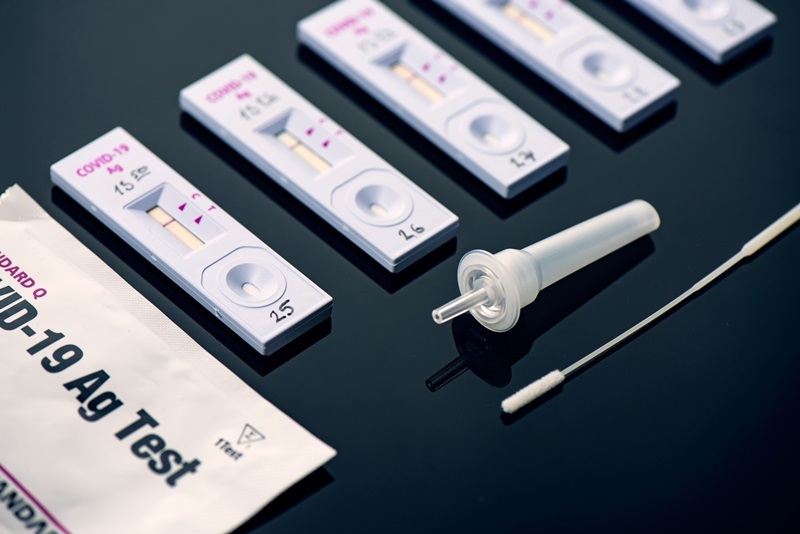
Dr. Thongchai Keeratihatthayakorn, Deputy Permanent Secretary of the Ministry of Public Health, stated that the Antigen test kit is another method for detecting infections, providing results within 15-30 minutes. This will expedite testing, as previously, community testing could take longer to get results.
Consumers can verify the test kits approved by the FDA on the website of the Medical Device Control Division
Consumers should not purchase self-testing antigen kits through online media or other sources, as they may receive substandard products that pose risks for incorrect usage and misinterpretation of results. Businesses advertising the sale of test kits must obtain permission from the FDA beforehand. Violations can result in imprisonment of up to six months or fines of up to fifty thousand baht, or both.
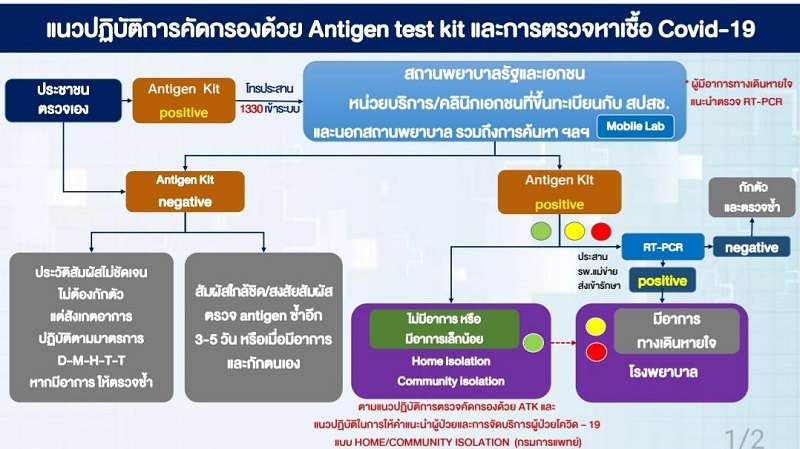
Dr. Supakij Sirilak, Director-General of the Department of Medical Sciences, emphasized that the critical aspect of the Antigen test kit is the proper collection of samples, as incorrect procedures can lead to false positive or negative results. A false positive means the test indicates an infection when there is none, possibly due to contamination during testing or incorrect testing procedures, such as reading results beyond the designated time. A false negative may occur if an infected person has a low viral load or if the sample collection was not done correctly.
When testing with the Antigen test kit, if the result is positive, two lines will appear on the cassette, indicating both line C and line T. If the result is negative, only one line will appear at line C.
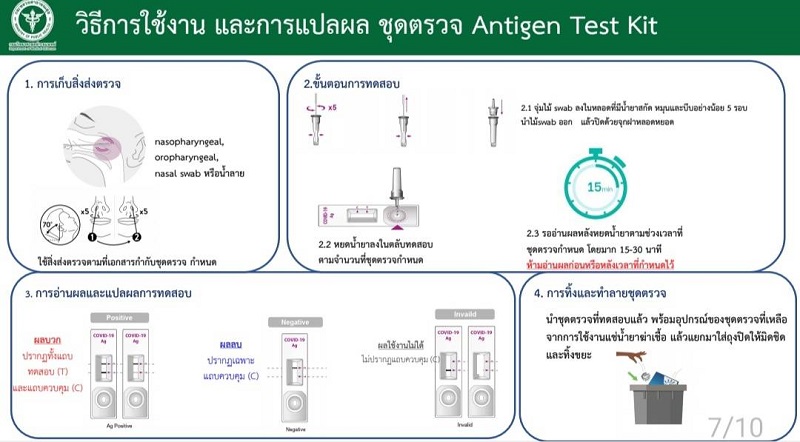
If the result is positive, contact a nearby healthcare facility or community clinic. It is not necessary to go to a large hospital. Alternatively, call 1330. Afterward, self-isolate to reduce the risk of spreading the virus, monitor your symptoms, and regularly check your temperature. If you experience difficulty breathing, seek medical attention.
If the result is negative, it can mean either you do not have the virus or it is a false negative, meaning there is not enough virus present to be detected. You should continue to self-isolate and retest after 3-5 days. If symptoms develop, testing should be done immediately.
Test kits include both Antigen test kits and Antibody test kits. If not observed carefully, their appearances may be similar.
In the future, when purchasing, consumers must ensure they buy the correct type. If testing for antibodies, it will require blood samples, either from a vein or a fingertip. Antigen test kits will collect samples from secretions in the nasal cavity, throat, or saliva. In some cases, saliva testing has been developed. If an infection is recent, there may not be enough virus present, leading to a negative result, necessitating retesting 3-5 days later due to the possibility of testing too early.
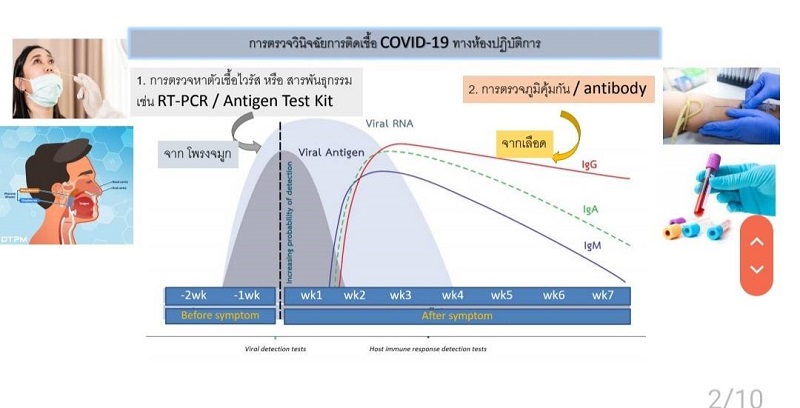
The guidelines for using Antigen test kits must involve kits that have been evaluated and registered with the FDA. There are 26 companies registered for use by medical personnel. Sample collection should be deep into the nasal cavity to the throat, which may not be suitable for self-testing. Therefore, kits that allow for easy self-testing, such as nasal swabs or saliva collection, should be sought.
Initially, if purchasing for self-testing, it is crucial to verify the product. It is not recommended to buy Antigen test kits through online channels or markets, as this remains illegal. Sales in pharmacies will be permitted in the future, as purchasing must still include guidance on usage.
For COVID infections, after a period of 2-7 days, symptoms may appear during testing to detect the virus. The standard method is RT-PCR, but today, Antigen test kits are being introduced to support quicker identification of infections to reduce transmission. Once the virus enters the body, the immune system will start to develop antibodies within 10 days, or in some cases, 2-3 weeks.