Advantages of Selling Real Estate to REITs
By Aranong Chaitong
CEO, Prospect REIT Management Co., Ltd.
Manager of the Prospect Logistics and Industrial Property Fund (PROSPECT)
Often, when we discuss investing in REITs from an investor's perspective, we highlight it as an investment tool that helps reduce portfolio risk and provides more consistent returns.
However, another important party involved in REIT investments is the original property owner, commonly referred to as the Sponsor. What reasons do these individuals have for selling their properties to a REIT instead of selling them outright or using them as collateral to secure loans from banks in the traditional manner?
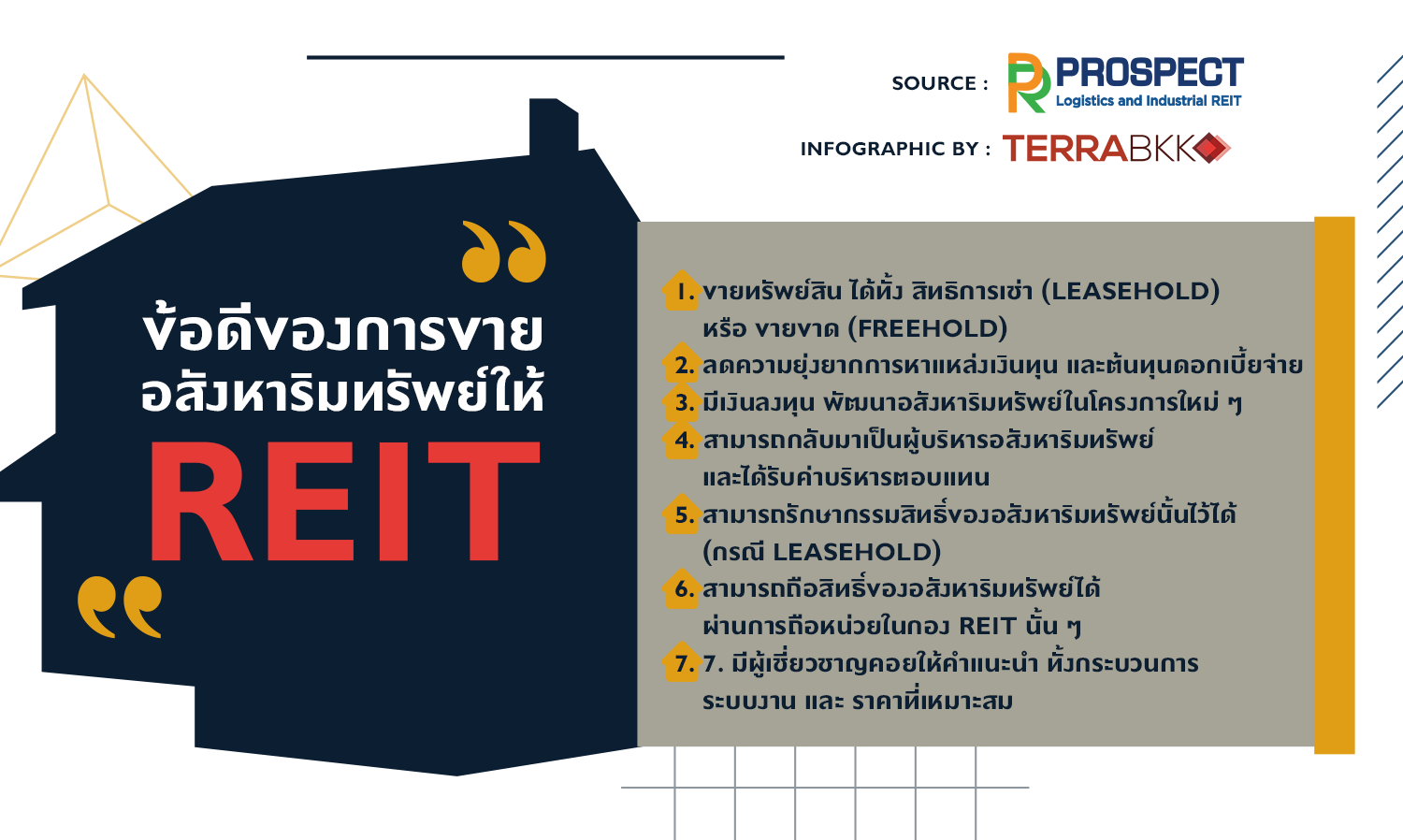
For the Sponsor, deciding to sell assets to a REIT has about seven main advantages.
- They can consider selling assets either as leasehold or freehold, based on the value they find satisfactory for each format.
- It reduces the complexity of finding funding sources, borrowing from banks, and interest costs.
- It provides investment capital for developing new real estate projects.
- They can return to manage the real estate of the project using their existing expertise, as they are already familiar with the project, and receive management fees in return.
- They can retain ownership of the property if they choose to sell it as leasehold.
- They can regain ownership rights of the property through holding units in the respective REIT.
- They have experts available to provide guidance throughout each process, including appropriate pricing, both before and after the decision to sell the asset to the REIT.
The REIT Manager is an expert who can offer advice, assistance, and recommendations throughout each process and on appropriate pricing, enabling the Sponsor to make informed decisions.
You can view the list of licensed REIT Managers authorized by the SEC through this link: >>> https://bit.ly/3rfEedN